Burg Zeltingen: A Medieval Castle on the Moselle


Site at a Glance
- Rating
- 4.1
- Popularity
- Very Low
- Country
- Germany
- Primary era
- Medieval
- Eras represented
- Medieval
- Civilizations
- Holy Roman Empire
- Site type
- Military
- Remains
- Castle
On this page7 sections
History
Burg Zeltingen is a ruined medieval castle in Germany, built on the Moselle during the twelfth or thirteenth century. Also known as Kunibertsburg or Rosenburg, it served as the administrative center of the Electoral Cologne Amt of Zeltingen, an administrative district governed by an appointed official. The territory formed a Cologne enclave surrounded largely by Electoral Trier lands, giving the castle an important political and administrative role in the central Moselle.
The Cologne enclave
Electoral Cologne and Electoral Trier were ecclesiastical principalities ruled by archbishops who also held the rank of imperial electors. The date when Zeltingen and Rachtig came under Cologne is unknown, although Cologne may have acquired them no earlier than the ninth-century Carolingian period, when Frankish territories were reorganized. Cologne’s possession is first known from eleventh- and twelfth-century evidence. In 1067, Archbishop Sigewin transferred the Moselle toll at Rachtig to Deutz Abbey. In 1116, Gladbach Abbey purchased a house, a farm, and vineyards at Zeltingen.
The political importance of the enclave increased during disputes between the archbishop of Cologne and the archbishop of Trier. In 1182, Philipp I of Heinsberg, archbishop of Cologne, pledged farms in Zeltingen and Rachtig to Arnold, archbishop of Trier. After Arnold died suddenly in 1183, Emperor Friedrich I claimed his estate under the imperial right of escheat, the legal reversion of property to the emperor when an owner died without a settled successor. The unresolved repayment of Philipp’s pledge became part of the dispute, which culminated in a military confrontation on the Moselle in 1187.
Philipp visited Rachtig in 1186, and this visit is thought to have been connected with planning the castle. He may also have chosen its building site. Securing the distant Cologne territory, especially its southern boundary, may have been one reason for establishing the stronghold. Its position near the Moselle was also consistent with the use of comparable slope castles as fortified toll stations, although whether Burg Zeltingen itself collected a shipping toll is unknown.
Castle, pledges, and administration
From the twelfth through the sixteenth centuries, Cologne repeatedly pledged the castle and its associated lands to raise money, repay debts, secure loans, and obtain continuing revenues. A pledge transferred control of revenues, and often administration, to a creditor until the debt was redeemed. In 1239, farms at Zeltingen and Rachtig were pledged to Count Heinrich of Sayn. In 1288, Count Heinrich of Veldenz seized the castle. An attempt was made to return it to Cologne in 1310, but it was pledged again to the Veldenz family in 1315. By 1345, the castle had returned to Cologne control.
In 1345, the castle and the Amt were pledged for 4,000 gulden to the knight Konrad of Lösnich. The Counts of Sponheim held the pledge from 1351 to 1361. From 1366 to 1389, it was held by Kuno, archbishop of Trier, for 5,000 gulden. In 1389, Cologne pledged it to the Koblenz alderman Johann von Sale and his wife, Meckel von Aschenbach. Further arrangements followed with the knight Konrad Beyer von Boppard in 1419 and Nikolaus Vogt von Hunolstein in 1446, the latter for a loan of 2,500 gulden.
Also in 1446, Wirich von Daun received a pledge for 4,250 marks and became the local official. From 1459 to 1527, Nikolaus von Kues held Zeltingen and Rachtig for 5,000 gulden on behalf of his hospital foundation in Kues. In 1527, the villages were pledged to the Cologne cathedral chapter. After 1583, the Amt was pledged for 12,000 gulden to Johann I of Palatinate-Zweibrücken, Count Palatine Johann Casimir, and Count Albrecht of Nassau-Zweibrücken. In 1585, it passed by pledge to Margrave Philipp of Baden, and this final arrangement was redeemed in 1586.
The castle remained the administrative center of the Amt until its military importance declined. Administration then moved into the settlement, where the Electoral Cologne Amtshaus, or administrative residence, was built during the sixteenth century. The castle appears to have been gradually abandoned and left to decay. In 1807, the Zeltingen notary Karl Hubert Merrem acquired its remains.
Territorial and ecclesiastical setting
The castle’s history was shaped by the competing jurisdictions of the central Moselle. Lösnich was a free imperial lordship until the mid-fourteenth century, when it became a Cologne fief. Erden belonged to the Krover Reich, Urzig developed as a separate free imperial community, and Wolf, Traben-Trarbach, and Enkirch belonged to the rear County of Sponheim. These neighboring territories made the Cologne enclave a regional administrative and political focal point within the surrounding Electoral Trier lands.
Zeltingen and Rachtig belonged ecclesiastically to the archbishopric of Trier. The patronage of their churches passed in 1252 from a donation by Mechthild of Sayn to the Teutonic Order, where it remained until secularization in 1803. The alternative name Kunibertsburg reflects a local tradition that Saint Kunibert, a seventh-century bishop of Cologne and leading churchman of the Merovingian period, owned Zeltingen and Rachtig and transferred them to Cologne. The tradition further connects the possible grant with Dagobert I, a Merovingian king of the Franks. Cologne’s possessions in the two villages are known only from the eleventh century onward, so the association with Kunibert remains a historical tradition rather than an established foundation date.
Kunibert was venerated from an early period as the second patron of Zeltingen’s parish church of St. Stephan. The name Rosenburg has no established explanation, although regional maps from around 1700 identify the location of the ruin as Rosenthal. In 1794, French troops entered the region, and the territorial states of the German lands were subsequently abolished. Zeltingen and Rachtig therefore ceased to remain under Electoral Cologne sovereignty.
In the decades before 1935, part of the ruin was demolished, its interior was filled, and the area was converted into a vineyard. Later repair work restored the ruin to its present condition, and the vineyard was removed from the interior.
Remains
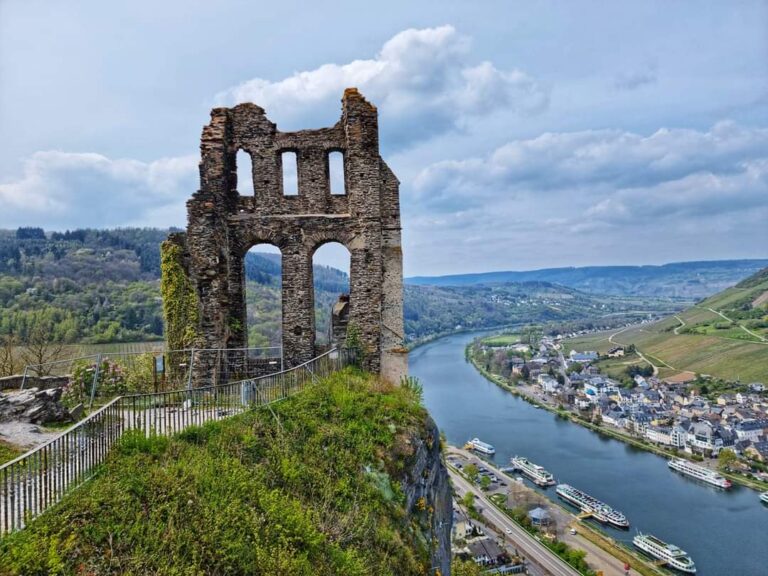
Burg Zeltingen occupies a slope among vineyard terraces on the right bank of the Moselle, about 300 metres southeast of the settlement exit toward Wehlen and Graach. The ruin lies close to the river but below higher ground, a position that exposed it to attacks from above. Additional protection on the uphill side may have been provided by the old Zeltingen Landwehr, a defensive boundary system of walls and ditches on the Zeltingen Heights. A path rises through the vineyard slopes from the direction of Zeltingen to the ruin.
Surviving castle fabric
The preserved remains include a gateway arch, sections of wall, and part of a tower belonging to the southern outer bailey. The castle appears to have been enlarged during the later Middle Ages, while the southern outer bailey tower probably belongs to a late medieval expansion. These fragments define the surviving defensive structure and indicate that the complex developed beyond its original form.
Interior and later preservation
The interior was formerly filled and used as a vineyard. During later preparation of the ruin, the fill and vineyard were removed, leaving the interior in its restored condition. The surviving gateway, wall sections, and outer-bailey tower now form the principal visible fabric of the castle.