Burg Windeck: A Medieval Hilltop Castle in Germany


Site at a Glance
- Rating
- 4.6
- Popularity
- Low
- Country
- Germany
- Primary era
- Medieval
- External website
- Open
- Eras represented
- Medieval
- Civilizations
- Holy Roman Empire, Landgraviate of Thuringia
- Site type
- Military
- Remains
- Castle
On this page11 sections
History
Burg Windeck, also called Neu-Windeck, is a ruined medieval hilltop castle in Germany above Altwindeck in Windeck, North Rhine-Westphalia. It was first mentioned in 1174 as castrum novum in windeke, although the site is probably older. Heinrich Raspe III, brother of Landgrave Ludwig III of Thuringia and his governor in Lower Hesse, is believed to have rebuilt it around 1170 after an earlier destruction.
Two castles and the rise of Berg control
The castle hill contained two separate twelfth-century strongholds. Alt-Windeck was a tower castle on the projecting ridge, while Neu-Windeck was the newer complex that became today’s Burg Windeck. Both belonged to the Landgraves of Thuringia in 1174. Heinrich Raspe III granted Neu-Windeck as a fief, a castle or estate held in return for allegiance and service, to Count Engelbert I of Berg. Emperor Frederick I confirmed the grant.
Between 1185 and 1188, Landgrave Ludwig III sold his allodial possessions in Westphalia, meaning property held directly rather than as a fief, to Philipp von Heinsberg, Archbishop of Cologne and Duke of Westphalia. The sale included Alt-Windeck and Neu-Windeck and amounted to 3,700 marks. After the rest of the purchase price had been paid, the transfer was formalized in 1197 through new oaths of allegiance to Archbishop Adolf I and Count Dietrich of Landsberg, who had married Ludwig III’s daughter and heir.
In 1247, Duke Henry of Brabant, acting for his three-year-old son Henry, who had recently been proclaimed Landgrave of Hesse, enfeoffed Count Adolf IV of Berg with Burg Windeck. A later settlement gave Adolf Windeck, Bensberg, and half the revenues of the County of Berg. Adolf subsequently purchased Alt-Windeck as well. A division of the County of Berg that same year assigned Neu-Windeck and Bensberg to him, and Burg Windeck thereafter remained closely connected with the dukes of Berg and their administration.
Countess Mechthild of Sayn sold Burg Windeck to the archbishopric of Cologne in 1250, but Adolf of Berg withheld his consent. In 1267 he offered the estates of Musbach and Merten as compensation. The archbishopric accepted them as the fief of Gerhard of Wildenburg, a vassal of Sayn, instead of Windeck. The Lords of Elberfeld settled their separate claims by surrendering control of the castle keys in exchange for a castle fief at Windeck and a house in Neu-Windeck.
Administrative castle and pledged possession
By the late Middle Ages, Windeck was both a fortified residence and an administrative centre. In 1388, Wilhelm Staël von Holstein served as its Amtmann, an appointed official who represented a territorial lord, supervised an administrative district, and could oversee a castle’s garrison and repairs. The castle, its territory, and its inhabitants had been pledged to him, and he was required to repair the stronghold and maintain eight armed men.
After Duke Wilhelm II of Berg lost the Battle of Kleverhamm, he pledged Burg Windeck in 1397 to Counts Adolf of Cleves and Dietrich of the Mark until a ransom was deposited. His son, Count Adolf of Berg, reoccupied it in 1398 after Dietrich of the Mark was killed in a feud with him near Elberfeld.
In 1433, Duke Adolf of Berg allied himself with Landgrave Ludwig of Hesse and transferred Denklingen, Neuenberg near Lindlar, and Windeck as part of the agreement. Two years later, the cost of his many feuds led Adolf of Jülich and Berg to pledge Burg Windeck and its lordship to his Amtmann Wilhelm von Nesselrode the Younger for 10,000 gulden.
Wilhelm von Nesselrode had to maintain the castle and spent 5,530 Upper Rhenish gulden on repairs between 1443 and 1445. The von Nesselrode family continued costly repair work until 1515. The office passed through several members of the family, including Bertram von Nesselrode from 1474 to 1510, Heinrich von Nesselrode from 1510 to 1513, and the underage Wilhelm von Nesselrode jointly with his uncle Mauritius from 1515 to 1528.
Johann von Seelbach zu Crottdorf held the office from 1542 to 1549. His remuneration included 100 florins, 300 hundredweights of oats, and the tithe. In return, he had to employ a chaplain, steward, baker, cook, district messenger, gatekeeper, and four watchmen. During the tenure of Wilhelm von Nesselrode’s son, which ended in 1561, Dattenfeld and Much were added to the Windeck administrative district. Johann von Lützenrath zu Vorst then served as Amtmann from 1561 to 1586. After his successor Wienand von Lyradt zu Hunstorf died in 1586, the office returned to the von Nesselrode family. Wienand von Leerath held it from 1586 to 1589, while the dates of Wilhelm von Nesselrode’s tenure and death remain unclear.
Succession disputes and the Thirty Years’ War
Major repairs were again needed around 1600. Following assessments by Johann II von Pasqualini, a grandson of the architect Alessandro Pasqualini, work took place in 1602 and 1609. Bertram von Nesselrode, the last successor of Wilhelm in this phase, was removed from office in 1610 during the Jülich-Cleves succession dispute and died in 1618.
The dispute followed the death in 1609 of the last Duke of Jülich-Cleves-Berg, when rival claimants contested his territories. Brandenburg, Palatine-Neuburg, the Dutch States General, Spain, France, and Imperial forces became involved in the wider struggle. Heinrich Quadt von Isengarten, a Lutheran military leader, occupied Windeck in 1609 or 1610 with local militia and mercenaries and served as Amtmann until 1617. He entered Brunswick-Lüneburg service in 1615 and died heavily indebted in 1617. Friedrich Wilhelm von der Lippe, who had been Amtmann since 1581, was dismissed after the castle was captured in 1622.
Brandenburg troops occupied Windeck until 1622, followed by troops of the Dutch States General. The Treaty of Düsseldorf in 1624 assigned Windeck to Brandenburg, but after Palatine-Spanish and Imperial forces captured Jülich in 1622, the castle passed at the beginning of 1623 to the Dukes of Jülich and Berg of the Palatine-Neuburg line. Walram Scheiffarth von Merode administered Windeck from 1622 until his death in 1625. A planned garrison of 50 men under Captain Heeß was never established. After the Spanish withdrawal, 30 Imperial companies passed through the area, placing heavy demands on the population.
The Thirty Years’ War, the major European conflict of 1618 to 1648 involving religious and dynastic struggles across the Holy Roman Empire, repeatedly brought fighting and military requisitions to Windeck. Adolf von Nesselrode zu Ehreshoven took office in 1625, followed by Wilhelm von Hillesheim until 1637 and Bertram von Nesselrode from 1637 to 1663. Imperial companies plundered the population in 1630, and clashes with Swedish detachments began in 1632. From 27 to 31 October that year, Swedish forces under Lieutenant General Wolf Heinrich von Baudissin captured Siegburg, Windeck on 30 October, and Blankenberg. The occupation involved extensive looting, killings, expulsions, and other violence.
Imperial forces under Philipp, Count of Mansfeld, entered Cologne in 1633 and operated in the surrounding region. In 1635 Windeck had to supply passing troops, including forces from Nassau-Dillenburg under Jorgen, Count of Wittgenstein, and later troops commanded by Ludwig Heinrich, Count of Nassau-Dillenburg. Between 1635 and 1639, troops from Cologne, Palatine-Neuburg, Bavaria, Württemberg, Münster, Lorraine, and the Empire were quartered in or around the district and demanded lodging and provisions.
From the beginning of the Hesse War in 1640, a connected regional conflict of the 1640s, troops repeatedly crossed Windeck. A Hessian cavalry protection company was stationed there in 1640. In 1641, Lieutenant Hans Dietrich von Eischewitz commanded about 160 regular soldiers as well as local militia. An attack by forces from Hachenburg and Sayn failed to capture the fortress in 1643.
Palatine-Neuburg troops occupied the Berg fortresses in 1644. The following year, Windeck’s 300-man garrison was reinforced by 30 local militia. Hessian forces captured Burg Windeck after a five-week siege in 1646. Colonel Sparr later retook a new entrenchment during a counterattack but withdrew. In a battle near Windeck-Herchen between Imperial troops and returning Hessian forces, a lieutenant, an ensign, and 40 soldiers were killed, while 60 Hessians were captured.
The Hessian occupation ended in 1647, when the garrison surrendered after a prolonged siege to Imperial troops under General de Lamboy, commander-in-chief of the Westphalian Circle, an administrative and military subdivision of the Holy Roman Empire. The Imperial garrison came from the infantry regiment of Colonel Heinrich von Plettenberg. When Imperial troops withdrew in 1648, they destroyed the castle. Only the chapel, some service buildings, rubble, and ruins remained.
Destruction and preservation
A reconstruction was considered in 1655 but rejected. Some ancillary buildings were nevertheless rebuilt for administrative and judicial use and as a prison. During the Dutch War in 1672, French troops attacked, captured, burned, and destroyed Windeck. The administrative district was then transferred to Denklingen, and people from surrounding villages used the ruins as a quarry.
The ruins remained in Prussian possession after the Grand Duchy of Berg was dissolved in 1815. In response to a petition from local inhabitants, the royal government president Ludwig vom Hagen ordered a demolition ban in 1819. Prussia sold the ruins in 1852 to Oscar Danzier, the Prussian district administrator of Waldbröl, who wished to preserve historic buildings. He organized clearance work and added paths and stairs, turning the grounds into a park landscape.
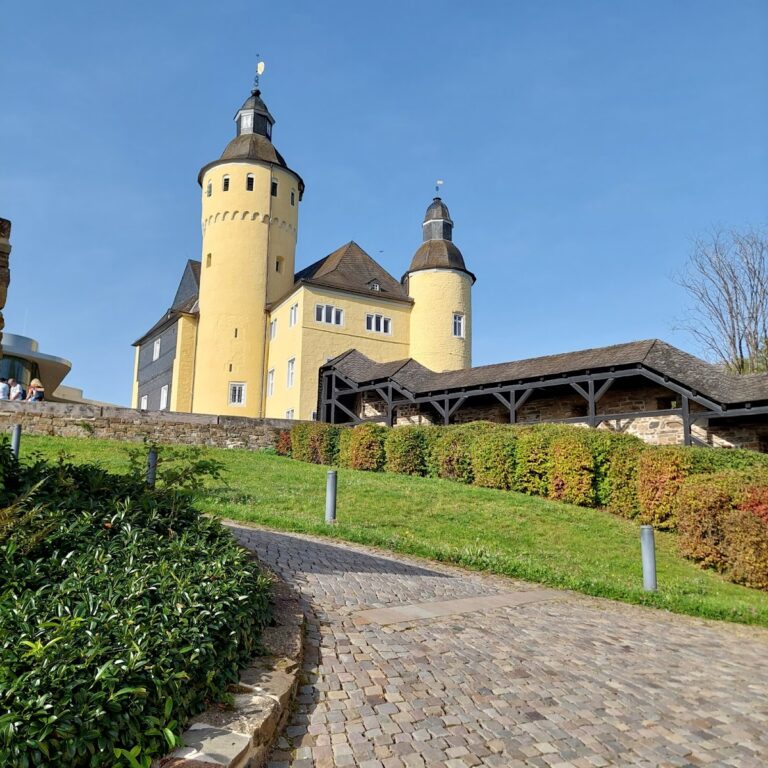
In 1859 and 1860, Danzier built Schloss Windeck on the southeastern tip of the castle hill, using foundations and vaults from the older castle. The building passed by inheritance to his daughter Arnoldine, who was married to the Sicilian Andrea Caminneci. American artillery set it on fire at Easter 1945. After the owners died, the unsecured burned-out ruin deteriorated.
In 1961, the former Siegkreis purchased the property from Manfred Caminneci, Andrea Caminneci’s grandson, for one Deutsche Mark to prevent further decay. Security and supplementary restoration began in 1962 and continued through the end of the 1960s. Schloss Windeck was completely demolished because the medieval ruins were considered more historically valuable and worth preserving. Since August 1987, the Rhein-Sieg district and the municipality of Windeck have carried out extensive archaeological excavation and conservation. Many excavated areas later became substantially overgrown because regular vegetation clearance was not maintained.
Remains
Hilltop layout and surviving fabric
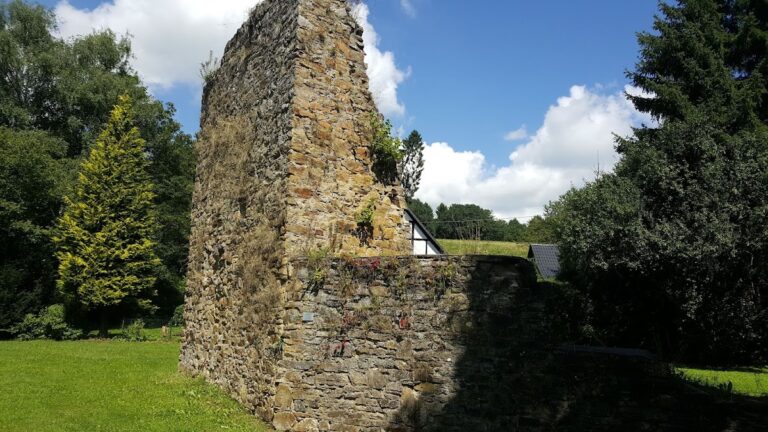
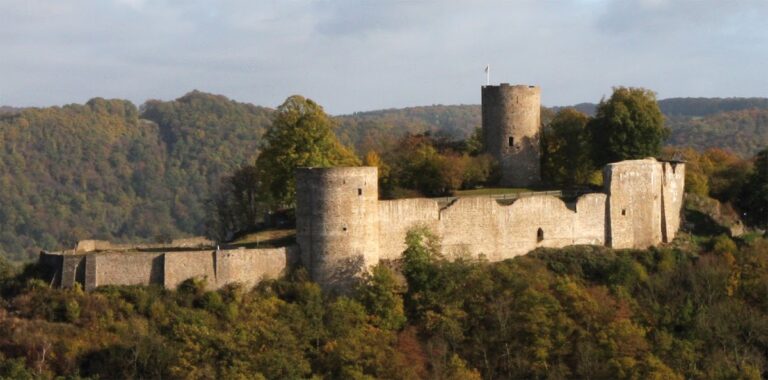
Burg Windeck occupies the projecting ridge of the Schlossberg above Altwindeck, at approximately 220 metres above sea level. The castle hill held the separate tower castle of Alt-Windeck on the spur and the newer Neu-Windeck complex, now called Burg Windeck. The surviving ruin is formed from medieval masonry and includes parts of the main fortified tower, a stair tower, sections of the outer wall, and a wall belonging to the principal residential hall.
Residential and service buildings
The residential hall wall
Schloss Windeck was built on the southeastern tip of the hill over older foundations and vaults. When the nineteenth-century building was demolished in the 1960s, its stones were reused to reconstruct the wall of the palas, the castle’s main residential and representational building. Only wall stumps had survived the destruction of the medieval castle. The reconstructed wall lacks the earlier sockets for ceiling beams and was erected with its sides reversed.
Chapel and ancillary buildings
Excavation revealed a chapel added to the castle at a later date. Its floor was decorated with tiles bearing the von Nesselrode coat of arms. Many tiles were removed by visitors, while a small remainder is preserved in the Windeck local history museum below the castle. After the destruction of 1648, the chapel and some service buildings continued to stand. Ancillary buildings were later used for administrative and judicial functions and as a prison before the nineteenth-century preservation work.
Later landscape and archaeological work
Danzier’s nineteenth-century intervention added paths and stairs and arranged the ruin grounds as a park landscape. Archaeological and conservation work since 1987 exposed and stabilized parts of the medieval complex. The remains include the conserved sections of the outer wall, the main tower, the stair tower, and the residential hall wall, while several excavated areas later became overgrown.