Burg Merten: A Lowland Castle in Germany


Site at a Glance
- Rating
- 4.3
- Popularity
- Very Low
- Country
- Germany
- Primary era
- Medieval
- Eras represented
- Medieval, Early Modern, Modern
- Civilizations
- Holy Roman Empire
- Site type
- Military
- Remains
- Castle
On this page12 sections
History
Burg Merten is a lowland castle in Germany, built as a fortified noble residence in Merten, now part of Eitorf. It was first mentioned in 1247 and stands opposite Merten Monastery, whose origins reach back to the twelfth century. An earlier castle and an earlier monastery occupied ground near the present railway cutting, linking the site to a settlement and religious foundation that developed before the surviving buildings.
Origins and the Kappenstein connection
Construction of the monastery began in 1160, and it is directly documented from 1217. A document from that period required that no house inhabited by laypeople stand within the monastery walls. It also required Otto von Kappenstein to transfer buildings to the monastery in return for compensation.
Otto had received the parish of Wissen and the bailiwick of Werden Abbey from his brother Eberhard von Arenberg. A bailiwick was an administrative or judicial jurisdiction exercised on behalf of a church institution. Otto established his residence at Kappenstein Court and was using the name Otto von Kappenstein by 1217. After an inheritance division, his son Gerhard built a new castle in the parish of Friesenhagen around 1230 and adopted the name Gerhard von Wildenburg from 1239.
The Wildenburg and Hatzfeld succession
Members of the Wildenburg family later held important offices, including the Cologne burgraviate, an office concerned with governing a castle or fortified town. Through the family’s succession, Godhard von Hatzfeld, known as “the Rough,” came to hold Burg Merten.
When the male line of Wildenburg ended, the counts of Sayn claimed Burg Merten and induced Godhard von Hatzfeld to surrender his possessions. He later revoked the surrender and died during the dispute. His widow, Lückel von Erfertzhausen, continued the claim, and the resulting war lasted 17 or 18 years. Jülich and Kassel also became involved before the property was returned to the Hatzfeld family.
In 1414, Godhard and Craft von Hatzfeld agreed with Archbishop Dietrich II of Cologne to campaign against Duke Adolf of Berg. In 1420, Gotthard von Hatzfeld, also called “the Rough,” received half of Wissen, the village of Merten, the wine tithe at Blankenberg, and the former Wildenburg fiefs. A tithe was a customary tax, often based on agricultural produce, while a wine tithe was levied on wine or grape production.
Formation of the Hatzfeld-Merten line
Godhard’s son Johann married Katharina, the daughter of Burgrave Johann of Drachenfels, in 1441. Their descendant Johann married Maria von Nesselrode of Ehreshoven in 1481. They had four daughters and eleven sons. In 1541, Franz I von Hatzfeld, one of their younger sons, married Elisabeth von Wylich and gained sole possession of Burg Merten, establishing the Hatzfeld-Merten line.
In 1572, Archbishop Salentin formally granted Franz von Hatzfeld, also called Franz II, his lands and rights in an enfeoffment. This was the formal granting of property or authority by a superior lord in return for service or allegiance. The grant referred to his predecessor Georg von Hatzfeld. In 1616, Archbishop Ferdinand enfeoffed Wilhelm von Hatzfeld and referred to Sebastian von Hatzfeld of Crottorf and Franz Wilhelm von Hatzfeld as predecessors. Johann Adrian von Hatzfeld of Wildenburg was also named as guardian and cousin. In 1575, Hermann von Hatzfeld secured the imperial immediacy of Wildenburg against the counts of Sayn, placing the territory directly under the Holy Roman Emperor rather than an intermediate lord.
Inheritance disputes and later Hatzfeld ownership
The Merten line ended in the male line with Daniel von Hatzfeld in 1681. His sister Lucie Christine von Hatzfeld had married Bertram Scheiffart von Merode in 1643. After a long legal case and a settlement for Lucie Christine, Burg Merten passed by agreement to the Scheiffart von Merode and Spies von Büllesheim families.
An inheritance agreement made in 1598 had excluded female succession and provided for reciprocal inheritance among the castles of Hatzfeld, Wildenburg, Schönstein, and Merten, together with the Crottorf estate and other possessions. Litigation arising from these arrangements continued until 1780. The Spies von Büllesheim successor lost Burg Merten and Schloss Allner to Clemens August von Hatzfeld as compensation for legal costs.
Melchior von Hatzfeld expanded the family’s territorial power through the Silesian estate of Trachenberg, which he received for military service during the Thirty Years’ War, the major European conflict of 1618 to 1648. After his death without heirs, Trachenberg passed to Count Hermann von Hatzfeld. The Crottorf line ended in 1794 with Prince Friedrich Franz Karl Kajetan, whose inheritance passed to Franz Ludwig von Hatzfeld of the Schönstein line. Franz Ludwig became a Prussian prince in 1803.
From estate seat to modern heritage monument
Burg Merten passed to Edmund von Hatzfeldt-Wildenburg-Weisweiler. In 1846, as owner of the Merten estate, he was invited to participate in the election of representatives to the state parliament. A settlement in 1859 divided the family inheritance into the Trachenberg, Merten, and Wildenburg branches. The Merten estate included Burg Merten, Merten Monastery Farm, and properties in Merten, Halft, Höhe, Dattenfeld, Derenbach, Velken, Lauthausen, Blankenberg, and Bülgenauel.
Edmund von Hatzfeld increased the estate associated with the castle to approximately 4,500 morgens, a historical unit of land whose exact area varied by region. Burg Merten later passed to Prince Hermann von Hatzfeld of the Schönstein line. After he incurred debts of 70,000 talers to the banker Landau, the castle was lost after two years. A taler was a historical European silver coin and monetary unit.
In 1909, Count Felix Droste zu Vischering von Nesselrode-Reichenstein purchased Burg Merten and Merten Monastery Farm. The monastery complex was converted into Schloss Merten and first served as a summer residence. After the First World War, it became the family’s principal seat. In 1930, the count acquired the east wing, which had previously served as the local school.
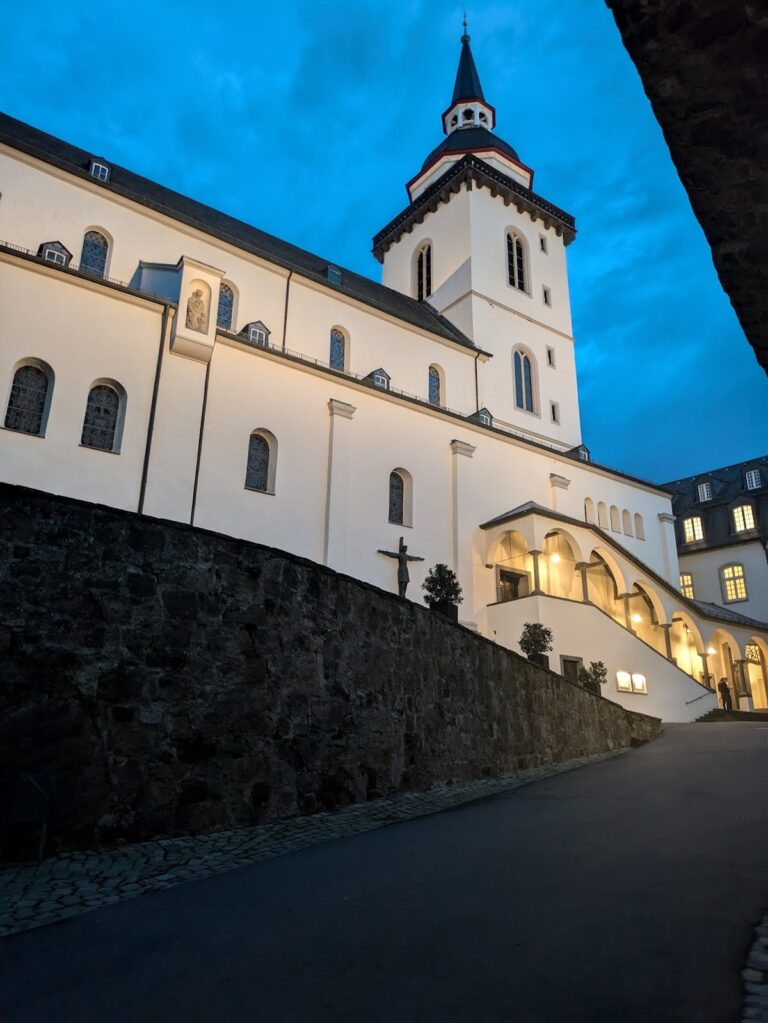
Severe wartime damage led to the abandonment and sale of Merten Monastery after the Second World War. The former monastery now houses a residential and nursing home, while Burg Merten remained in the family’s possession. Burg Merten is designated as an architectural heritage monument in North Rhine-Westphalia.
Remains
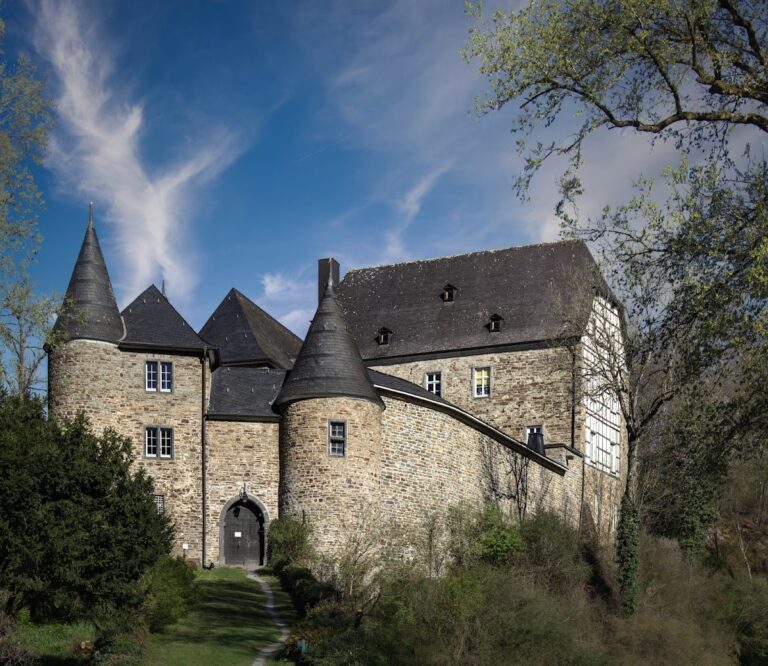
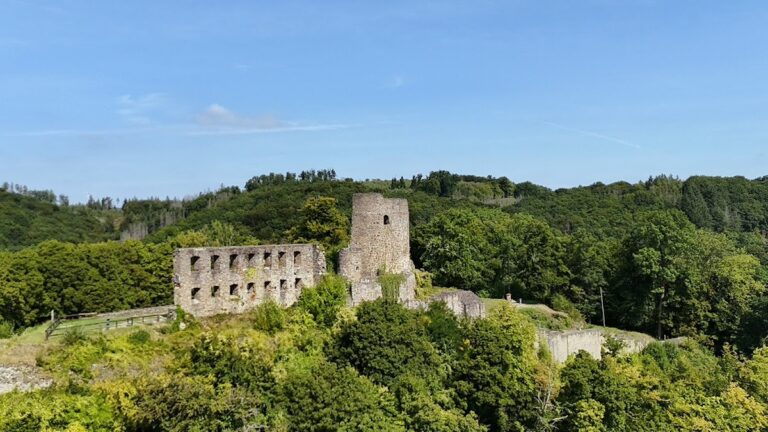
Burg Merten occupies a gently sloping hill surrounded by ditches. Its trapezoidal ground plan belongs to the group of fortified complexes known as Kastellburgen, castles arranged around an enclosed, often regular courtyard protected by walls and towers. Access is from the east through a simple gate structure, while surviving sections of the late-medieval curtain wall define the enclosure.
Walls, towers, and entrance
Eastern gate
The eastern approach enters the castle through a simple gate structure. It forms the principal access point within the fortified enclosure and connects with the courtyard organized by the surrounding walls.
Northeastern tower
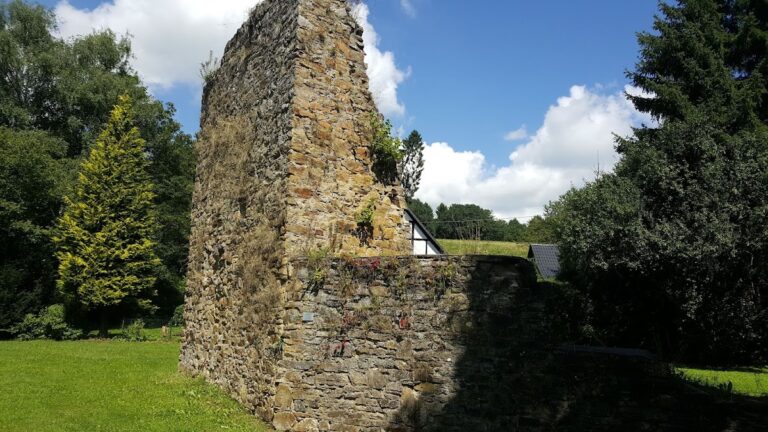
At the northeastern corner, the curtain wall encloses a quadrangular tower. Only the basement of this tower survives, preserving part of the defensive arrangement at the edge of the courtyard.
Western towers
The western side retains the remains of two round towers. Together with the late-medieval wall and the northeastern tower basement, they preserve elements of the castle’s former system of corner and side defenses.
Southern manor house
The manor house occupies the southern side of the courtyard. It is a two-storey building with a half-hipped roof and was constructed in 1791. At the southwestern corner, a tower was renovated in the late 1990s and given a simple conical roof, providing a later architectural element within the historic castle complex.