Burg Tangermünde: A Medieval Fortress and Residence in Germany


Site at a Glance
- Rating
- 4.7
- Popularity
- Medium
- Country
- Germany
- Primary era
- Medieval
- External website
- Open
- Eras represented
- Medieval, Early Modern
- Civilizations
- Holy Roman Empire, Margraviate of Brandenburg
- Site type
- Military
- Remains
- Castle
On this page14 sections
History
Burg Tangermünde, also known as Tangermünde Castle, is a medieval fortress in Tangermünde, Germany, founded around 925 by Ascanian margraves as one of the earliest strongholds of the Mark Brandenburg. It probably monitored the frontier and the meeting point of the Tanger and Elbe rivers, facing territories controlled by Slavic communities.
Imperial Castle and Margravial Residence
The fortress was first mentioned in 1009, in a chronicle written by Thietmar, bishop of Merseburg. During the tenth and eleventh centuries, it served as an imperial castle, a fortress held by the German king or emperor for authority, residence, and administration. Emperors of the Holy Roman Empire stayed there, and customs duties were collected from people crossing the Elbe.
A town grew beneath the fortress during the thirteenth century. Under the Ascanian margraves, Tangermünde formed part of an itinerant system of rule, in which rulers moved among residences including Osterburg, Salzwedel, Arneburg, and Werben. During their stays, the margraves also used the Colbitz-Letzlingen Heath as a hunting ground.
Charles IV and the Luxembourg Ambition
On 7 September 1373, Emperor Charles IV entered Tangermünde after appointing his twelve-year-old son Wenceslaus as Brandenburg’s elector. An elector was a prince entitled to participate in the election of the Holy Roman Emperor. Having acquired Brandenburg from the Wittelsbach dynasty, Charles began expanding the fortress from 1374 into a castle-like residence.
Charles IV intended Tangermünde to become the principal residence and capital of the northeastern territories ruled by the House of Luxembourg, replacing the older princely seat at Brandenburg an der Havel. Its position on the Elbe also offered river access from Charles’s Bohemian lands and from Prague. A castle chapel, first mentioned in 1371, became a collegiate foundation in 1377, meaning that it was served by a community of clerics rather than monks in a monastery. Charles IV, Wenceslaus, and Sigismund did not remain there for long periods, and Sigismund received Brandenburg from Wenceslaus in 1378.
Hohenzollern Rule and the End of the Residence Plan
In 1415, Sigismund, then King of the Romans, granted Frederick I, Burgrave of Nuremberg, Brandenburg and its electoral dignity in return for payment. The King of the Romans was the elected German king, normally before receiving the imperial title. The arrangement was intended to pacify the margraviate, which was controlled by rebellious nobles, and Frederick I subsequently resided mostly at Tangermünde.
The Hohenzollerns, the dynasty granted Brandenburg in 1415, abandoned Charles IV’s plan for a permanent capital at Tangermünde. The dynastic connection with Bohemia had ended, while Berlin-Cölln had become the commercial center of the eastern Mark. Frederick II began constructing Berlin Castle as a new residence from 1442, and John Cicero gave up Tangermünde as a residence after a citizens’ revolt against a beer tax in 1488.
Administrative Use, War, and Reconstruction
After the residence plan ended, the castle became an administrative center for the Altmark and Prignitz. Swedish troops burned it in 1640 during the Thirty Years’ War, the major European conflict that devastated many parts of central Europe in the seventeenth century.
Elector Frederick III commissioned the Amtshaus, an administrative office building, in 1699 and inspected it in 1701 after becoming King Frederick I. Reconstruction of the castle complex began in 1902. Before German reunification, the former castle building known as Amt I housed a children’s hospital, while the Alte Kanzlei stood vacant and Amt II contained rented housing. After reunification, Amt I deteriorated during a period of vacancy. The housing buildings remained occupied but were in very poor condition, and the gardens became overgrown.
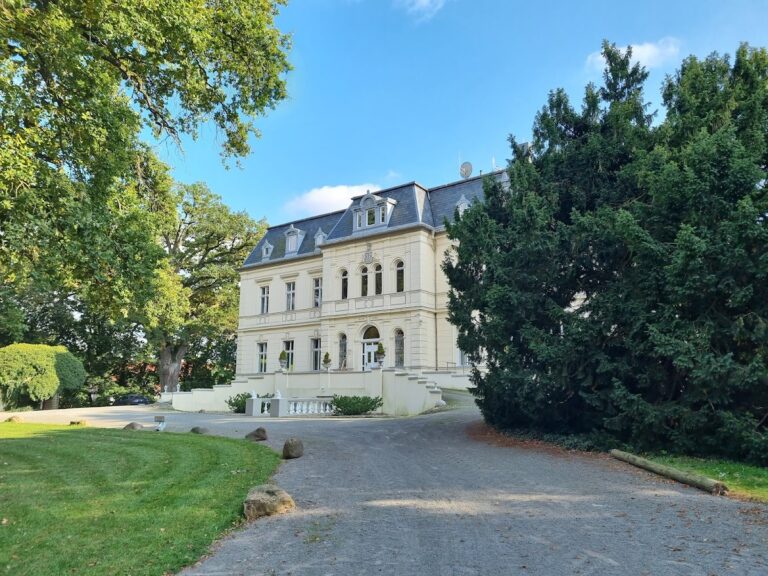
Amt I was sold in 1999 and converted into a hotel with a function hall and gardens. Amt II was acquired in 2005 and incorporated into the hotel complex, along with the Kaisertherme wellness facility and additional grounds. The town continues to own the Alte Kanzlei, which the hotel uses for events. The nearby Königin Luise house was acquired in 2009 and converted into a conference and events center.
Remains
The partially preserved castle occupies a high bank of the Elbe north of Tangermünde’s town center, at the confluence of the Tanger and Elbe rivers. Its surviving medieval layout includes a castle gate, ring walls around the outer and main baileys, a moat, several towers, and substantial historic buildings. Early twentieth-century reconstruction forms part of the complex’s present appearance.
Fortifications and Towers
Gate, Walls, and Moat
The medieval castle gate remains within the defensive arrangement, together with sections of the ring walls enclosing both the outer bailey and the main bailey. The moat continues to define the fortified complex, while additional towers and wall sections preserve parts of its medieval defensive perimeter.
Kapitelturm
The Kapitelturm is a 50-meter-high residential tower. Extensive repairs made it accessible as a lookout tower during guided tours from May 2003. Its height and surviving form distinguish it within the castle complex, where a large lawn extends beside the tower.
Gefängnisturm
The circular Bergfried, known as the Gefängnisturm, is another surviving tower. A Bergfried was the principal defensive tower of a medieval German castle, generally used as a stronghold and lookout rather than as a permanent residence.
Historic Buildings and Grounds
Alte Kanzlei
The Alte Kanzlei is a late Gothic building within the castle precinct. It remains in municipal ownership and is used by the hotel for events, retaining a role in the complex’s present use while preserving its historic architectural identity.
Former Amtshaus
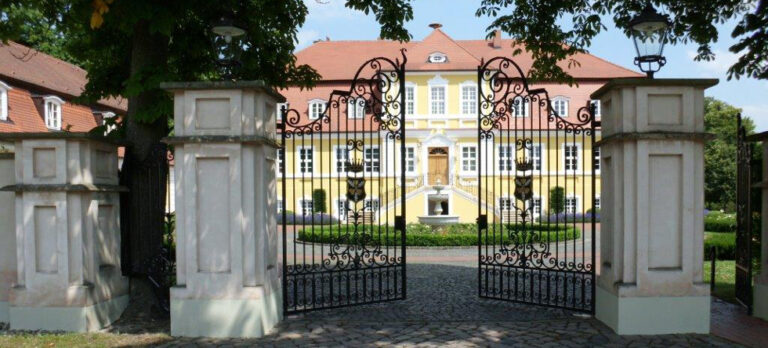
The former Amtshaus is a Baroque building that probably stands on the foundations of the former Palas, the principal residential and representative building of a medieval castle. It now contains the Schlosshotel Tangermünde.
Courtyard and Grounds
The former Amtshaus courtyard functions as the hotel terrace. The present complex also includes gardens, a large lawn beside the Kapitelturm, and the Kaisertherme wellness facility, integrating later uses with the surviving castle buildings and fortifications.