Kilravock Castle: Historic Seat of Clan Rose in Scotland


Site at a Glance
- Rating
- 4.3
- Popularity
- Very Low
- Country
- United Kingdom
- Primary era
- Medieval
- Eras represented
- Medieval, Early Modern
- Civilizations
- Kingdom of Scotland
- Site type
- Military
- Remains
- Castle
On this page11 sections
History
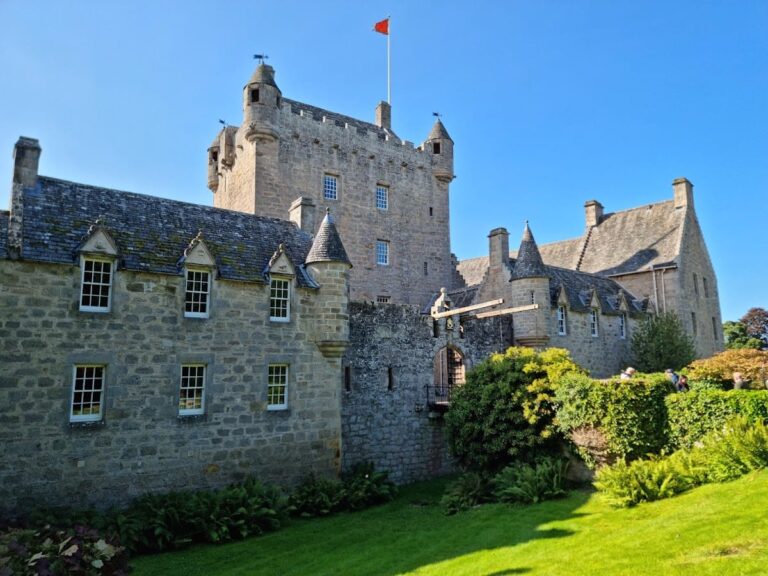
Kilravock Castle, near Croy between Inverness and Nairn in Scotland, United Kingdom, is a red-sandstone castle whose construction began around 1460 as the seat of Clan Rose. Its principal building is a fifteenth-century tower house, a fortified residence organized around a substantial tower. Historically located in Nairnshire, the castle remained associated with the Rose family for centuries.
The Rose succession
The lands at Kilravock were first held by the Boscoe family. After Andrew Boscoe died, they passed through his widow, Elizabeth Bissett, and then through the marriage of their daughter Mary Boscoe to Hugh II de Ros in the thirteenth century. The Roses, a family of Norman origin traditionally connected with William the Conqueror’s arrival in Britain, settled at Kilravock in 1293. In that year, John Balliol, king of Scots from 1292 to 1296, made the Rose family Baron of Kilravock.
The succession at Kilravock continued directly from parent to child without an intervening collateral heir. This was described as an exceptional example of direct descent in Scottish history. Many members of the family were named Hugh, while only one rose above the rank of laird, a Scottish landed proprietor generally below the nobility.
Royal and Jacobite connections
Mary, Queen of Scots, who ruled Scotland from 1542 to 1567, was received at Kilravock in 1562. Prince Charles Edward Stuart stayed at the castle for four days before the Battle of Culloden in 1746. That battle ended the Jacobite attempt to restore the Stuart monarchy. Charles Edward Stuart led the Jacobite forces, while the Duke of Cumberland commanded the opposing government army, and the duke visited Kilravock soon after the battle. Robert Burns, the Scottish poet and songwriter, visited in September 1787.
Later ownership and the Rose chiefship
Kilravock eventually ceased to be occupied by the Rose clan and no longer formed part of the Rose estate. In 1984 it passed to a charitable Christian trust and was later operated for a period as bed-and-breakfast accommodation. The castle is a Category A listed building.
Anna Elizabeth Emily Guillemard Rose, the 25th of Kilravock and chief of Clan Rose, died at Nairn on 9 December 2012, aged 88. In June 2013, the Lord Lyon, the Scottish officer responsible for regulating heraldry and recognizing clan chiefs, recognized her nephew David Hugh Heriot Baird Rose as chief of Clan Rose and 26th Baron of Kilravock.
Remains
Kilravock is a lowland castle built of red sandstone. Its complex developed around a fifteenth-century great tower and later enclosed additions, forming a quadrangle with associated gardens, garden walls, and a dovecote.
The tower and fortified entrance
Great tower
The keep, or great tower, dates from around 1460. The Baron of Kilravock received permission from the Lord of the Isles, the medieval ruler of a powerful lordship across much of Scotland’s western seaboard and islands, to build a fortified house. The tower forms the earliest surviving part of the castle and represents its original fortified residential core.
Iron yett
A new iron yett, a heavy gate used in Scottish fortified buildings, was made for the great tower in February 1568. George Robertson, a blacksmith from Elgin, produced the entrance grille.
Later ranges and grounds
Seventeenth-century additions
A square stair tower and a south range were added in the seventeenth century. These additions expanded the castle beyond the original tower and contributed to the later form of the complex.
Quadrangle and garden features
The north and west sides of the quadrangle were added later. The surviving complex also includes gardens, garden walls, and a dovecote, extending the castle’s built arrangement beyond its residential and defensive buildings.