Complesso fortificato di Mattarello: An Austro-Hungarian Defensive Complex near Trento


Site at a Glance
- Rating
- 4.4
- Popularity
- Very Low
- Country
- Italy
- Primary era
- Modern
- Eras represented
- Modern
- Civilizations
- Habsburg
- Site type
- Military
- Remains
- Fort
On this page14 sections
History
The Complesso fortificato di Mattarello in Italy was an Austro-Hungarian group of fortifications near Trento, built during the late nineteenth century as part of the Fortress of Trento. Its three principal works defended the southern and eastern approaches to the city, where routes through the Adige Valley, Valsorda, the Fricca Pass, and the Valsugana converged.
Strategic Setting and Construction
Mattarello occupied an important position on the slopes of the Vigolana, controlling north-south movement through the Adige Valley and east-west movement through Valsorda. Fortifications had existed in the area during the medieval period, and Austro-Hungarian military authorities later incorporated the position into the defensive system surrounding Trento. Together with Fort Romagnano, the complex helped block access to the city through the Adige Valley and supported the works at Doss Fornas, Brusafer, and San Rocco.
The Military Engineering Directorate of Trento directed the construction of the three main works. The lower and upper batteries were built in 1879–1880, while the main fort was completed in 1900. Their development reflected concerns about the southern approaches, which had demonstrated their vulnerability during the Third Italian War of Independence in 1866, the conflict in which the Kingdom of Italy fought Austria for territorial control.
Obsolescence and First World War Reconstruction
By the beginning of the First World War, the original complex was already militarily outdated. The main fort could be seen from a considerable distance because its roof lacked an earth covering designed to absorb artillery fire. Its stone-and-concrete construction offered inadequate protection against modern siege artillery, and the concentration of guns in its casemates, or protected gun chambers, made them vulnerable to a single accurate hit. Although the artillery could reach targets as far as 8 kilometres away, the works were considered ineffective by 1915.
In 1915, Lieutenant Field Marshal Franz Edler von Steinhart, director of the Military Engineering Directorate of Trento, ordered the defensive reconstruction of the area. The existing works were disarmed, and their guns were moved to field fortifications. The former buildings continued to serve as decoy targets, stores, and accommodation for troops. The main fort’s guns went to the Zampetta position, also known as Caposaldo Martini, southeast of the fort. Guns from the lower and upper batteries were transferred to cave positions and other nearby field works.
The new arrangements included the Zampetta battery, which received the main fort’s 15-centimetre howitzers, the cave battery south of the complex, which received guns from the lower battery, and Battery Roncolo, which received guns from the upper battery. After the Fortress of Trento was dissolved in 1916, Battery Roncolo was re-equipped with anti-aircraft guns. None of the works took part in combat during the war.
Italian Army Reuse and Later Changes
After the First World War, the Italian Royal Army took over the complex and used it as an ammunition depot. An explosion in 1928 destroyed the lower battery and killed one soldier. The main fort remained in use as a powder magazine, a fortified storage place for gunpowder or ammunition, until the 1970s or 1980s.
After the Italian Army left, parts of the site passed into private ownership. The upper battery and main fort were later incorporated into a redevelopment project intended to integrate them into a public park, while the surrounding area was redeveloped by the forestry agency in 2009. The main fort remains abandoned, and the upper battery and fort preserve different parts of the complex’s military history.
Remains
The complex occupies a rise on the Vigolana slopes on the left side of the Adige Valley, just outside Mattarello. Its principal works were placed at different heights, with the lower battery at about 300 metres, the upper battery on Doss Rocol at approximately 345–350 metres, and the main fort at roughly 405–416 metres. The later First World War positions extended the defensive system into the surrounding slopes and rock, combining exposed gun positions with underground galleries, shelters, and stores.
Nineteenth-Century Fortifications
Lower Battery
The lower battery, known as Untere Batterie Mattarello, was a small open work built in 1879–1880. Its four 9-centimetre M75/96 quick-firing guns stood openly behind an earth parapet. The battery was intended for close defence and had no troop accommodation. Its planned garrison for a war with Italy was 2 officers and 73 non-commissioned officers and men, while the planned establishment for a war with Russia was 1 officer and 15 non-commissioned officers and men.
Only ruins survive in woodland. The remains lie on privately owned land and have been adapted for storage and use as a stable. They are not open to visitors and are now difficult to locate.
Upper Battery
The upper battery, or Obere Batterie Mattarello, was built on Doss Rocol in 1879–1880. This single-storey work consisted of two partly underground main bodies enclosed by a largely freestanding crenellated stone wall with loopholes for rifle fire. A protected flanking position, or traditor, occupied the right front. The left rear contained a filled section and entrance structure, while a ditch caponier, a protected position projecting into a ditch for close defence, covered the nearby ditch.
Five gun emplacements lay between protective traverses, or walls separating gun positions. Two recessed hollow traverses crossed the front behind the guns and contained rooms for troop accommodation and ammunition storage. The battery was connected to the main fort by telephone. Its armament comprised four 9-centimetre M75/96 field guns arranged in two half-batteries and seven 15-centimetre M61 K guns. The ordinary garrison was 5 officers and 156 soldiers. The planned wartime establishment was 4 officers and 77 non-commissioned officers and men for war with Italy, or 1 officer and 38 non-commissioned officers and men for war with Russia.
The upper battery remains in relatively good condition, with only minor damage. It is privately owned but accessible, and its surrounding area was included in the park redevelopment carried out in 2009.
Main Fort
Fort Mattarello, or the Hauptwerk, was built at the Zampetta site and completed in 1900. It had an approximately rectangular plan, three levels including one underground floor, and a surrounding ditch with a stone wall. The fort was constructed during the period associated with Field Marshal Lieutenant Vogl. Although it had the characteristics of a full fort, its roof lacked a bombproof earth covering. Its stone construction therefore provided protection only against shelling by weapons of approximately 15 centimetres or less.
At the beginning of 1914, the fort carried four 12-centimetre M96 K guns in armoured casemates, two 15-centimetre M80 armoured mortars in revolving turrets, two 8-centimetre M94 P armoured guns in revolving turrets, seven M93 8-millimetre machine guns, and eleven rifle mounts. The 15-centimetre mortars had a stated range of 6,400 metres, compared with 3,200 metres for the M80 mortar mounting. The 8-centimetre guns were intended for rapid close defence. The ordinary garrison comprised 7 officers and 177 soldiers, and the fort was equipped for troop accommodation. In peacetime, it served as a powder magazine.
During the summer of 1915, the main armament was removed. The two 15-centimetre M99 howitzers and their armoured turrets were installed in the underground Zampetta battery. The two 8-centimetre armoured turrets were also moved, although their later locations are not well documented. The four 12-centimetre guns went to Battery Pianizza near Battery Brusafer. Concrete dummy turrets, nonfunctional imitations intended to attract enemy fire, replaced the original turrets at the fort.
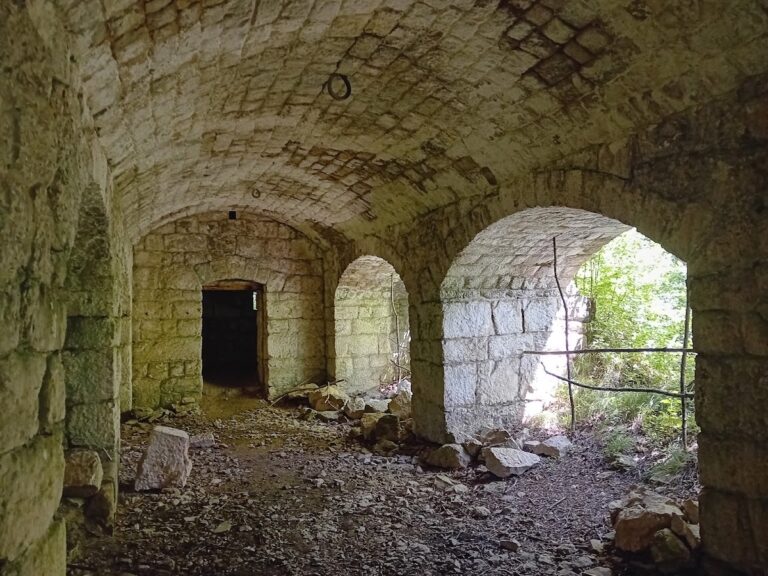
The main fort is abandoned but remains accessible and is generally in good condition. Two reinforced-concrete guard platforms from its period as an Italian ammunition depot still survive.
First World War Batteries and Underground Works
Zampetta Armoured Battery
The Zampetta armoured battery was built during the First World War in a cave on a rise about 400 metres high southeast of the main fort. It housed the two 15-centimetre M99 howitzers removed from Fort Mattarello and was designed to protect them from modern siege artillery. The two armoured turrets stood above shafts cut into the rock and lined with concrete. Each shaft was 10 metres deep, and the shafts were 30 metres apart. A concrete ring about 2 metres thick around each turret base added further protection.
A main gallery joined the shafts, with stairs leading upward to the turrets and an ammunition store excavated halfway along the gallery. Three parallel corridors crossing the main gallery formed the entrances. The side facing the enemy was protected by approximately 60 metres of stone, leaving the two small turrets as the principal external elements.
Cave Battery
The cave battery was excavated into the steep slope south of the lower battery. It held two 9-centimetre M75 guns transferred from other fortifications. Trenches belonging to the advanced defensive lines of the Fortress of Trento ran below the gun positions, linking the battery to the wider wartime system.
Battery Roncolo
Battery Roncolo was built below the cave battery and received four 9-centimetre M75 guns transferred from other fortifications. Concrete trenches connected the gun positions, and each position had a cave that served as shelter for the artillerymen and as a store. The battery’s main purpose was close defence against a frontal attack. After the Fortress of Trento was dissolved in 1916, it was re-equipped with anti-aircraft guns.
Surrounding Shelters and Stores
Additional shelters and stores were excavated in caves around the complex. Some of these underground spaces were later used as air-raid shelters during the Second World War.
Nearby sites