Burg Boxberg: A Medieval Castle in Germany


Site at a Glance
- Rating
- 4.2
- Popularity
- Very Low
- Country
- Germany
- Primary era
- Early Modern
- Eras represented
- Early Modern
- Civilizations
- Holy Roman Empire
- Site type
- Military
- Remains
- Castle
On this page9 sections
History
Medieval origins and noble lordship
Burg Boxberg, also called Schloss Boxberg, is a medieval castle site in Boxberg, Germany, whose origins reach back to at least the eleventh century. It stood in the Main-Tauber district of Baden-Württemberg, in an area that belonged to the Duchy of Franconia during the period of the tribal duchies. The noble lords of Boxberg came into possession of the castle around 1144, and the settlement probably received town and market rights around 1250.
In 1287, the castle, town, and lordship passed to the Knights Hospitaller of Wölchingen, a religious military order that maintained charitable, religious, and military institutions. The castle had previously been held as a fief of the Würzburg bishopric, meaning property granted by a superior lord in return for obligations. Würzburg Bishop Berthold II of Sternberg exchanged it for Schweinberg Castle. Konrad Rupert of Boxberg received Schweinberg and its lordship in return, together with their association with the office and hereditary dignity of chamberlain of the Franconian duke. A hereditary chamberlain was an official connected with the ruler’s household whose position passed through the family.
The Rosenberg castles and the 1523 destruction
Heavy debts eventually forced the Knights Hospitaller to sell Boxberg and Schloss Unterschüpf. With support from the Electoral Palatinate, a major territorial state of the Holy Roman Empire ruled by an elector, and probably from Würzburg, the Lords of Rosenberg acquired both lordships. In 1430 they built a second castle on the foundations of the first.
The Rosenbergs later became involved in raids against the Archbishopric of Mainz, the Electoral Palatinate, and the Würzburg bishopric. The castle was destroyed in 1470 after these attacks. During the late fifteenth and early sixteenth centuries, many Franconian noble families faced financial pressure as the economy shifted increasingly toward money-based transactions. Kuntz von Rosenberg, then the owner of Boxberg Castle, supported Hans Thomas von Absberg, a Franconian nobleman known for abducting merchants and demanding ransoms, in the hope of restoring his declining wealth.
In response, the Swabian League, an alliance of imperial estates formed to preserve public peace and enforce authority in southwestern Germany, sent troops against 23 sites associated with this raiding. The army reached Boxberg on 14 June 1523 and blew up the castle on 15 June. The property of the outlawed Melchior von Rosenberg then passed to the Electoral Palatinate. A woodcut by Hans Wandereisen, an early-sixteenth-century artist, depicts the castle during this destruction.
Rebuilding and later history
A third castle was built after the destruction of 1523. It existed from 1547 until 1857, when it was demolished. Albrecht von Rosenberg attempted to enforce his right of possession in 1548, but Boxberg was finally sold to the Electoral Palatinate in 1561.
The town acquired the castle complex in 1893. A local beautification association then began measures to prevent further deterioration. Finds from the castle are displayed in the Boxberg local history museum, while the surviving structures and ground plan preserve parts of the site’s long development from medieval lordship to modern archaeological landmark.
Remains
Layout and defensive works
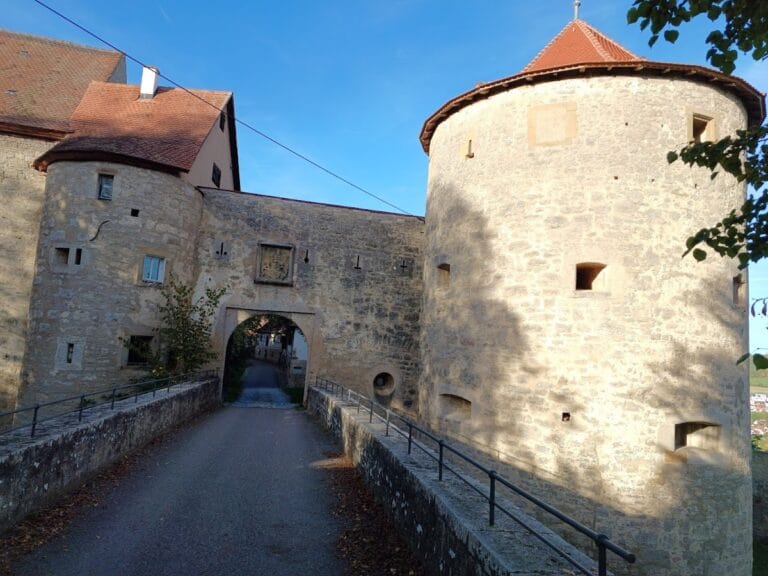
The castle stood at the center of the town, and its ground plan indicates a substantial fortified complex. Two concentric enceinte walls, meaning surrounding defensive walls, enclosed the site. The plan also shows two drawbridges and several defensive towers. The scale suggested by these remains is reinforced by Wandereisen’s woodcut, which presents Boxberg as a very large complex with a palisade, two moats, and a castle wall.
Towers, ditch, and rock defenses
Three defensive towers survive. The tower at the southwest was rebuilt, and a ditch extends from it. This ditch also functioned as a zwinger, a protected outer defensive passage between fortification lines. In the rock supporting the former shield wall are casemates, protected vaulted chambers used for defense. A tower fragment and additional wall remains also survive within the castle area.
Inner castle features
A well has been uncovered again in the inner castle. Other surviving features include an entrance to a cellar and part of a cistern, a reservoir for storing water. A rock formation leads into the castle interior, while a concealed ascent reaches a rock behind the entrance. Together, these elements preserve evidence of the site’s defensive arrangements, water supply, and movement through the fortified enclosure.
Wandereisen’s view of the destruction
Wandereisen’s woodcut provides a detailed historical image of Boxberg during the 1523 attack. Buildings incorporated into the castle wall are shown burning, while the palas, the principal residential and representative building of a medieval castle, and the inner-castle buildings appear to be collapsing. A smaller adjoining structure is the target of a cannon placed near the center of the image. In the upper-left portion, troops of the Swabian League include more than 30 infantrymen and two mounted trumpeters, together with their commander.
Nearby sites