Burg Montclair: A Medieval Hilltop Castle on the Saar


Site at a Glance
- Rating
- 4.4
- Popularity
- Medium
- Country
- Germany
- Primary era
- Medieval
- External website
- Open
- Eras represented
- Medieval, Early Modern, Modern
- Civilizations
- Carolingian, German, Holy Roman Empire
- Site type
- Military
- Remains
- Castle
On this page15 sections
History
Burg Montclair is a medieval hilltop castle ruin in Germany, near Mettlach in Saarland. Built and expanded by regional noble families, it controlled the Saar as a transportation route and became one of the important fortifications of the lower river during the Middle Ages. The site developed through several phases, from an earlier Frankish castle to the large Romanesque stronghold known as Alt-Montclair and the smaller fifteenth-century castle called Neu-Montclair.
Early fortifications and Burg Skiva
The Burgberg ridge had already been used before the medieval castle was built. Celtic inhabitants constructed a defensive wall about two kilometres east of Montclair, and the mountain spur probably served as a refuge. Traces of Roman activity occur on the steep, sun-facing slope.
Probably in the ninth century, an Ardennes noble family established Burg Skiva on the spur. The castle is also found under the names Skipha and Sissiva. It was a motte castle, a fortification centered on an artificial earthen mound, with associated ditches and embankments. The stronghold became involved in repeated conflicts with the archbishops of Trier, its feudal overlords. An archbishop was a bishop with senior authority over an ecclesiastical province, while a fief consisted of land or rights granted by a superior in return for obligations.
In 1016, Archbishop Poppo of Babenberg captured and destroyed a castle belonging to a lord named Adalbert. Adalbert’s identity is otherwise unclear. After this destruction, the site became a Trier fief and, from 1052, a Luxembourg fief.
The rise of Montclair
By the end of the twelfth century, a new castle had been built near the ruins of the older Frankish hilltop fortification. During the tenure of Archbishop Arnold I, from 1169 to 1183, a settlement recognized Arnulf of Walecourt’s right to build a castle at the place called Skiva within a feudal relationship. The document settled an earlier dispute rather than functioning as a simple building permit.
The name Montclair first appears as Munkler in a 1190 document issued by Pope Clement III, which confirmed the possessions of Trier Archbishop Johann I. The modern terms Alt-Montclair and Neu-Montclair distinguish the principal older and later building phases. Arnulf’s son Johann, who died childless in 1205, was already using the name von Moncler.
Through Johann’s sister Irmgard, also known as Ermengarde, the fief passed in 1218 to her second husband, Simon of Joinville and Vaucouleurs. After Irmgard’s death that year, the fief reverted to Trier, but Archbishop Theoderich of Wied granted it back to the Joinville family. Simon then used the title Lord of Montclair.
Simon and Irmgard’s daughter Isabella, who died in 1268 or later, brought Montclair by marriage into the French noble dynasty of Clefmont. Her son Guy of Clefmont also used the name Montclair and became the effective founder of the knightly family known as the Lords of Montclair. The family’s power rested on contested rights to the castle, its revenues, associated privileges, and surrounding fiefs.
Conflict between Trier and Lorraine
Montclair’s legal position remained disputed between Trier and Lorraine. In 1344, Guy’s grandson Jakob of Montclair agreed to divide the castle’s rooms between himself and Lorraine. The family’s position between Trier, Luxembourg, and Lorraine helped it exercise considerable regional influence and probably contributed to the formation of the condominium of Merzig-Saargau, a territory governed jointly by Trier and Lorraine.
Jakob allied himself with Duke Johann I of Lorraine and the rising citizens of Trier against Archbishop Balduin of Luxembourg. He continued his robber-knight activities despite several attempts at arbitration. Balduin therefore declared a feud against him and began the siege of Montclair in April 1351.
The castle resisted until November, supported by its food supplies. Jakob surrendered on 22 December after Balduin captured the water source. Balduin then partly destroyed Montclair, which Jakob had developed into a powerful fortress. During the siege, he also built Burg Saarstein about 800 metres away above the Wellesbach gorge. Only slight wall remains of that castle survive. A coin hoard discovered in the area in 1844, containing coins from the first half of the fourteenth century, is associated with the siege.
In 1368, Trier and the Montclair dynasty reached a settlement and renewed the feudal relationship, but the damaged castle could not be rebuilt. Jakob’s grandson Johann von Montclair died in 1427 as Luxembourg burgrave at Freudenburg, bringing the male line of the Montclair family from the house of Clefmont to an end.
Neu-Montclair and the Sierck family
Montclair passed to the Lords of Sierck through the marriage, around 1370, of Elisabeth von Montclair, daughter of Johann von Montclair, to Jakob II von Sierck. Their son Arnold VI later styled himself Arnold von Sierck, Lord of Montclair. Unlike the earlier lords, Arnold and his successors lived at the larger castle of Meinsberg rather than at Montclair.
After obtaining permission from Trier Archbishops Otto von Ziegenhain and Raban von Helmstatt in 1428 and 1433, Arnold VI began a much smaller castle beside the older ruins. Its enfeoffment ceremony took place on 25 November 1428, and construction was completed in 1439, the same year as Arnold’s castle at Meinsberg. The new stronghold is known as Neu-Montclair.
Arnold was the father of Trier Archbishop and Elector Jakob I von Sierck, who also served as imperial chancellor to Emperor Frederick III. On 1 September 1442, Arnold VI became an imperial count, a count holding status directly under the Holy Roman Emperor. Montclair thereby became an imperial county, although the Siercks remained bailiffs at Montclair and did not possess full ownership rights within the overlapping Trier and Lorraine feudal structures.
The Sierck male line was approaching extinction. On 1 February 1453, Elisabeth von Sierck, heir to Meinsberg, Montclair, Freudenburg, Baldringen, and associated Luxembourg and Trier fiefs and revenues, married Count Gerhard II von Sayn in her second marriage. After Gerhard’s death in 1493, his sons Gerhard III and Sebastian I divided the Sierck estates. Sebastian received Meinsberg and Montclair, although Lorraine had by then reclaimed its part of the Montclair lordship.
In 1515, Sebastian’s son Johann IV von Sayn received Montclair and Meinsberg when he reached adulthood. His poor administration left substantial debts at his death in 1529. His brother Sebastian II then held the two castles. When Sebastian died unmarried and childless in 1573, they passed to the children of their brother Johann V. Heinrich IV von Sayn eventually received Montclair and Meinsberg.
Repairs, disputed ownership, and decline
Heinrich IV repaired and enlarged Montclair between 1581 and 1583 under the direction of Peter Eschenbrenner of Mettlach. In 1601, he transferred the castle to his niece Katharina Dorothea. Trier Elector and Archbishop Lothar von Metternich opposed the transfer and occupied Montclair through his official at Saarburg.
On 19 August 1603, Katharina Dorothea arrived with a mounted retinue and compelled the occupants to pay homage to her as owner. Under pressure from Trier, Heinrich IV later revoked the gift, and Katharina’s renewed claim after his death in 1606 failed. Lorraine Duke Karl III nevertheless confirmed the gift and enfeoffed her with Montclair and Meinsberg in 1604.
Katharina had married Karl Ludwig, Count of Sulz, in 1585 and formally brought Montclair and Meinsberg into the marriage as her dowry. Their son Alwig von Sulz received the Lorraine portion of Montclair and Meinsberg from Lorraine Duke Heinrich II on 2 April 1609.
After Heinrich IV’s death in 1606, Lothar von Metternich confiscated the Trier portion of the Montclair lordship as a reverted fief. By about 1620, the castle had deteriorated into a ruin. Only the farm building and chapel remained usable. In 1641, Lorraine Procurator-General Jean Sellier occupied the castle with soldiers to protest Trier’s failure to maintain it, but the action did not secure repairs.
Alwig von Sulz died near Bamberg on 18 February 1632 while serving as a colonel under Johann T’Serclaes von Tilly, commander of the Catholic League during the Thirty Years’ War. This conflict, fought from 1618 to 1648, combined religious, dynastic, and territorial struggles across the Holy Roman Empire and neighboring states. Alwig’s only son had died in infancy, further weakening the line connected with Montclair.
French, Prussian, and modern phases
Under the Peace of Vincennes, Montclair came to France in 1661. Louis XIV, then occupying Lorraine, agreed with Trier Archbishop Karl Kaspar von der Leyen that the ruin must not be rebuilt because it could be used against France in wartime. The prohibition was reaffirmed in the partition treaty of 1778, which transferred Montclair completely to the Electorate of Trier.
The farm building continued to serve the Mettlach bailiff until a fire destroyed it in 1786. Two years later, the Electorate of Trier leased the Burgberg to Mettlach Abbey. After the abbey disappeared during the French Revolution, Montclair became French national property and its associated lands were sold to private buyers. In 1815, following the collapse of Napoleonic rule, the ruin and surrounding woodland passed to Prussia.
Stones from the ruin were still being used to repair the Saar riverbed in 1844. From 1855, the surviving remains were secured and archaeological excavations began at the initiative of Prussian King Frederick William IV, who had first visited Mettlach in 1835. State conservator Ferdinand von Quast directed restoration funded by the Prussian state. The surroundings were cleared in 1856 in the search for Alt-Montclair remains, and excavations were undertaken by Johann Jacob Hewer, a physician and local historian from Saarburg.
Ownership passed to Eugen von Boch in 1870, while restoration continued under August von Cohausen. Iron walkways, railings, and a spiral staircase were added within the ruin. During the Nazi period, Adolf Hitler’s government planned a 170-hectare Reich training castle on the wooded ridge. The scheme, designed by Clemens Klotz under Robert Ley and the German Labour Front, included a 4,000-person Thing site, an open-air ceremonial and assembly space for mass political events, together with a tower, an honour hall for the victims of the Saar, and an 800-metre training building for 600 people. Postponed in 1936 because of West Wall fortification work, the project was never realized.
At the end of the Second World War, members of the Mettlach Volkssturm occupied positions in the castle towers. US artillery fired from the direction of Nohn, destroying the connection between the towers and parts of the southeast rondel. The von Boch family arranged limited repairs after the war, but continued deterioration eventually led to closure because of the danger of collapse.
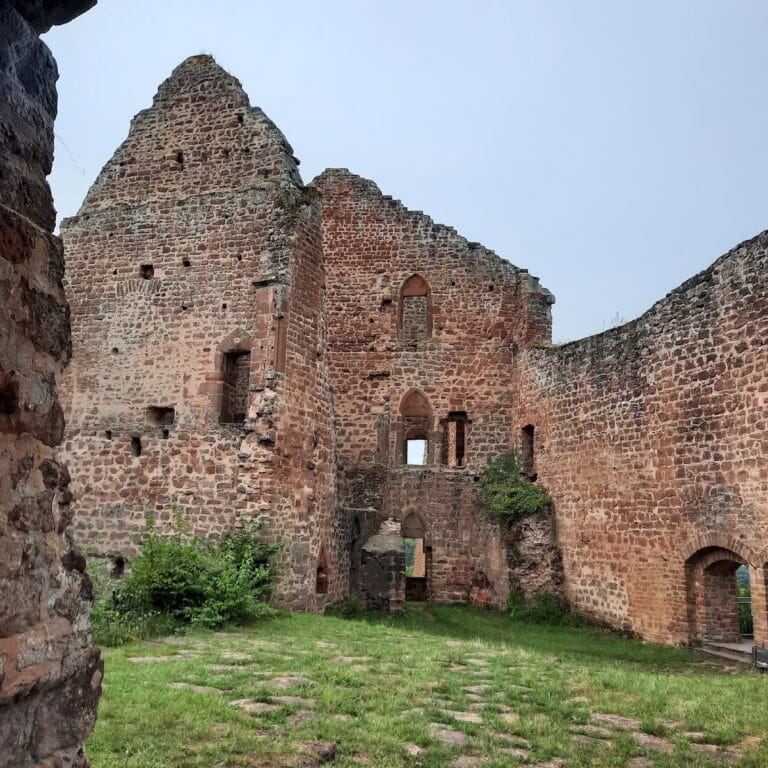
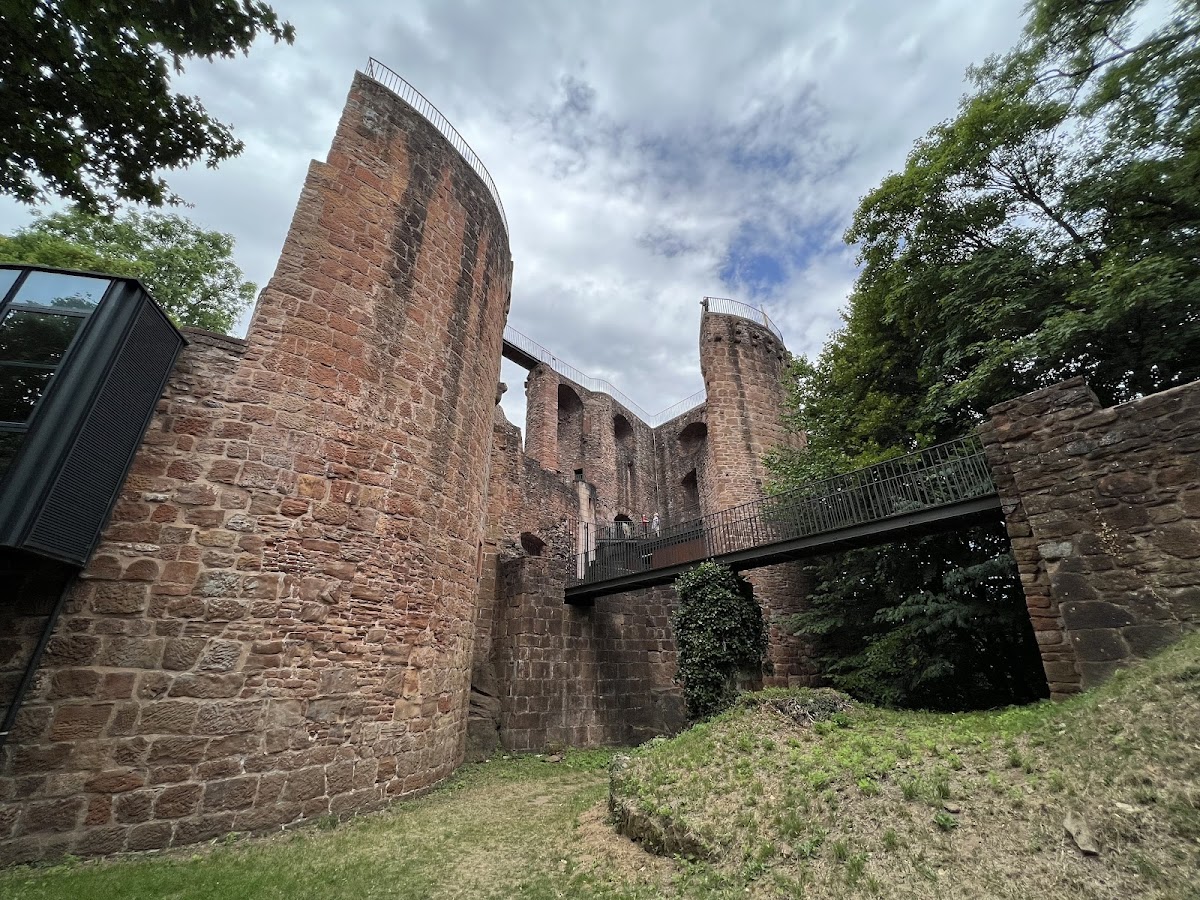
A further excavation in 1964 investigated the prehistoric installation. On 21 June 1991, Merzig-Wadern District acquired the completely ruined castle from the von Boch family. Restoration, partial rebuilding, and the insertion of modern installations followed in 1992 and 1993. The work stabilized the complex and made parts of it usable, but did not reconstruct the gate complex or the northeast rondel. A museum was installed in the northeast tower, along with hospitality rooms and sanitary facilities. Burg Montclair is an architectural heritage monument.
The castle is also linked with eight legends recorded by Saarbrücken art historian and folklorist Karl Lohmeyer. Their titles include “The Bees Save Montclair,” “The Horseshoe and the Cart Rut on Breitenstein,” “The Giant Toad beneath Breitenstein,” “The Last Burgrave of the Cloef,” “The Penitent Knight at St John’s Fountain,” “The Hermit at St John’s Fountain,” “The Mettlach Monastery Hans and the Count of Montclair,” and “The Lord God Stone.”
Remains
Ridge setting and early fortifications
Burg Montclair stands at about 290 metres above sea level on the long Burgberg ridge, surrounded by the Saar at the Saarschleife south of Mettlach. The ridge extends for about five kilometres and is approximately 300 metres wide. It rises around 150 metres above the river, whose elevation is about 166 metres, while the ridge reaches 318.7 metres at its highest point.
The castle uses the natural defenses of the spur. Steep, difficult slopes protect the northwest and south sides, while a ditch secured the landward approach. The Saarschleife lies where the Saar leaves the red sandstone of the Merzig basin and enters harder quartzite. The river follows an older fracture zone in the quartzite, and later uplift deepened the loop and the Mettlach meander. Stepped river terraces can be seen from the Cloef, the rocky overlook above the outer bank of the loop.
Forest covers much of the surrounding landscape. Beech woodland grows on remnants of red sandstone, while hornbeam and oak occur on quartzite and steep slopes. European holly is also present. Weathered rubble slopes known as Rosseln support mainly lichens and mosses.
Burg Skiva
The earlier Burg Skiva lies about 350 metres east of Neu-Montclair. Its surviving features include the artificially raised mound of the motte, associated ditches, and ramparts. These earthworks preserve the basic form of the earlier medieval fortification on the mountain spur.
Alt-Montclair
Alt-Montclair developed through several stages into a large Romanesque high-medieval hilltop castle. It stood behind Neu-Montclair toward the Cloef. Its principal sections extended for about 450 metres, while the entire complex, including the eastern fore-area, covered nearly 900 metres.
The older castle was arranged in three principal parts. An eastern outer bailey led to a central main or inner bailey, followed by western forward defenses. Each section was separated from the next by a neck ditch, a ditch cut across a narrow approach or spur to isolate a fortification.
The central area contained the keep, defensive towers, entrance gate, chapel, residential building, stables, and barns. The 1351 siege and destruction left Alt-Montclair in ruins, and later agreements prevented its reconstruction. Its scale and successive building phases contrast with the more compact arrangement of Neu-Montclair.
Neu-Montclair
Neu-Montclair forms a much smaller rectangular castle. The eastern access side measures approximately 32 metres, while the western side is about 19 metres wide. Massive round towers protect the two eastern corners, and smaller towers occupy the western corners. The layout has strong architectural parallels with Meinsberg, the larger sister castle built by Arnold VI von Sierck between 1419 and 1436.
Eastern towers and entrance
The northeast rondel, a round fortified tower or defensive projection, has an external diameter of 15 metres. It is flattened toward both the steep slope facing the Saar and the courtyard, and it remains 22 metres high when measured from the bottom of the ditch. The southeast rondel has an external diameter of 13 metres, rises 20 metres, and has walls up to four metres thick.
The entrance between the two eastern towers was flanked by a pair of stair towers. A 12-metre-wide outer ditch protected the approach. A drawbridge crossed the ditch, while a small gatehouse guarded the bridge. The Second World War artillery damage destroyed the connection between the towers and affected parts of the southeast rondel. Later work stabilized and partly rebuilt these areas, but the gate complex and northeast rondel were not recreated.
Western towers and courtyard
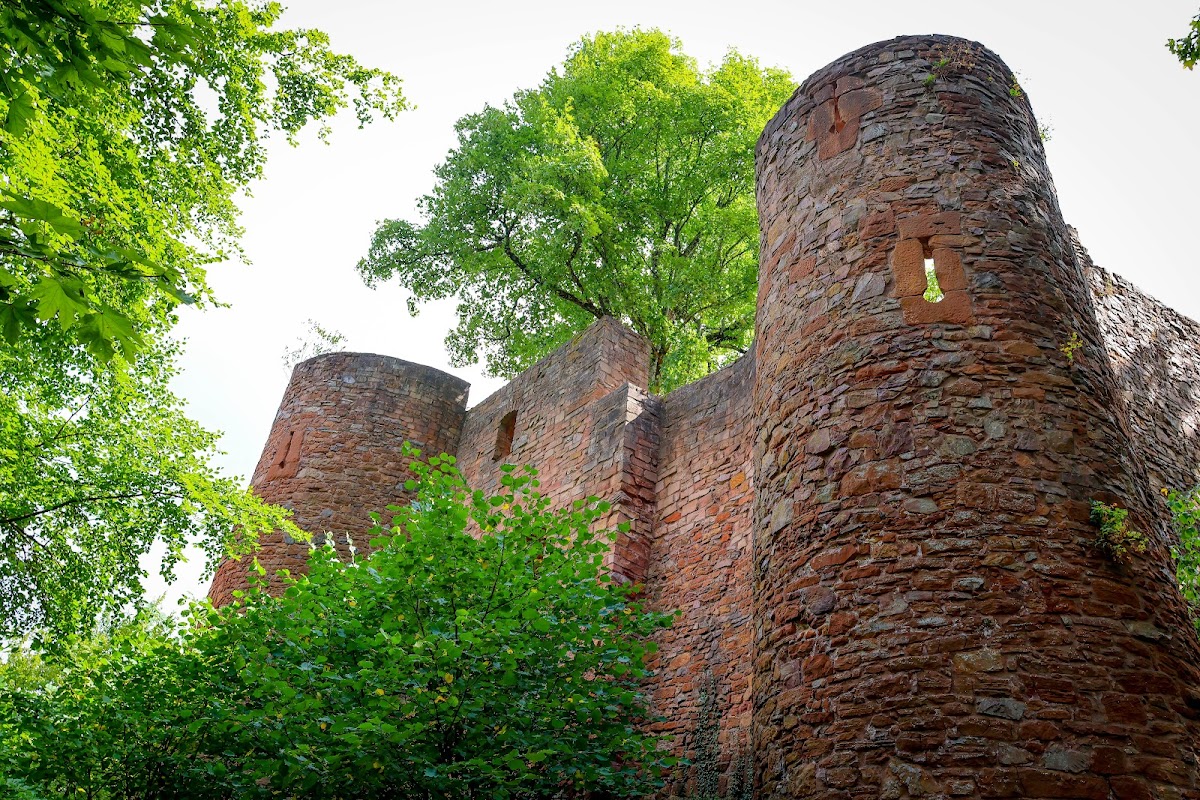
The western corners were protected by smaller round towers. Their external diameters measure 5.60 metres and four metres, and their walls are about 0.85 metres thick. The former economic building stood between them. Within this area, the courtyard measures approximately 15 by 19 metres, and a shallow ditch runs along the rear of the castle.
Defensive details and later use
The towers originally carried conical roofs and continuous fighting galleries, protected passages from which defenders could observe and fire. Their crenellation walls rested on corbels and arch friezes. Openings between the supports functioned as loopholes, allowing defenders to fire downward through the tower floors. The curtain walls also had fighting galleries.
The northeast tower now contains the castle museum. Hospitality rooms and sanitary facilities were inserted during the restoration of 1992 and 1993. That intervention stabilized and partly rebuilt the ruin while preserving the surviving relationship between the towers, courtyard, ditches, and walls.