Adelburg Castle Ruins: A Medieval Hilltop Castle in Germany


Site at a Glance
- Rating
- 4.4
- Popularity
- Very Low
- Country
- Germany
- Primary era
- Medieval
- Eras represented
- Stone Age, Bronze Age, Iron Age, Medieval
- Civilizations
- Holy Roman Empire
- Site type
- Military
- Remains
- Castle
On this page8 sections
History
Adelburg Castle Ruins, also known as Adelnburg, are the remains of a high-medieval noble castle in Germany, situated at Haag, a locality of Seubersdorf in Bavaria. The Lords of Adelburg apparently built the hilltop stronghold during the second half of the twelfth century. Its surviving lower masonry supports this date, while the first recorded member of the family, Engelhardus de Adelenburg, appears in written records around 1180.
The Lords of Adelburg
The noble family associated with the castle appears in written records for only two generations, ending around 1230 when it apparently died out. Adelburg stood within a zone of imperial property around Oberweiling. This means that the surrounding estate was connected with property held by the medieval German king or empire, although the route by which it entered imperial possession is unclear. The often-repeated claim that Adelburg itself was an imperial fief is not documented.
In 1246, during the final struggle for Staufen rule, the inheritance connected with Adelburg became contested. The Staufers, also called the Hohenstaufens, were a medieval ruling dynasty that produced several German kings and emperors. Their opponent Heinrich Raspe, a thirteenth-century counter-king, promised the inheritance to Gottfried of Sulzbürg if he succeeded in capturing the castle.
Changing lordship and destruction
In 1269, Adelburg was among the Staufen possessions of Konradin, the dynasty’s last major heir, that passed to Duke Heinrich of Lower Bavaria. The castle was subsequently pledged or exchanged many times. A pledge was a form of mortgage arrangement in which control could pass to a creditor or holder without necessarily transferring ultimate ownership. Long-term holders included the Auer family from 1339 to about 1360, the Mendorfer family from 1399 to about 1418, the Lords of Parsberg from 1435 to 1468, and the Wiesbeck family of Velburg from 1507 to 1574. The dates for the Auer and Mendorfer holdings are uncertain.
A document dated 10 November 1455 records Fridrich von Parsperg entering the service of the Imperial City of Nuremberg for three years with eleven companions and twelve horses, together with Adelburg Castle and its residential buildings. The castle was destroyed several times between 1413 and 1584, either because of its reputation as a stronghold of robber knights or during late-medieval feuds.
The superior ownership of Adelburg also moved repeatedly among branches of the Wittelsbach dynasty, a major Bavarian ruling house. After an intervening Bohemian phase, the castle passed to the Electorate of the Palatinate in 1329, to Upper Bavaria in 1373, to Bavaria-Munich in 1392, and finally to the newly established principality of Palatinate-Neuburg in 1505.
Decline and earlier settlement
Adelburg’s decline accelerated around 1755, when the pilgrimage church at Batzhausen was built. Almost the entire outer facing of the castle’s perimeter wall was removed for the church, leaving projecting masonry blocks visible in the ruin. The hill itself, the isolated Kellerberg, had a much older history. Finds recovered repeatedly since 1957 belong to the Chamer culture, a Neolithic archaeological culture of the region conventionally dated here to approximately 3100–2700 BC. The settlement is one of the northwesternmost known sites of this cultural group in the Old Bavarian region.
Later metal finds made with metal detectors remain unpublished. Gold-mica ware from the hill has raised the question of whether the larger lower plateau also served as a refuge during the period associated with Hungarian incursions. Adelburg is protected in Bavaria as an architectural monument under designation D-3-73-167-72. It is also registered as an archaeological monument under D-3-6835-0044, which covers prehistoric highland settlements of the Chamer culture and the Urnfield period, as well as archaeological evidence within the medieval castle ruin. The Urnfield period refers to a later prehistoric European tradition associated in part with cremation burials and urn use.
Remains
Hilltop layout and defensive masonry
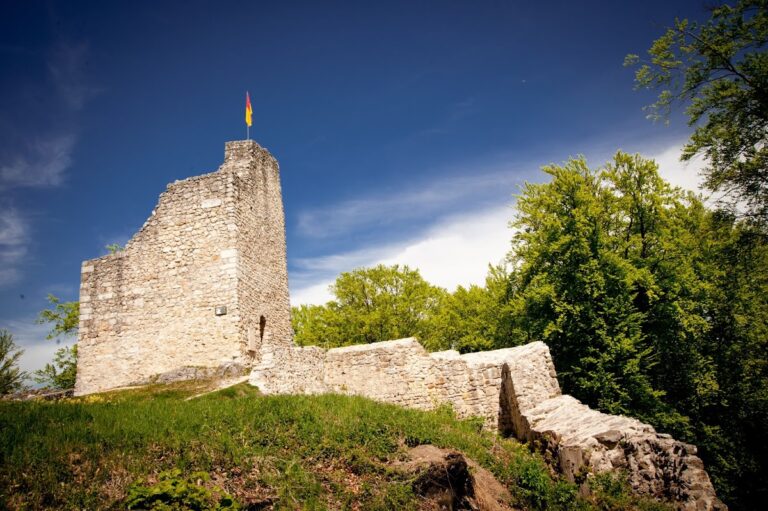
The ruin occupies the wooded summit of the isolated, island-like Kellerberg, which reaches 610.7 metres above sea level. It lies about 1.3 kilometres northeast of Eichenhofen. Velburg-Hollerstetten is below to the northwest, the mouth of the Frauenbach into the Schwarze Laber lies to the north on the opposite side, and Parsberg-Klapfenberg lies to the east.
Adelburg was arranged as a three-part hilltop castle, with a core castle and two fortified outer courtyards. Its perimeter wall was approximately five metres high and 1.45 metres thick. The wall was built from rusticated ashlar blocks known as Buckelquader, roughly dressed masonry with raised outer faces and recessed margins. This form of construction was typical of twelfth-century fortifications.
Surviving wall fabric
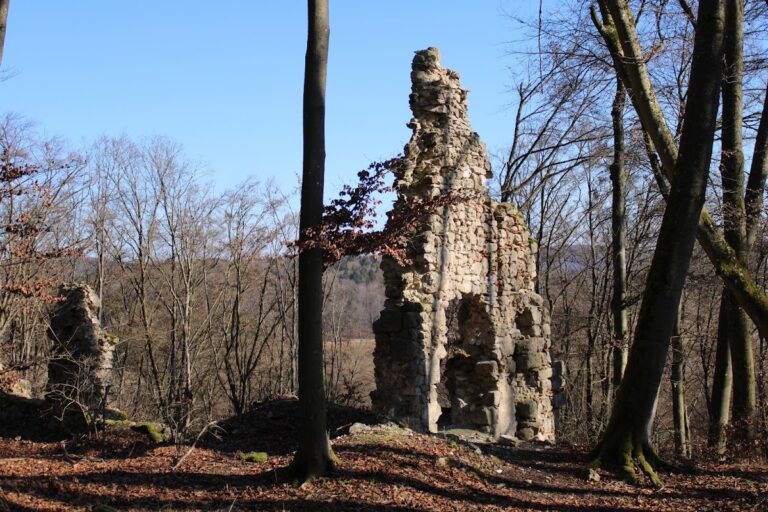
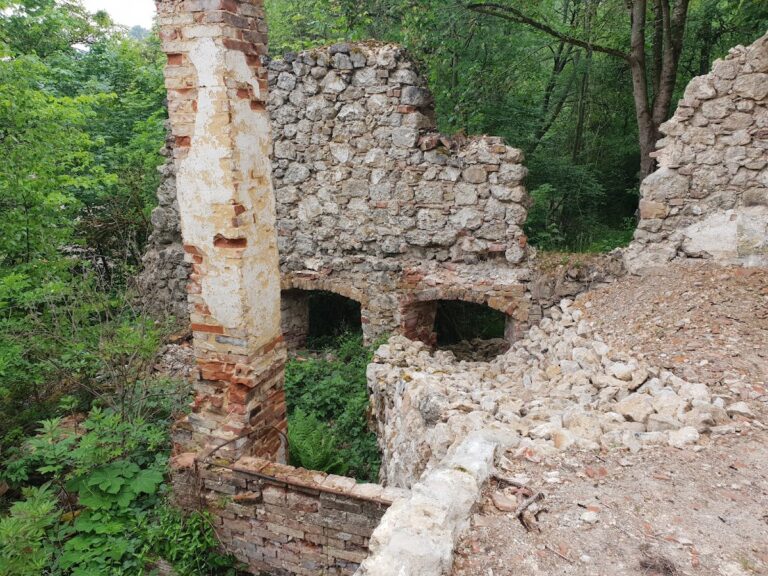
Only sections of the perimeter wall remain. A small number of rusticated blocks survive in the lower courses of the outer wall facing, while most of the outer facing was removed, particularly during construction of the Batzhausen pilgrimage church. The projecting blocks visible in the ruin therefore preserve part of the castle’s original twelfth-century masonry technique and also reflect the later removal of building material.
Prehistoric evidence and associated features
The archaeological monument extends across the area of the medieval ruin and includes evidence of prehistoric settlement associated with the Chamer culture and the Urnfield period. These remains place the castle site within a much longer sequence of occupation on the Kellerberg. A horse-watering trough at Haag is listed as an associated component of the Adelburg monument.
Local tradition holds that an underground tunnel once ran from Klapfenberg and Oberweiling beneath the Schwarze Laber to Adelburg. According to the legend, villagers used it to seek refuge in the castle from passing troops. The existence of such a tunnel remains unverified.