Burg Krämpelstein: A Medieval Customs Castle Above the Danube in Austria


Site at a Glance
- Rating
- 4.5
- Popularity
- Very Low
- Country
- Austria
- Primary era
- Medieval
- External website
- Open
- Eras represented
- Medieval, Modern
- Civilizations
- Holy Roman Empire
- Site type
- Military
- Remains
- Castle
On this page10 sections
History
Medieval origins and Passau administration
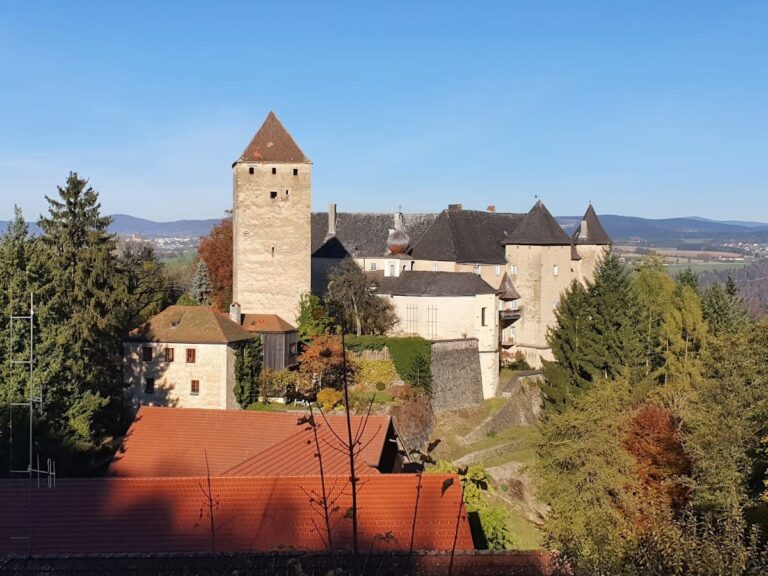
Burg Krämpelstein is a medieval rock castle in Austria, situated at Pyrawang above the right bank of the Danube. First mentioned in 1337, it became associated from 1370 with ministerials, members of the medieval service nobility who held administrative or military positions for a territorial lord, serving the bishops of Passau. The bishops were both senior church authorities and territorial rulers in the medieval German lands.
Krämpelstein functioned as a customs station and later as a residence for the bishops of Passau. Its documented keepers included Jans Thymayer, who served from 1370 to 1380, the Raspen family from 1406 to 1421, and Ulrich Kastenmayer from 1421 to 1424. Later custodians and administrators included Hans Zenger in 1424, Heinrich Hevraus in 1473, Georg Perneck in 1495, and Burghart von Messenbeck between 1505 and 1510. From 1601, the castle was administered from Burg Vichtenstein.
Captivity and transfer to Austria
One of the castle’s most striking episodes involved Rupert von Moosheim, a prelate and provost of Passau Cathedral. A cathedral provost was a senior cleric with important administrative duties in the cathedral chapter. Because of views associated with the Reformation, the movement that challenged established Western Church structures in the sixteenth century, von Moosheim was forcibly detained at Krämpelstein as a heretic. He died there in 1545 after five years of captivity.
In 1782, Krämpelstein passed to Austria with the Innviertel. The castle later endured a long period of neglect before being acquired by the Counts of Pachta in 1865.
Modern transformation
Eduard Munninger leased Krämpelstein in 1937 and enlarged it between 1938 and 1942. He established a pension and artists’ hostel, and until 1965 the castle served as a meeting place for his pansophical organization, AORRAC. Pansophism promoted the ideal of comprehensive or universal knowledge. A fire in 1984 was followed by a complete renovation. The castle remains privately owned, and the municipality of Esternberg derives its coat of arms from it.
Earlier Roman association
Krämpelstein is believed to have been associated with an earlier Roman watch post. Roman coins dated to AD 284–306 were found in 1845. Associated with the reigns of the emperors Diocletian and Maximian, who ruled during the late third and early fourth centuries, the coins have been used to support the possibility of this earlier military presence.
The castle’s name was also given to a motor vessel equipped with a 400-horsepower engine and an eccentric mechanism. In 1955, the vessel was used as an icebreaker on the Danube in the reservoir area near Jochenstein Power Station.
Remains
Residential buildings on the rocky promontory
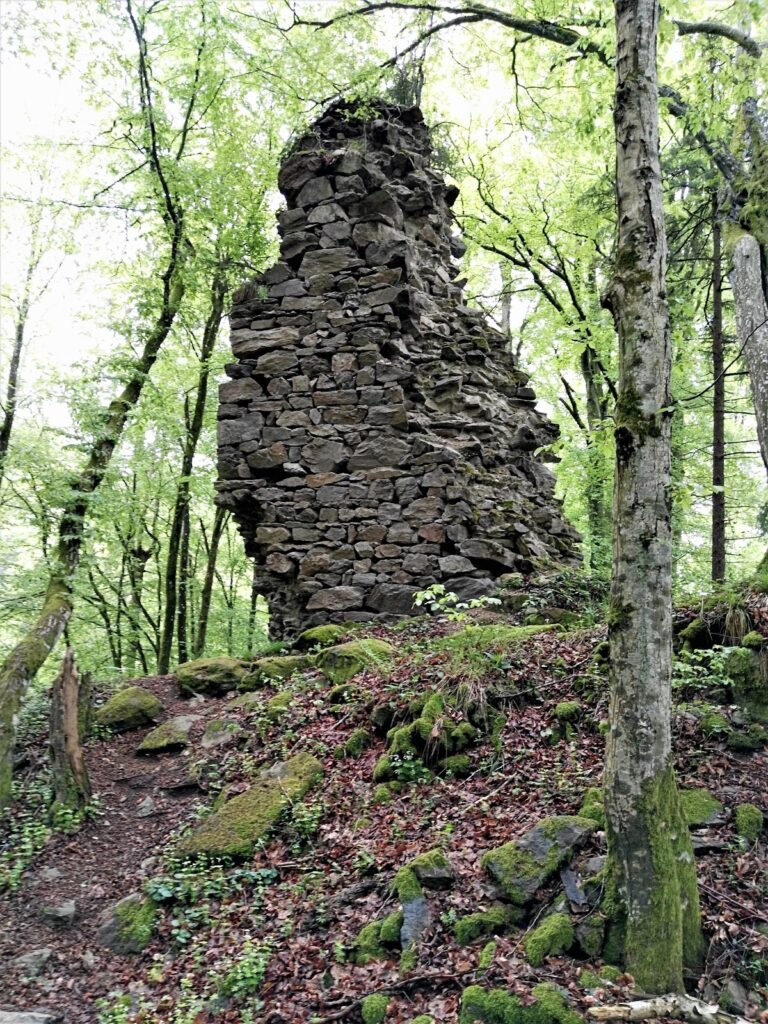
Burg Krämpelstein occupies a rocky promontory in a forested landscape above the Danube. Its principal surviving arrangement consists of a residential tower joined to a palas, the main residential and representative building of a medieval castle. The tower forms the core of the complex, while the palas was added later and expanded the residential portion of the site.
Residential tower
The residential tower measures approximately 9.5 by 11 metres at its base. Corbels beneath it show that a wooden fighting gallery, a defensive walkway attached to a wall or tower, could be installed during wartime. The roof was formerly removable, allowing the tower to be adapted for defence.
Palas and chapel
The attached palas measures approximately 15 by 15 metres. Its later construction is indicated by an entrance on the palas’s first floor that leads into the tower. A projecting latrine bay, a medieval toilet structure extending from a building, is attached to the right side of the palas and has been modernized. A small castle chapel stands above the entrance.
Defensive and lower-level features
The castle’s former defensive walls extended from the tower towards the projecting rock face. The area in front of the tower was artificially filled, creating additional usable ground on the rocky site. Vaults interpreted as former stables lie beneath this area, with light slits in the wall providing the basis for that interpretation.
Nearby sites