Veste Oberhaus: The Prince-Bishops’ Fortress in Passau, Germany


Site at a Glance
- Rating
- 5
- Popularity
- Very Low
- Country
- Germany
- Primary era
- Early Modern
- Eras represented
- Medieval, Early Modern, Modern
- Civilizations
- Holy Roman Empire
- Site type
- Military
- Remains
- Castle
On this page16 sections
History
Veste Oberhaus is a fortress in Passau, Germany, founded in 1219 by Ulrich II, the first prince-bishop of Passau, around an existing chapel dedicated to St. George. Its construction followed the acquisition of imperial princely status by the bishops in 1217. The fortress expressed their military authority, defended the territory against external enemies, and helped contain internal opposition, including Passau citizens who sought the status of a free imperial city.
Medieval Stronghold and Episcopal Residence
For most of its history, Veste Oberhaus was both the stronghold and residence of the prince-bishops of Passau. As siege technology changed, the complex was renovated and enlarged repeatedly from 1255 to 1256 through the early nineteenth century. Its successive forms trace the development of fortification from the thirteenth century to the early nineteenth century.
Major rebuilding campaigns took place under Prince-Bishops Leonhard von Laiming, Christoph von Schachner, Wiguleus Fröschl von Marzoll, Urban von Trennbach, and Johann Philipp von Lamberg. Under their rule, the complex developed from a Gothic citadel into an early Renaissance princely residence, then a fortified princely castle, and finally a representative regional fortress shaped by the period of the Ottoman threat.
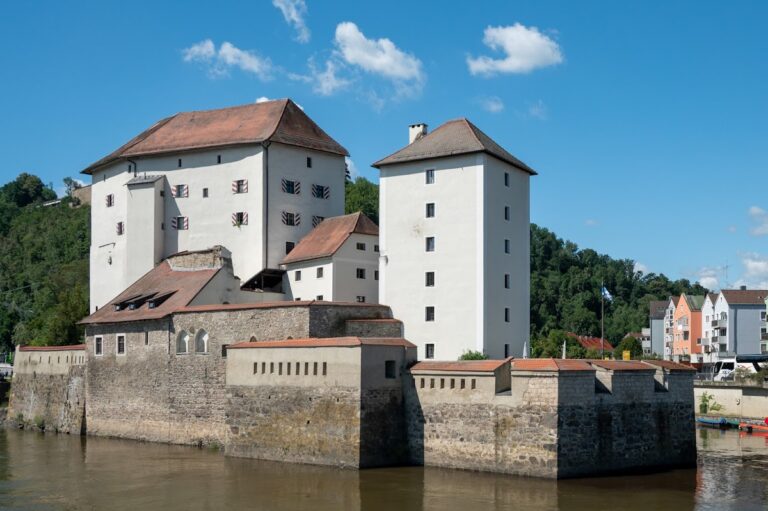
Veste Oberhaus withstood five attacks between 1250 and 1482. Passau’s citizens attacked the fortress in 1298 and 1367 during rebellions against the bishop. After the attack of 1367, Veste Niederhaus was added on the Danube bank below Oberhaus and linked to it by a fortified wall-walk, creating a double fortress almost 700 metres long.
Religious Conflict and Imprisonment
Between 1535 and 1540, numerous Anabaptists were imprisoned in the fortress dungeon because of their religious beliefs. The Anabaptists were a sixteenth-century reform movement that rejected infant baptism and emphasized adult baptism and disciplined Christian communities. During the prisoners’ confinement, the Ausbund, a collection of Anabaptist hymns associated especially with the Amish tradition, was developed. Some hymn writers died in captivity, while many others were later martyred. Ruprecht von Mosham was subsequently imprisoned at Veste Oberhaus for his religious views and died there.
War, Secularization, and Bavarian Control
The fortress surrendered to opposing forces in 1704, 1742, and 1800. Secularization in 1802 ended the prince-bishops’ possession of Veste Oberhaus. Napoleon I used the complex during his campaign against Austria, and it was placed under Bavarian control as a border fortress. The Austrian army captured it in 1805.
After the Congress of Vienna, Veste Oberhaus returned to Bavarian control. From 1822 until 1918, it served as a fortress, a state prison for political prisoners, and a military penal institution. Its reputation led to the feared nickname “the Bastille of Bavaria.”
Museum and Twentieth-Century Uses
Passau acquired Veste Oberhaus in 1932. The city museum, founded in Passau’s town hall in 1905 by curator Wolfgang M. Schmid, was transferred to the fortress and reopened there as the Ostmarkmuseum in 1933. Its early collections included archaeological finds, material relating to the prince-bishopric and the civic city, coins, weapons, and ethnographic objects.
In 1937, under Mayor Max Moosbauer, some rooms were converted into representative guest rooms, while other museum rooms remained accessible. The United States Army captured the fortress in May 1945 and used it as a rest center until February 1946. An auxiliary hospital for tuberculosis and venereal diseases then occupied the complex. After the hospital closed, the Oberhausmuseum opened on 26 August 1952.
The Oberhausmuseum now comprises the Passau city museum, an art gallery, collections on Eastern Bavaria, Bohemia, and Austria, a firefighting museum, and a porcelain collection. The complex also contains a restaurant, youth hostel, observatory, and viewing facilities.
The Thingplatz
During the Nazi period, the baroque forward fortifications were replaced by a Thingplatz, an open-air theatre intended for mass political and cultural spectacles. Designed by Ludwig Moshamer, it was begun on 26 August 1934 and dedicated on 22 September 1935. A 1937 performance of Eberhard Wolfgang Möller’s Frankenburger Würfelspiel was intended to become an annual event, but political objections in Austria prevented its continuation. In 1938, 85 boys and 162 girls born in 1927 and 1928 were sworn in there as members of the Hitler Youth. The theatre is no longer used, and no visible remains survive.
Veste Oberhaus is recognized as both an archaeological monument, with underground medieval and early-modern remains and finds, and a built monument of Passau.
Remains
Veste Oberhaus occupies the crest of St. Georgsberg, 105 metres above the valley between the Danube and the Ilz. Steep slopes descend on both sides, and the fortress faces the old city of Passau across the Danube. Its surviving layout combines medieval defensive works, early modern residential buildings, and later fortifications arranged around outer and inner courtyards.
Outer Defenses and Approach
Ravelintor and Kronwerk
The Ravelintor, built in 1703, bears the arms of Cardinal Johann Philipp von Lamberg. It gives access to the Kronwerk, a baroque bailey and forward defensive zone constructed between 1674 and 1740. Beyond it lies a second defensive area dating predominantly from the sixteenth century. A ravelin was a detached or projecting defensive work that protected an entrance or curtain wall.
Gates and Fortified Connection
From the middle defensive ring, the Burgstraße passes the main watchtower, built around 1350, and crosses a drawbridge through a tower dating from 1433. The gate tower at the entrance to the main fortress carries the arms of Prince-Bishop Leonhard von Laiming and the date 1440. Veste Niederhaus stands below Oberhaus on the Danube bank and is connected to it by a battlement, a fortified wall or wall-walk used for defense and movement between fortifications.
Courtyards and Episcopal Buildings
Church of St. George
The inner courtyard contains the Church of St. George, which predates the fortress. Its early and High Gothic frescoes survive alongside later Baroque renovation, preserving evidence of the chapel’s changing architectural and religious character.
Schachner Building and Princely Residence
Buildings around the outer courtyard date mainly from the sixteenth century. The Schachner building was erected around 1500 by Christoph von Schachner and carries a prominent coat of arms and the date 1499 on its facade. Its upper floor contains the ceremonial Knights’ Hall, which is linked by an open arcade to the Dürnitz and the princely suite. A Dürnitz was a residential or service building in a medieval or early modern princely complex, while the princely suite formed the ruler’s residential and ceremonial section. The connected buildings date from the fourteenth to the seventeenth centuries, and cannon batteries occupy the Schachner building’s lower floor.
The inscription “1499” records one rebuilding year rather than the complete construction history of Veste Oberhaus. Archaeological investigations in the 1990s revealed traces of a seventeenth-century residential tower.
Batteries, Towers, and Later Facilities
Linde Battery
The Linde Battery is a terrace enclosed by the fortress walls. It overlooks the Dreiflüsseeck, where the Inn, Danube, and Ilz meet. From the terrace, the differing colors of the three rivers are visible.
General’s Building and Observation Tower
The building known as the General’s Building dates from 1597 and now contains a youth hostel. An eighteenth-century Observation Tower provides a viewing platform, and an observatory is also located within the fortress.