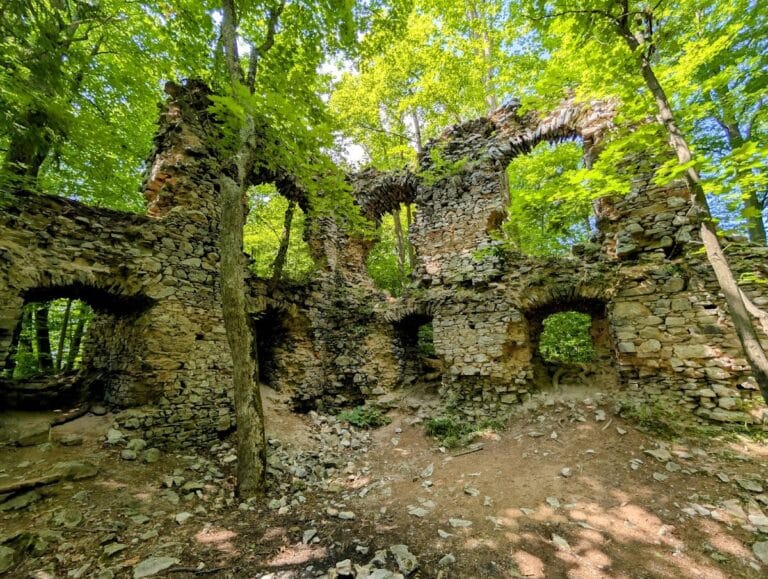
Kuchlov: A Short-Lived Medieval Castle in Czechia


Site at a Glance
- Rating
- 4
- Popularity
- Very Low
- Country
- Czechia
- Primary era
- Medieval
- External website
- Open
- Eras represented
- Medieval
- Civilizations
- Holy Roman Empire, Kingdom of Bohemia
- Site type
- Military
- Remains
- Castle
On this page6 sections
History
Kuchlov is a small medieval Gothic castle in Czechia, founded during the second half of the thirteenth century. Built during a period of changing lordship and colonization in Moravia, it occupied a strategic position in the Drahany Highlands, although its original name and precise historical role are unknown.
Foundation and regional power
No written record survives from the castle’s period of use, so its history must be reconstructed from archaeological finds and the political circumstances of the surrounding region. Occupation lasted from the end of the thirteenth century into the fourteenth century, indicating that Kuchlov existed for only a relatively short time. The name Kuchlov appears in written records only in the sixteenth century and derives from the woodland tract where the ruins stand.
One explanation assigns the foundation to the Benešovci family, especially Milota of Dědice, a prominent Moravian nobleman who controlled the Dědice–Račice territory during the second half of the thirteenth century. Kuchlov may have helped defend this domain against the expansion of the neighbouring lords of Holštejn. This possibility is linked with the deserted medieval village of Hamlíkov. Part of its former land lay beyond the Ruprechtov stream opposite Kuchlov, while another section extended between the castle and the stream within the Dědice–Račice territory.
A different interpretation identifies a member of the lords of Čeblovice as the founder and places Kuchlov within the Holštejn lordship. Under this view, the castle may have developed as a centre during the German colonization of the Drahany Highlands. It may also have guarded a route leading north from the Haná lowlands through the highlands towards Boskovice and Svitávka, or connected the bishop’s Pustiměř–Vyškov estate with episcopal possessions in the Blansko area.
Kuchlov may have stood at the centre of a small domain that included Ruprechtov and the later-deserted settlements of Hamlíkov and Vilémov. These settlements do not appear in the earliest lists of the surrounding domains’ possessions. Kuchlov lies less than one kilometre from the ruined castle of Stagnov, but the relationship between the two fortified sites and their respective roles in the region’s medieval power structure remain uncertain.
Destruction and abandonment
The castle’s destruction cannot be dated with certainty. One proposed date is 1285–1286, when King Wenceslaus II campaigned in Moravia against castles and strongholds held by brigands and predatory knights. The campaign followed the five-year period of political instability after the death of Přemysl Ottokar II in 1278. This explanation is considered less likely because Milota of Dědice, if he founded Kuchlov, was a leading Moravian nobleman unlikely to have permitted the castle to become a robber stronghold.
A more probable interpretation places the destruction around 1312, during the campaign of the young King John of Luxembourg against Moravian lords accused of brigandage. John besieged and captured nearby Račice, regarded as the strongest of the strongholds belonging to Friduš of Linava, and Friduš was then forced to demolish another castle, Drahaus. If Friduš also controlled Kuchlov, the castle may have been destroyed during the same campaign.
Kuchlov may instead have declined after the Čeblovice family disappeared in the early fourteenth century. It was not mentioned when the Holštejn possessions were divided during the first half of that century, which suggests that the castle had already been deserted. The small number of artefacts recovered from its occupation period likewise points to early abandonment or destruction around the turn of the thirteenth and fourteenth centuries.
The ruins have been protected as a cultural monument of the Czech Republic since 1970. Kuchlov remains an important Moravian example for studying a castle that had a comparatively brief existence in the second half of the thirteenth century.
Remains
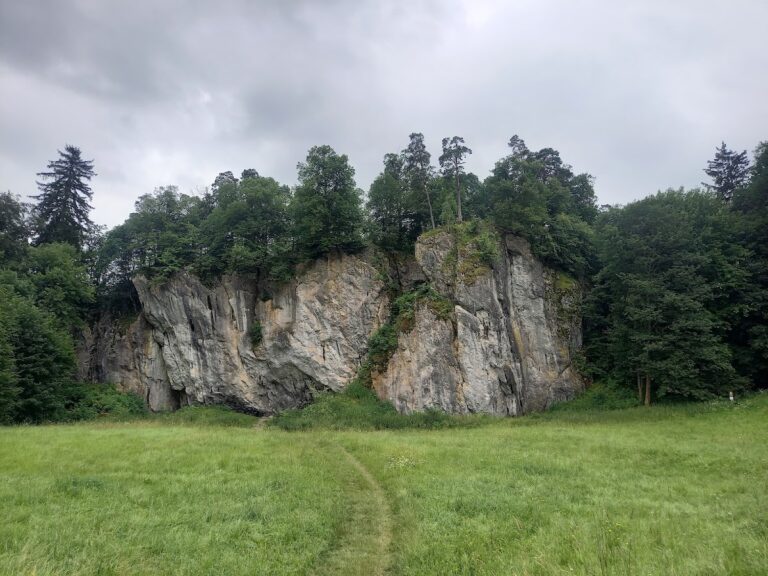
Kuchlov stands on a spur about 400 metres above sea level on the southeastern slope of the Drahany Highlands. It occupies the right side above the confluence of a small stream with the Malá Haná, in the valley between Ruprechtov and Rychtářov and approximately 2.5 kilometres east of Ruprechtov. Only small wall fragments and earthworks survive, but the castle’s ground plan remains clearly visible in the terrain.
Fortified layout
The castle was a small fortified Gothic settlement organized around a trapezoidal central core. The core occupied about one-third of the enclosed area and was protected by a substantial rampart, an earth bank built for defense. A deep ditch separated it from the outer bailey, the less strongly defended outer part of a medieval castle. This five-sided area occupied roughly two-thirds of the site and was itself separated from the approach road by a second ditch. The compact inner core and broad bailey form an arrangement associated with castles built during the second half of the thirteenth century.
The rampart above the ditch between the palace gable and the southern part of the central core is the most prominent surviving feature. A depression in the rampart probably marks the former entrance gate to the courtyard. Wooden buildings probably stood in the bailey, while recent excavations have affected the courtyard area. The surviving remains therefore present Kuchlov as an almost-vanished ruin rather than a standing castle.
Palace and masonry remains
The palace occupied the northern side of the central core and formed part of the perimeter wall. Traces of its masonry remain, and a stepped rise in the bottom of a hollow on the northern side indicates a second palace room. Together with the surrounding earthworks, these fragments preserve the basic organization of the castle even though very little of its above-ground fabric survives.
Nearby sites