Georgium: A Neoclassical Palace and Landscape Garden in Germany


Site at a Glance
- Rating
- 4.6
- Popularity
- Low
- Country
- Germany
- Primary era
- Early Modern
- External website
- Open
- Eras represented
- Early Modern
- Civilizations
- Holy Roman Empire
- Site type
- Domestic
- Remains
- Palace
On this page18 sections
History
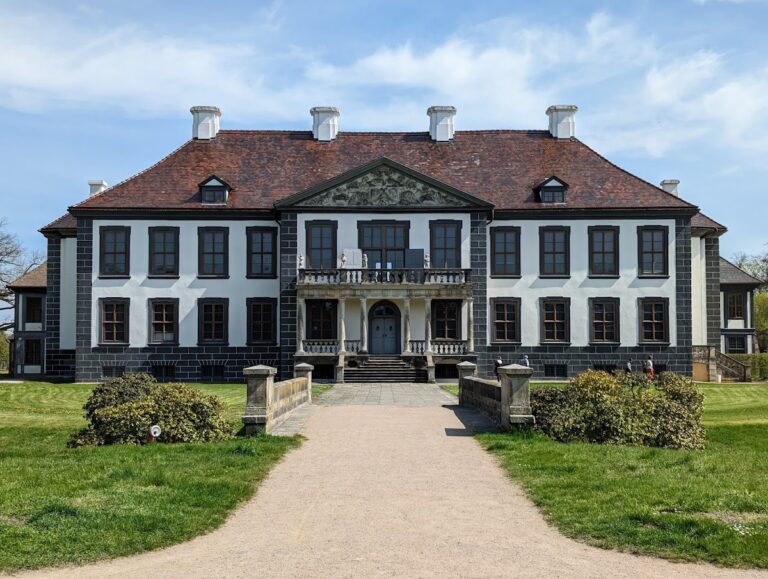
Georgium is a Neoclassical palace and English-style landscape garden in Dessau-Roßlau, Germany, created in the late eighteenth century for Prince Johann Georg, the younger brother of Leopold III Friedrich Franz of Anhalt-Dessau. The palace was completed in 1784, and the grounds became part of the Dessau-Wörlitz Garden Realm, an ensemble of historic parks, gardens, palaces, and landscape features developed mainly under the Anhalt-Dessau princely house.
Creation under Johann Georg
From around 1780, Johann Georg commissioned Friedrich Wilhelm von Erdmannsdorff, an architect associated with German Neoclassicism, to build a country residence north of Dessau. The site lay in alluvial woodland outside the town gates. Its surrounding grounds were reshaped as an English-style landscape garden, a design based on irregular planting, curving paths, water, views, and picturesque buildings rather than formal geometric layouts. The garden planning is also attributed to Johann Friedrich Eyserbeck, a landscape designer associated with the Dessau-Wörlitz estates.
Georgium was named after its patron. The residence began its history as a private country palace, but after repeated alterations it became the home of the heir to the Anhalt-Dessau principality and retained that function until 1944. In this period, the palace and its park formed part of the wider landscape programme that connected princely residences, gardens, and natural floodplain environments around Dessau.
War, political change, and new uses
During the Second World War, part of the palace was occupied by the Gauleiter of Anhalt-Magdeburg. A Gauleiter was a regional leader of the Nazi Party who also exercised political authority in the corresponding German administrative region. After the war, the building housed the commandant’s office of the Red Army.
Before 1959, the palace was used as a Pioneer House by the youth organization of the German Democratic Republic. A pioneer railway was planned for the park during this period, but it was never built. The building then entered a new phase when it became the home of the Anhaltische Gemäldegalerie Dessau in 1959. The gallery had previously occupied the Neoclassical Palais Reina in central Dessau, which was destroyed during the Second World War.
The Anhaltische Gemäldegalerie Dessau
The gallery grew from Dessau’s first public art collection, established by the Amalien Foundation in 1793 from paintings collected by Princess Henriette Amalie of Anhalt-Dessau. In 1927, the Free State of Anhalt used this collection as the foundation for a central state art museum. Works from former ducal collections were added, followed by acquisitions of contemporary art.
The collection remains chiefly shaped by German and Dutch paintings, drawings, and prints from the princely Anhalt collections. Its strongest areas include art from the Reformation era, the Baroque period, and the age associated with Goethe. Holdings include major works by Lucas Cranach the Elder and Johann Friedrich August Tischbein, who had served as court painter to Leopold III Friedrich Franz in Dessau, as well as drawings by Albrecht Dürer and Wassily Kandinsky.
The collection suffered serious wartime losses. Part of it had been evacuated to the Solvayhall potash mine near Bernburg. US soldiers stole several works, some of which later appeared on the American art market. In July 1945, the Red Army Trophy Commission confiscated an important part of the remaining collection and transported it to the Soviet Union in April 1946. The confiscated holdings comprised 800 paintings and 17,000 graphic sheets. Between 1958 and 1959, 600 paintings, 1,000 drawings, and 10,000 prints were returned.
Heritage and conservation
Georgium, Georgengarten, and Beckerbruch form part of Saxony-Anhalt’s Garden Dreams project. The palace and park have belonged to the UNESCO World Heritage site of the Dessau-Wörlitz Garden Realm since November 2000. The gallery was placed on the German Cultural Council’s Red List in January 2015 as an endangered cultural institution. A long-term renovation and modernization of Georgium Palace was completed in 2023, when the gallery’s permanent exhibition reopened.
Remains
Palace and art collection
Georgium Palace
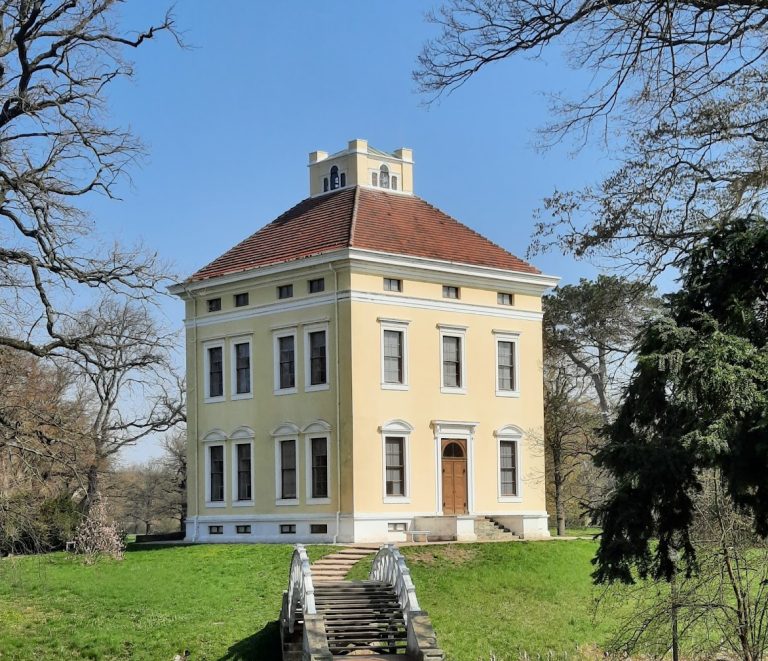
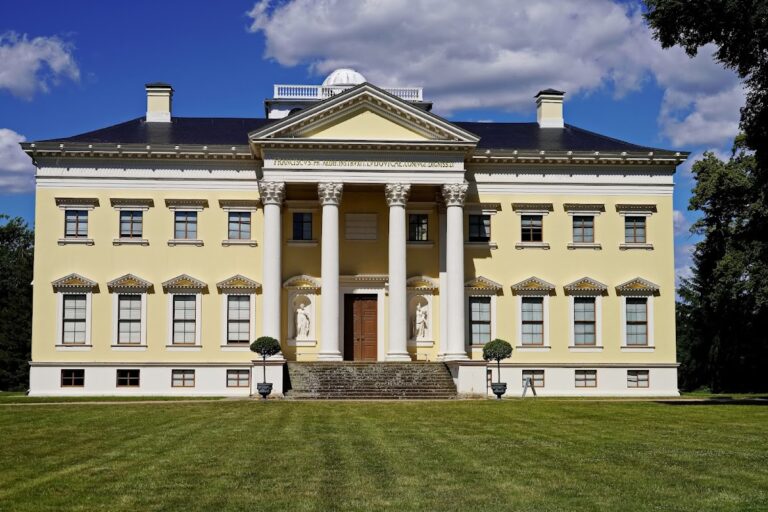
Georgium is centered on a compact Neoclassical palace set within a 21.3-hectare English-style landscape garden. The building began as a cube-shaped central block and was later enlarged with two side wings. It is a two-storey residence crowned by a belvedere-like upper element. Its successive alterations reflect the change from a country residence commissioned by Johann Georg to a palace used by the Anhalt-Dessau hereditary line and later by public institutions.
Anhaltische Gemäldegalerie Dessau
The palace now houses the Anhaltische Gemäldegalerie Dessau. Its collection comprises approximately 1,800 paintings and 18,000 works on paper, including 8,000 drawings and 10,000 prints, together with smaller holdings of sculpture and applied art. The works range from the Late Middle Ages to the present, with a principal concentration between 1500 and 1850.
Among the works associated with the gallery are Jacob Philipp Hackert’s View of the Villa Albani in Rome from 1779, Jan Mijtens’s Portrait of the Daughters of Frederick Henry of Orange from 1666, Albrecht Dürer’s Melencolia I from 1514, Wilhelm Trübner’s Marbachtal in the Odenwald from 1902, and a sixteenth-century work after Jheronimus Bosch depicting The Temptation of Saint Anthony.
Garden structures and monuments
Landscape garden
The grounds around the palace contain numerous small architectural features, sculptures, monuments, and buildings arranged within the English-style landscape. Their placement forms part of the garden’s designed setting, in which architectural elements are combined with planting, open views, and the wooded alluvial environment.
Roman Ruin and circular temple
The garden includes a Roman Ruin modeled on the Temple of Concordia in Rome. It also contains an Ionic circular temple, or monopteros, an open-sided building formed by a ring of columns carrying a roof or dome. Two reproductions of ancient archways add further classical elements to the grounds.
Prince Franz monument
A monument in the garden depicts Prince Franz, the shorter name of Leopold III Friedrich Franz, in antique clothing. The monument connects Georgium’s physical landscape with the princely patron whose wider programme shaped the Dessau-Wörlitz Garden Realm.
Beckerbruch and the Elbe landscape
Georgengarten and Beckerbruch
Georgengarten adjoins the 97-hectare Beckerbruch, an alluvial and marsh landscape along the Elbe. Beckerbruch was largely left in a natural state, but small architectural features and monuments were introduced into it. The resulting landscape joins the designed garden with the natural floodplain while retaining the distinct scale and character of the marsh environment.
Elbe Pavilion and Wallwitzburg
The Elbe Pavilion and Wallwitzburg, an artificial ruin, are features of the landscape along the Elbe. Both provide wide views across the garden landscape and the riverine setting. Their placement extends the designed sequence of structures beyond the immediate palace grounds.
Mausoleum Park
Park and mausoleum
Mausoleum Park borders Georgium. It was laid out in the 1890s during the conversion of the palace for use by the widowed hereditary princess Elisabeth, a member of the Anhalt princely house. A mausoleum for the princely family was established during the same period, adding a later funerary component to the palace and garden ensemble.
Nearby sites