Burg Hohenerpfingen: A High-Medieval Castle in Germany


Site at a Glance
- Rating
- 4.3
- Popularity
- Very Low
- Country
- Germany
- Primary era
- Medieval
- External website
- Open
- Eras represented
- Medieval
- Civilizations
- Holy Roman Empire
- Site type
- Military
- Remains
- Castle
On this page11 sections
History
Burg Hohenerpfingen, also known as Schnatren, is a high-medieval hilltop and spur castle in Germany, probably built by the local Erpfingen nobility during the second half of the twelfth century. Dated pottery finds support this period of construction. The castle occupied a rocky promontory above the Erpf Valley and served as the high-medieval residence of the Erpfingen noble family.
From the Erpfingen family to the Schenken
The Erpfingen nobles probably first held their traditional residence at Stollenhof, an older manor associated with the settlement of Niederhofen. They later moved to Hohenerpfingen, which was probably established toward the end of the twelfth century. Christine von Erpfingen, probably the last member of the family, appears in 1304 as a nun at Stetten monastery.
A change in ownership probably followed the marriage in 1314 of Werner II, Schenk von Andeck, Erpfingen and Stauffenberg, to a daughter of Johann von Salmendingen. The Schenken, a medieval service-noble family whose name came from the court office of cupbearer, may have received Niederhofen from the former Erpfingen nobles as a wedding gift. The extent of this transfer remains uncertain.
By about 1340, the Schenken von Erpfingen had entered documentary records. They were probably Werner II’s nephews and members of a ministerial family, a service nobility responsible for offices, land, or military duties on behalf of a higher lord. The family was loyal to the House of Zollern, one of the major dynasties competing for influence in southwestern Germany.
Salmendingen and the decline of the lordships
By the middle of the fourteenth century, the Lords of Salmendingen owned and occupied Stollenhof, Niederhofen, and Burg Hohenerpfingen. Ritter Hanß von Salbadingen lived at Hohenerpfingen in 1350, followed by Haintz von Salbadingen in 1358. Both were probably sons of Johann von Salmendingen.
Around 1350, Agate von Salmendingen, probably a sister of the lords at Erpfingen, married Burkhard von Mansberg. Through the marriage, Burkhard acquired Salmendingen Castle, linking the Mansbergers with the families who held Hohenerpfingen and Salmendingen.
In 1358, Heinz von Salmendingen sold Friz Remp of Pfullingen all his goods and rights at Erpfingen, including woodland, fields, meadows, and jurisdiction. He expressly retained Schnatren Castle and the woodland below it. Conflicts between the Mansbergers and the rising House of Württemberg then contributed to the weakening of the local lordships.
In 1385, Hohenerpfingen was described as a Burgstall, meaning a former castle whose fortifications were already ruined or largely lost, and was sold to the Pfullingen family. The House of Teck sold its ancestral territory around Teck to Württemberg in 1386, further reducing the political position of the Mansbergers and their allies.
War, territorial change, and abandonment
During the War of the Cities from 1387 to 1389, a conflict between Württemberg and allied self-governing imperial cities in southwestern Germany, the Mansbergers sided with the imperial cities. Burkart von Mansberg commanded forces from Esslingen during an attack on Grötzingen. The possibility that the lords of Erpfingen sought protection in the imperial cities remains conjectural.
After Württemberg won the war, the former Salmendingen territory, including Erpfingen, was assigned to the Princely House of Fürstenberg. The House of Werdenberg administered it through Jehle of Trochtelfingen, a ministerial official. The Mansbergers and associated families subsequently had to serve the victorious Württemberg counts as officials or administrators. Tradition holds that the former lords of Hohenerpfingen descended from Heinz von Salmendingen’s family and were resettled in villages around their former territory, although this tradition is not established.
The ruin from the fifteenth century onward
In 1487, the House of Württemberg acquired the Hohenerpfingen ruin from Caspar Remp of Pfullingen. A map prepared under Duke Frederick of Württemberg called the site “Schnatren, also an old Burgstall.” The fishpond associated with the castle apparently still existed then.
The relationship between the names Hohenerpfingen and Schnatren is disputed. Bizer used Schnatren exclusively, with the colloquial form Schnatrete. The name may come from Snade, an old term for a boundary, because the castle stood at the outer edge of a small lordship.
Around 1800, the municipality of Erpfingen owned the ruin and sold the old tower and its immediate surroundings, covering approximately one to two morgen, a variable historical unit of agricultural land, to Count Wilhelm of Württemberg. He intended to create a romantic medieval-style castle for one of his sons. Erpfingen unsuccessfully tried to buy the ruin back in 1868. Restoration work followed in 1985 under the architect Rudolf Brändle. An unproven theory also connects the Heinz family of Sonnenbühl-Willmandingen with the former Heinz von Salmendingen lineage.
Remains
Burg Hohenerpfingen occupies a rocky promontory of the Kobelberg at about 785 metres above sea level. It stands roughly 75 metres above the Erpf, which approaches from the east before turning south. The ground drops steeply to the north, northeast, and west, while the Kobelberg rises gradually southward to about 808 metres. The former settlement of Niederhofen lay below the castle, approximately in the area of the present festival hall.
Fortified summit
Castle ditches and front wall
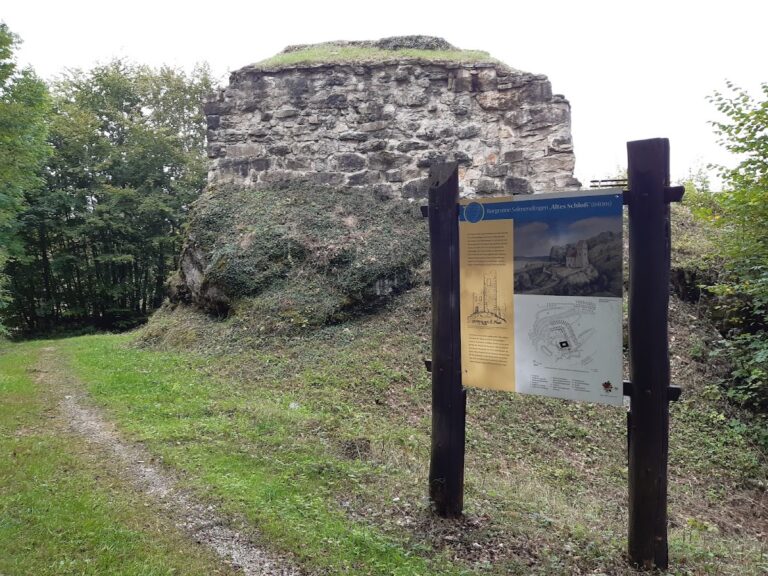
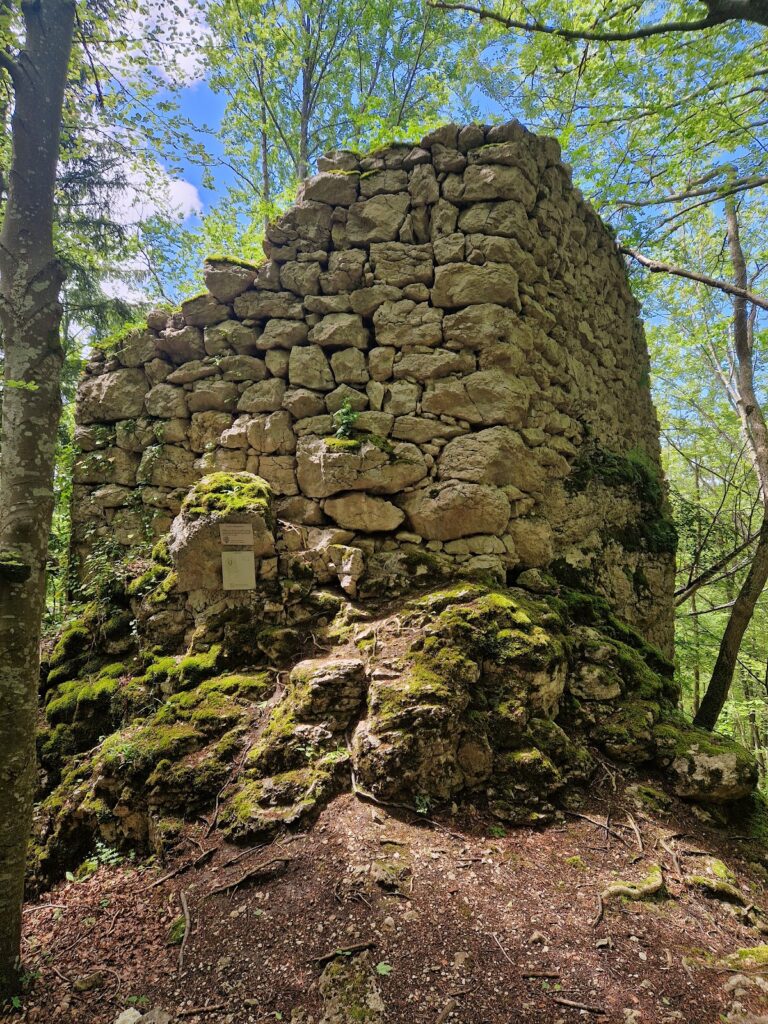
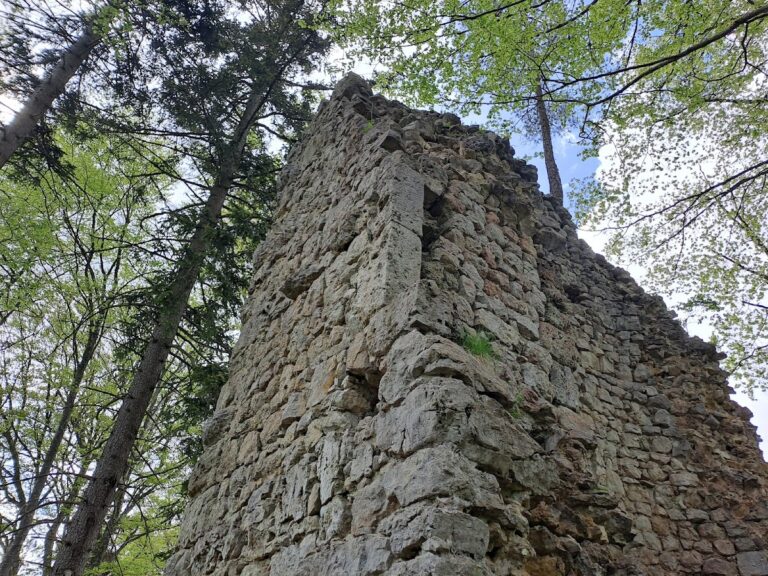
Only limited defensive remains survive on the summit. Rock-cut ditches mark parts of the castle defenses, while a tall front wall rises from a rocky outcrop within the inner castle. Built in ashlar and bossed ashlar, whose outer stone faces project to create a rugged surface, the wall has the character of a shield wall, a particularly strong defense for the castle’s most exposed side.
Tower castle
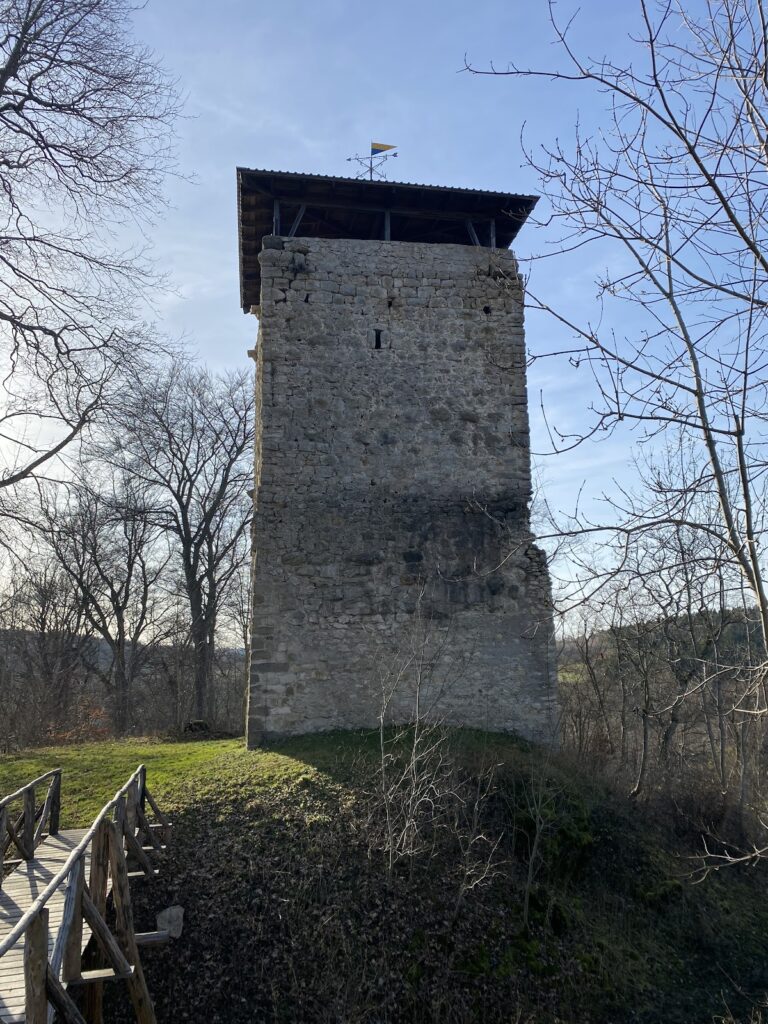
The site also contains the ruin of a tower castle. Together with the surviving front wall and rock-cut ditches, it forms the principal visible evidence of the fortified complex. The old tower was the part of the ruin sold by the municipality of Erpfingen to Count Wilhelm of Württemberg around 1800, when plans were made to create a medieval-style residence on the site.
Water management
Wuhrbuckel dam
Below the castle, the remains of a substantial dam called the Wuhrbuckel can still be recognized where the Erpf was formerly dammed to create a fishpond under the authority of the castle lord. The structure connects the castle’s physical setting with the water management associated with its former lordship.
Nearby sites