Burg Diemerstein: A Medieval Spur Castle in Germany


Site at a Glance
- Rating
- 3.8
- Popularity
- Very Low
- Country
- Germany
- Primary era
- Modern
- External website
- Open
- Eras represented
- Modern
- Civilizations
- Kingdom of Bavaria
- Site type
- Military
- Remains
- Castle
On this page8 sections
History
Burg Diemerstein is a ruined hilltop spur castle in Frankenstein, Germany, established before 1216 by an unknown builder. A spur castle is a fortified site on a projecting ridge or rocky outcrop, where steep slopes strengthen its defenses. Diemerstein was associated with free nobles, members of the nobility who held their status without being subordinate vassals of a higher territorial lord.
Early lords and the Raugrafen
Rudegar of Dimarstein was the first nobleman recorded using the castle’s name, in 1216. The following year, Nebelung and Rudiger of Dymerstein became involved in a dispute with Otterberg Abbey over dues from the Sendelborn estate. Nebelung also possessed the patronage rights of the church at Hochspeyer. In 1221, he and Berthold of Dyrmstein transferred those rights to the Bishop of Worms.
The Raugrafen were recorded as owners in 1250 and appointed the knight Gundelmann as castle warden. No surviving document explains how they acquired Diemerstein. At this time, the castle appears to have been connected with an extensive woodland district rather than with a settlement of its own. The Raugrafen were a regional noble family whose influence continued to shape the castle’s later ownership.
Pledging and shared ownership
In 1362 or 1380, Diemerstein was pledged to Kuno von Falkenstein, Archbishop of Trier, an ecclesiastical and territorial prince of the Holy Roman Empire. His castle warden, Johann Schilling, also administered half of nearby Burg Frankenstein.
The castle returned to the Raugrafen in 1397. They then sold three-quarters of it to several members of the Palatine nobility. Diemerstein consequently became a jointly owned castle, a form of possession in which several noble families governed their rights and duties through formal agreements. The remaining quarter passed by inheritance to Philipp II von Daun-Oberstein, the son-in-law of Raugraf Otto. He sold his share to the Elector Palatine in 1418.
The Elector Palatine and eleven other nobles subsequently held Diemerstein together under a detailed castle peace agreement. The Electoral Palatinate was a major principality of the Holy Roman Empire ruled by an elector, one of the princes entitled to participate in choosing the emperor. From 1478, the Lords of Weingarten held the castle as the electors’ feudal tenants, while owning the remaining quarter directly. The Electors Palatine gradually acquired three-quarters of Diemerstein.
Reformation, destruction, and later ownership
In 1521, Christoph Bonn von Wachenheim gave shelter at Diemerstein to Ulrich von Hutten, a German humanist and supporter of the Reformation. The castle was destroyed during the Thirty Years’ War, the European conflict fought from 1618 to 1648 amid religious, dynastic, and territorial struggles. It was not rebuilt. During the war years, ownership reverted to the Electoral Palatinate.
At the beginning of the eighteenth century, the castle and the Diemerstein Forest passed to the Counts of Wartenberg. Around 1845, Paul Camille von Denis received the ruin as a gift from the Palatine Ludwig Railway. He remodelled and enlarged the remains and built Villa Denis at the foot of the castle hill, giving the site a new nineteenth-century phase without restoring the medieval castle.
Landscape and performance history
In the eighteenth century, the castle hill was arranged as a landscape garden. Only limited traces of this design remain recognizable. A small open-air stage above the castle was used exclusively for Johann Jakob Hamm’s play German Destiny: The Events at Diemerstein Castle and Country House. Its last recorded performance took place in 1986. The ruin remains privately owned.
Remains
Castle setting and surviving fabric
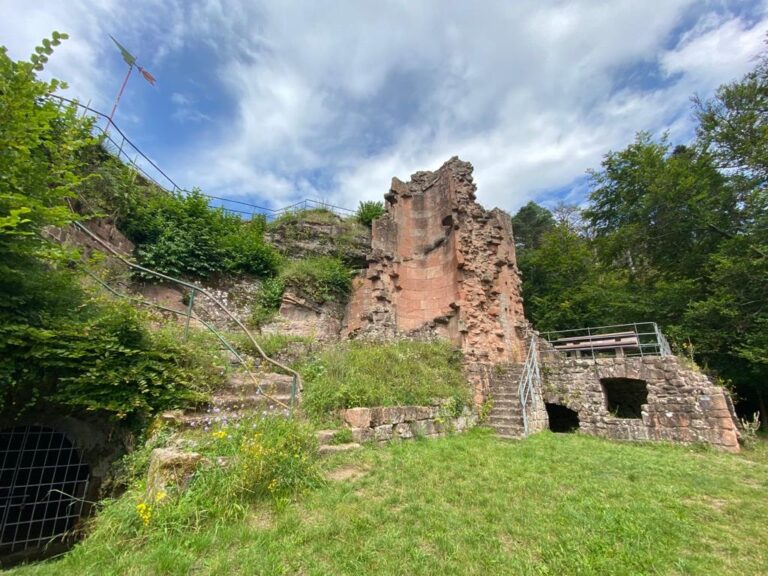
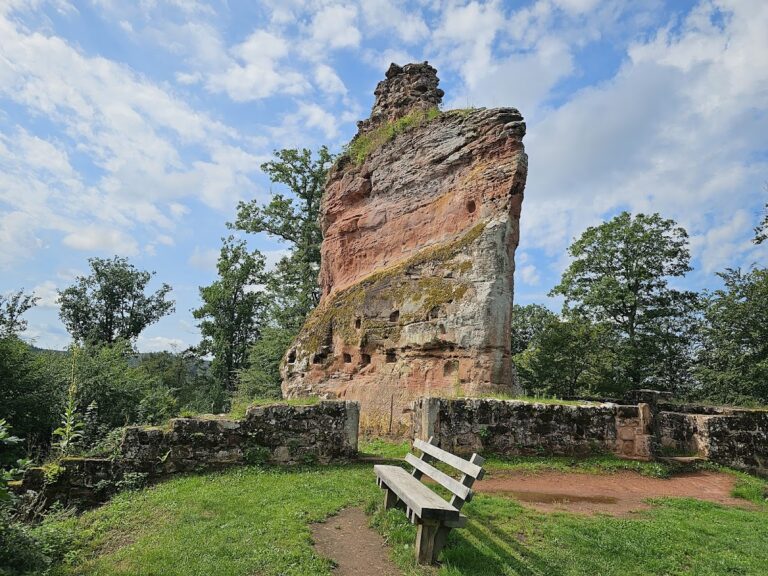
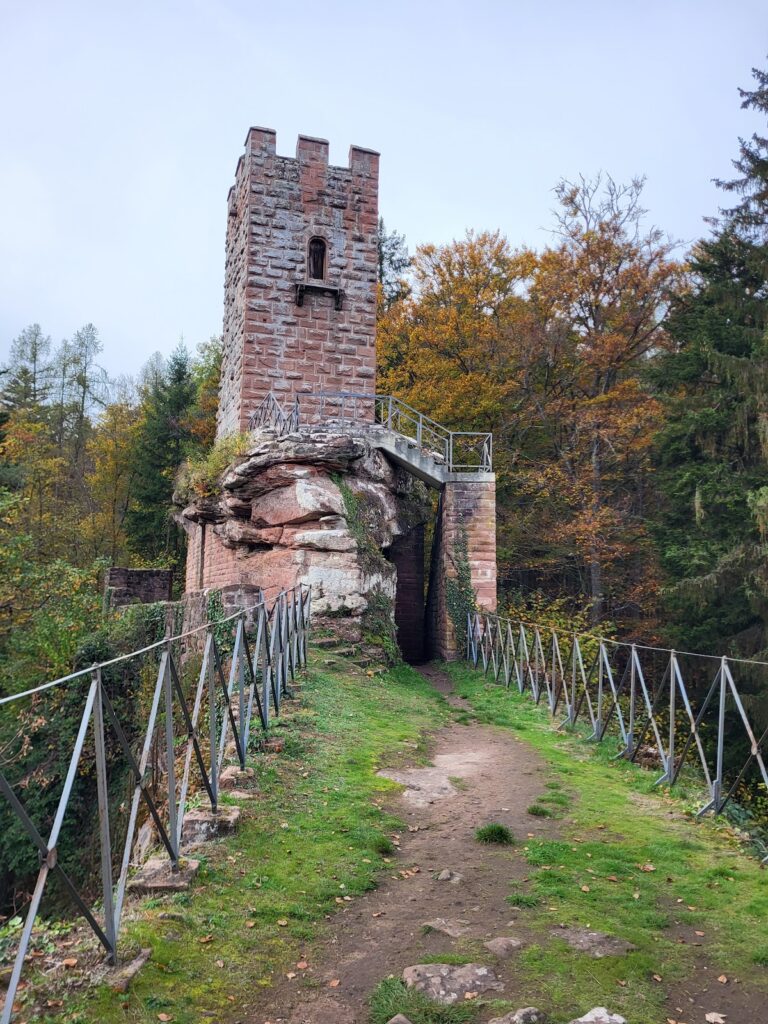
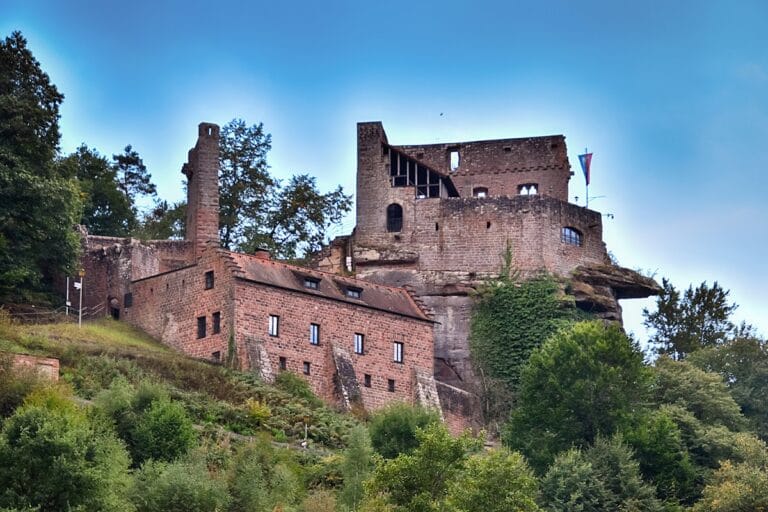
Burg Diemerstein stands at approximately 280 metres above sea level in the Glasbach valley, at the end of a long mountain ridge. The castle occupies a steeply descending rocky plateau, a position that forms the physical basis of its spur-castle layout. The surviving ruin represents the remains of the medieval fortified site, while the crenellated wall visible today belongs to the nineteenth-century remodelling carried out in the architectural taste of that period.
Hilltop and foot-of-hill features
The castle hill retains indistinct traces of its former eighteenth-century landscape-garden design. Above the ruin is a small open-air stage associated with Johann Jakob Hamm’s play about Diemerstein Castle and Country House. At the foot of the hill stands Villa Denis, the private residence built by Paul Camille von Denis around 1845 as part of his remodelling and expansion of the ruin.
Nearby sites