Burg Braunsberg: Ancestral Castle of the Counts of Wied in Germany


Site at a Glance
- Rating
- 5
- Popularity
- Very Low
- Country
- Germany
- Primary era
- Medieval
- Eras represented
- Medieval, Modern
- Civilizations
- German, Holy Roman Empire
- Site type
- Military
- Remains
- Castle
On this page10 sections
History
Burg Braunsberg is a medieval castle in Germany, built around 1200 by Bruno I of Isenburg as one of the ancestral castles of the Counts of Wied. Located above the Aubach Valley near Anhausen, it later became associated with the Isenburg-Braunsberg line and held the status of a high-nobility residence.
Origins and comital succession
Bruno I of Isenburg was married to Theodora of Wied, linking the castle to the Wied family. After the death of their last male heir, Bruno I’s son Bruno II established the second comital house of the Counts of Wied. The Counts of Wied were a German noble dynasty whose territories and succession shaped the political history around the Wied and lower Rhine.
Warfare and later use
After the Thirty Years’ War, the major European conflict fought mainly between 1618 and 1648, Burg Braunsberg was reportedly drawn into the regional conflict known as the Braunsberg War. The fighting involved Count Friedrich III of Wied, founder of Neuwied, against troops from Electoral Cologne and the Electoral Palatinate, territories ruled by prince-electors of the Holy Roman Empire. The conflict caused deaths and probably damaged the castle’s defensive works, at a time when artillery had become an important part of warfare.
The castle site had been largely abandoned since the eighteenth century. It remains owned by the Wied princely family and, as of 2010, also served as the seat of a district forestry office operated by the princely Wied forestry administration.
Destruction in 1945
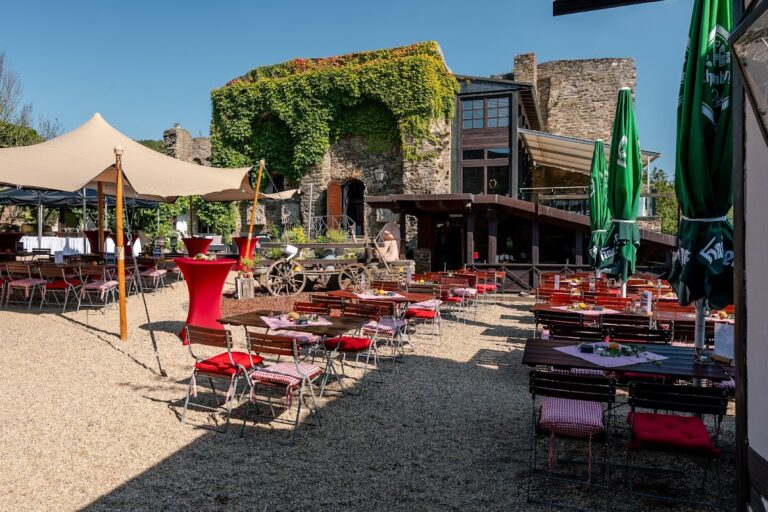
In March 1945, United States artillery fire almost completely destroyed the castle walls. Some had still reached the level of the former roofline. The damaged part of the lower castle was later repaired for forestry use, producing a modern-looking forestry facility with residential quarters within the castle grounds.
Remains
Hilltop setting and defenses
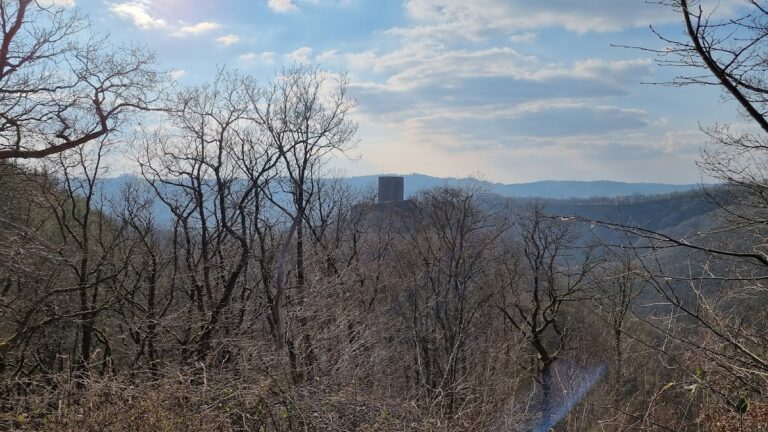
Burg Braunsberg occupies a rocky spur on the left slope of the Aubach Valley, at approximately 265 metres above sea level, in the territory of Anhausen in northern Rhineland-Palatinate. Its position made approach relatively easy from only one direction. On the landward side, a broad neck ditch cut into the rock and a natural rock formation protected the approach, while steep slopes toward the Aubach Valley defended the other three sides.
Castle buildings
Compact residential tower
The complex represents a compact, polygonal residential tower, a fortified tower designed to provide living quarters as well as defense. Its visible form developed through later alterations and additions. Surviving remains and historical interior photographs preserve evidence of a building whose earlier arrangement was changed over time.
Upper and lower castle
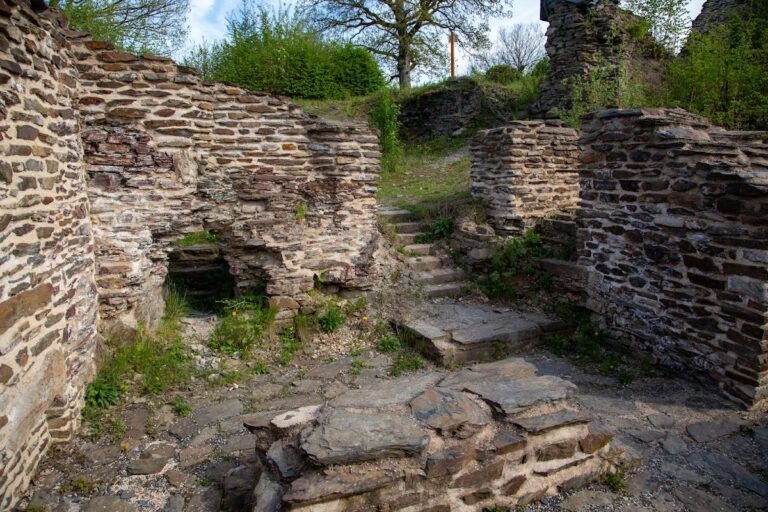
The upper castle survives as a ruin, while substantial parts of the lower castle remain. Repairs made after the 1945 destruction adapted part of the lower castle for forestry operations and residential use, giving these areas a modern appearance within the historic grounds.
Archaeological potential
Long abandonment from the eighteenth century and limited later building disturbance have preserved conditions suitable for archaeological investigation. Study of the castle could help clarify its original layout and construction, particularly because earlier damage during the Braunsberg War and the destruction in 1945 altered the defensive complex.
Nearby sites