Burg Alt-Wolfstein: A Hohenstaufen Castle in Germany


Site at a Glance
- Rating
- 4.4
- Popularity
- Very Low
- Country
- Germany
- Primary era
- Medieval
- External website
- Open
- Eras represented
- Medieval
- Civilizations
- Holy Roman Empire
- Site type
- Military
- Remains
- Castle
On this page8 sections
History
Burg Alt-Wolfstein is a ruined medieval hillside castle in Germany, probably built under Emperor Frederick I Barbarossa around 1160–1170 in the High Hohenstaufen architectural tradition. It stood above Wolfstein to secure and administer the imperial estate around Kaiserslautern, territory held directly by the Holy Roman Emperor rather than by a subordinate ruler.
Imperial foundation and early administration
The castle first appears in written records in 1275 under the name Woluistein. At that time, imperial ministeriales occupied it. These dependent nobles served rulers in military, administrative, and governmental roles, and their presence reflects the castle’s connection with imperial authority.
A contested imperial pledge
During the fourteenth century, Burg Alt-Wolfstein served as an imperial pledge, a financial and political arrangement in which imperial property or rights were transferred as security for an obligation. It passed into the possession of the Counts of Sponheim and the Counts of Veldenz. Baldwin of Luxembourg, the influential archbishop of Trier, made several unsuccessful attempts to obtain it through such a pledge.
The garrison included members of Sponheim ministerial families, whose repeated raids contributed to armed conflicts in the surrounding region. The Bishop of Speyer occupied the castle in 1362. In 1400, the Archbishops of Mainz and Trier, the Duke of Lorraine, and Count Palatine Rupert III besieged it. The settlement that followed gave Electoral Palatinate one quarter of the castle. Electoral Palatinate was a major territory of the Holy Roman Empire ruled by the Counts Palatine of the Rhine, who also held the rank of prince-electors.
Destruction and later custody
Electoral Palatinate and the neighboring Duchy of Zweibrücken disputed possession during the fifteenth and sixteenth centuries. The conflict ended in 1504 when Prince-Elector Philip of the Palatinate destroyed the castle. It was then left to decay.
In the nineteenth and twentieth centuries, the ruins belonged to Bavaria. Since 1963, the Castle Authorities of Rhineland-Palatinate have administered them. Masonry stabilization took place in 1979–1981 and again in 1985–1986, helping preserve the surviving fabric.
Remains
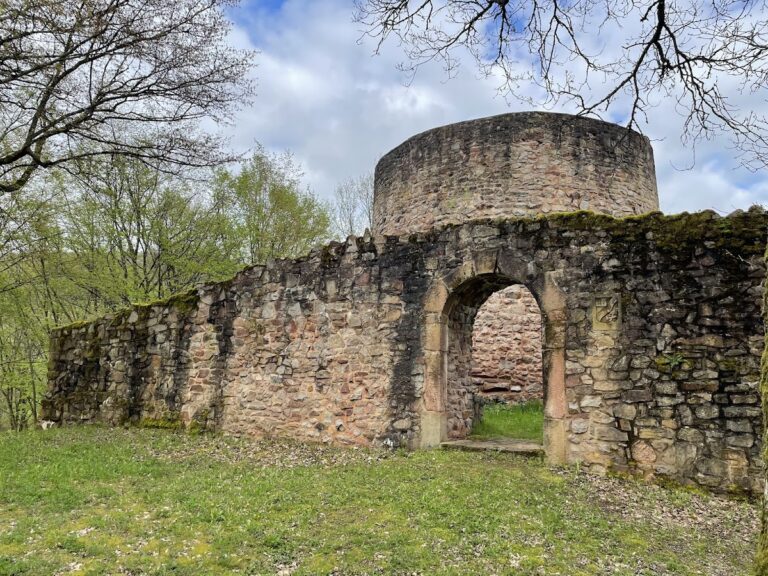
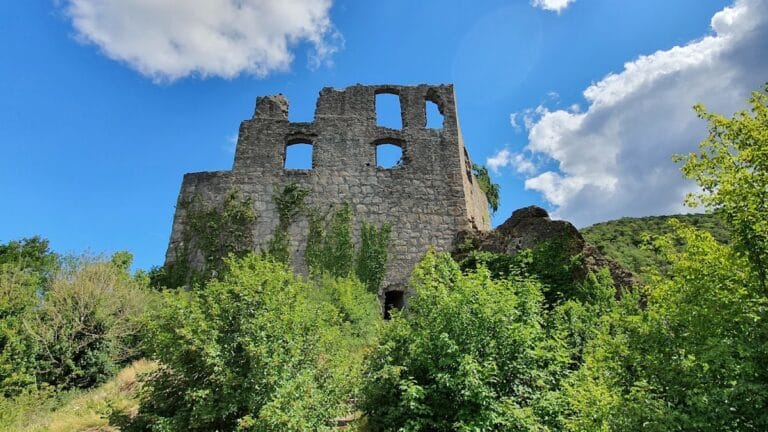
Burg Alt-Wolfstein occupies the eastern slope of the Königsberg at the narrowest point of the Lauter valley near Wolfstein, in Kusel district, Rhineland-Palatinate. The small complex survives as a ruined hillside castle whose remains include a substantial defensive tower, parts of the residential and entrance buildings, a shaft well, and evidence of a lower outer ward.
The bergfried
The principal surviving structure is a 20-metre-high, five-sided bergfried, the main tower of a medieval German castle, used chiefly for defense and refuge rather than ordinary residence. Its platform overlooks the surrounding area. The tower has an elongated projecting point on the side facing the likely direction of attack, a feature associated with the castle’s High Hohenstaufen design. The interior wall also preserves the handle and front part of a mason’s trowel. They were probably embedded there as a memorial after a craftsman fell from the castle and was killed during restoration work. The exact date is unknown, but the memorial predates 1970.
Residence, gate tower, and well
Archaeological work carried out from 1961 to 1975 uncovered remains of the castle residence, a gate tower, and a shaft well. These discoveries reveal elements of the former complex beyond the surviving tower and help identify its residential, defensive, and water-supply facilities.
Outer ward
North of the ruins, rubble from a former wall lies on the steep hillside. The remains indicate the position of a lower-lying outer ward, extending the castle complex beyond its principal surviving structures.
Nearby sites