Buranlure: A Medieval Stronghold in France


Site at a Glance
- Rating
- 4.8
- Popularity
- Very Low
- Country
- France
- Primary era
- Medieval
- External website
- Open
- Eras represented
- Medieval, Early Modern
- Civilizations
- French
- Site type
- Military
- Remains
- Castle
On this page9 sections
History
Buranlure is a former stronghold in Boulleret, France, associated with the late Middle Ages and the transition to the Renaissance. Its lordship, or seigneurie, depended on the County of Sancerre and served a defensive purpose in Berry from the fourteenth to the sixteenth century.
A Loire frontier during the Hundred Years’ War
Buranlure stood along the Loire near the frontier between the French kingdom and Burgundy. During the Hundred Years’ War, the prolonged conflict between the English and French crowns from the fourteenth to the fifteenth century, the French king was based at Bourges, while Cosne was occupied by Anglo-Burgundian forces from around 1420. Buranlure became a base and command post for royal French troops during this period.
The de Bar family held particular influence at Buranlure during these centuries. Through its connection with the County of Sancerre, the stronghold formed part of the military and political landscape of the region.
Religious conflict and changing ownership
During the French Wars of Religion, the sixteenth-century conflicts between Catholics and Protestants in France, Antoine de Bar, then lord of Buranlure, raised troops to support Marshal Claude de La Châtre de La Maisonfort during the 1573 siege of Sancerre, a Protestant stronghold.
The de Bar family gradually abandoned Buranlure. In 1769, the Perrinet-Langeron family acquired the property chiefly for its pastures and converted the castle into farm buildings and lodgings. This agricultural use continued until the beginning of the twentieth century and helped preserve the buildings from major architectural modernization.
Restoration and protection
By the end of the Second World War, Buranlure had fallen into poor condition. Substantial restoration began in 1944 under Arnaud de Vogüé, a descendant of the Perrinet-Langeron family. Experts and local craftsmen worked to preserve or recover the castle’s original appearance and authenticity. An order dated 25 May 1944 classified Buranlure as a monument historique, a protected French heritage designation for a site of historical or architectural importance. The de Vogüé family remains its owner.
Remains
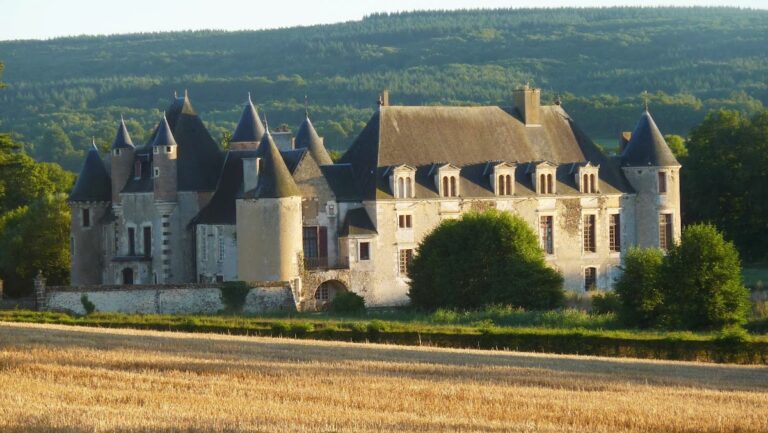
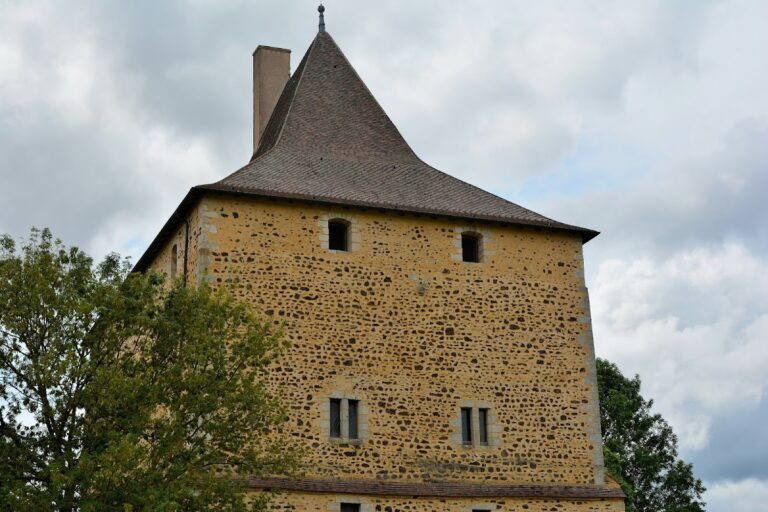
Buranlure is arranged around an inner courtyard, with a semicircular lower bailey in front of the castle. The surviving complex combines vestiges of the earlier feudal castle with later medieval, Renaissance, and early-modern alterations. A bridge and entrance tower lead from the outer area into the enclosed courtyard, while agricultural buildings preserve the estate’s later use.
Lower bailey and entrance
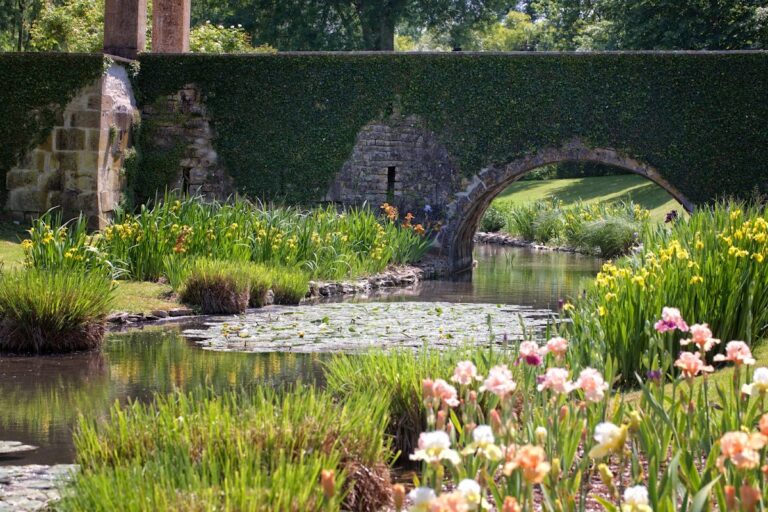
The semicircular lower bailey contains a dovecote, stables, and barns. Its buildings feature Renaissance-style stone dormers with carved decoration. An eighteenth-century stone bridge with one arch replaced the former drawbridge and provides access to the castle. The entrance to the inner courtyard passes beneath a square tower.
Courtyard buildings
Fifteenth-century building
The rear of the courtyard is occupied by a fifteenth-century building. A stair turret divides its facade, and its windows are decorated with colonnettes or prismatic mouldings. The courtyard enclosure also incorporates remains of the original feudal castle, preserving evidence of the earlier stronghold within the later building complex.
Later wings and interior features
The north and south wings were built after the fifteenth-century building. During the sixteenth and seventeenth centuries, large windows were opened in the outer walls. The first floor of the south wing contains a chapel and a room with a fireplace mantel bearing a carved Renaissance frieze. The frieze depicts a mythological combat between mounted horsemen.
Nearby sites