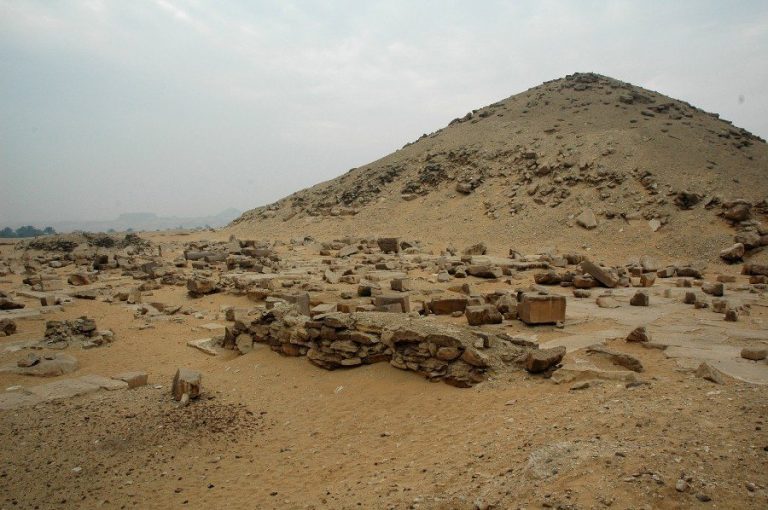
Bubasteion of Saqqara: Sanctuary and Catacomb Complex of Bastet
Site at a Glance
- Rating
- 4.8
- Popularity
- Very Low
- Country
- Egypt
- Primary era
- Classical
- Eras represented
- Bronze Age, Classical
- Civilizations
- Egyptian, Ptolemaic, Roman
- Site type
- Religious
- Remains
- Sanctuary
On this page8 sections
History
The Bubasteion of Saqqara is an ancient Egyptian sacred precinct, sanctuary, and catacomb complex dedicated to Bastet at the entrance to the Memphis necropolis in Saqqara, Egypt. Its principal complex is associated with the Ptolemaic and Roman periods, although a temple to Bastet already stood here during the New Kingdom, the period of Egyptian imperial power conventionally dated to about 1550 to 1070 BC. Bastet, a goddess associated especially with cats and household protection, was worshipped here as the Lady of Ankhtawy, a designation linked with the Memphis necropolis.
From New Kingdom temple to sacred precinct
The ancient Egyptian name of the sanctuary was Per-Bastet Nebet-Ankh-Tawy, meaning “House of Bastet, Lady of Ankhtawy.” The name Bubasteion came into use during the Ptolemaic period, when Egypt was ruled by the Macedonian Greek Ptolemaic dynasty after Alexander the Great’s conquest. The site may also have been known in antiquity as “the Cliff.” In Arabic it is called Abwab el-Qotat, or “the Gates of the Cats.”
During the second half of the Eighteenth Dynasty and throughout the Nineteenth Dynasty, high officials commissioned rock-cut tombs in the area. These tombs were later plundered in the Late Period before being remodelled and reused as catacombs, underground or rock-cut burial complexes, for cat mummies associated with the nearby sanctuary of Bastet.
The feline cemetery
The feline cemetery developed during the second half of the first millennium BC and became comparable in importance to the cat cemetery at Bubastis, also called Tell Basta. Radiographic examinations found that most of the cats had died young. About two-thirds had been killed by strangulation, while many others had suffered violent blows to the skull. This pattern has been interpreted as ritual slaughter carried out by authorized temple personnel, although the exact procedure remains uncertain.
Cat-mummy packages varied greatly. Some contained only a few bones, while others held no bones and consisted of clay and pebbles. Alongside the simple mummification process, this variation has led to the suggestion that priests sold pilgrims mummies of different qualities. The complex continued to preserve animal remains associated with Bastet and related feline worship. Maia’s tomb, belonging to Tutankhamun’s wet-nurse, was discovered in 1996. A lion skeleton excavated there in 2001 was regarded as a manifestation of Maahes, a lion deity considered in this context to be a son of Bastet. Five lion mummies were found in the necropolis in 2019.
Investigation and interpretation
Alain-Pierre Zivie began investigating the Bubasteion in 1976, and excavations started in 1980. The Mission Archéologique Française du Bubasteion was founded in 1986 and has continued to examine the site, particularly its rock-cut tombs. Objects from the tombs, especially finds from the tomb of Aperel, are held in the Imhotep Museum at Saqqara.
Remains
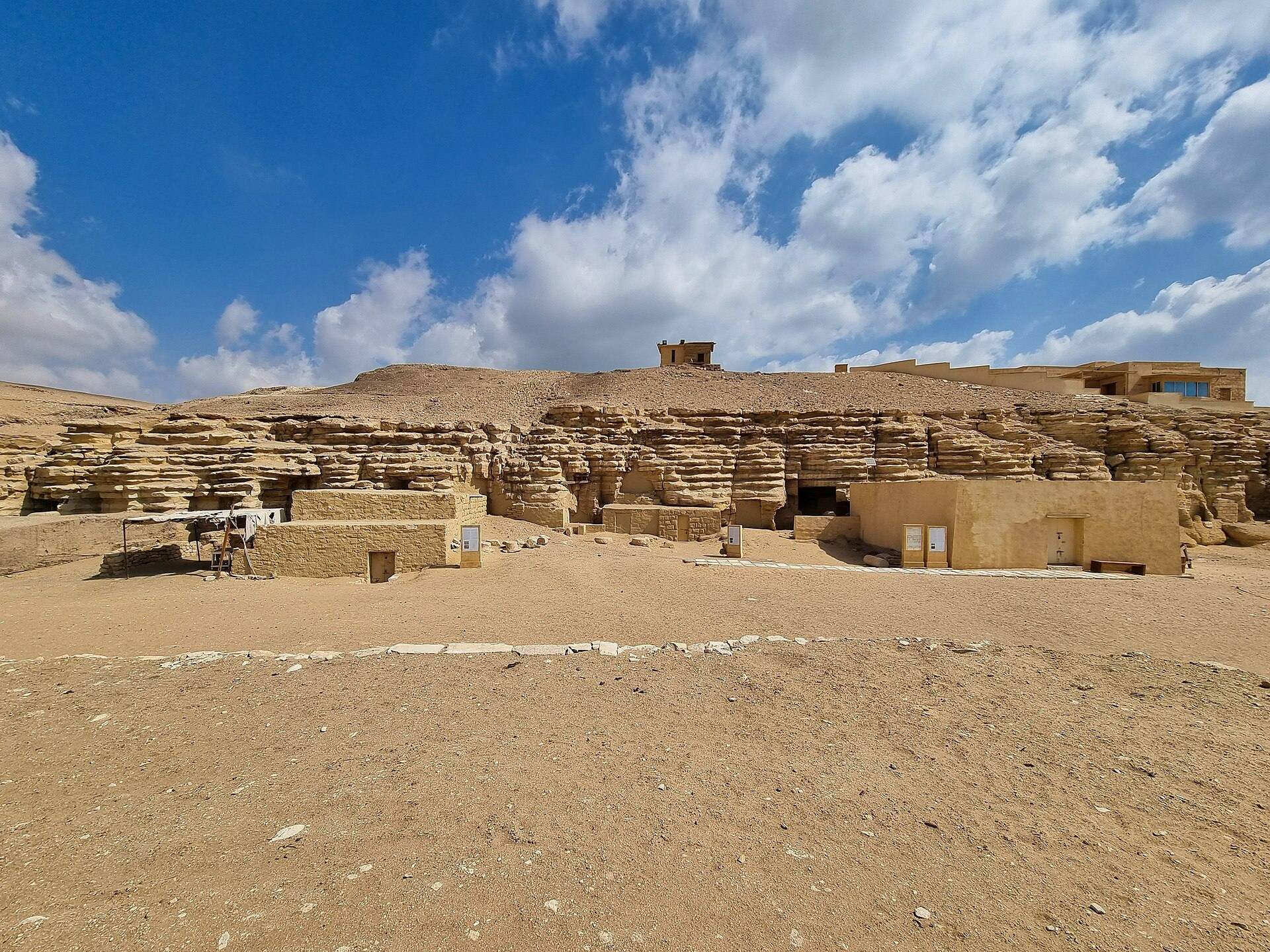
The Bubasteion occupies a cliff at the desert boundary of Saqqara, southeast of the Pyramid of Teti and south of the Anubieum. Its sacred precinct was enclosed by a wall approximately 275 metres wide and 325 metres long. The Bubasteion and Anubieum had separate enclosures, with a space between them. A water body south of the enclosure was probably larger in antiquity and may have played a sacred part in funerary festivals that involved crossing it.
Enclosure and temple area
A massive main gate stood in the southern wall. Another gate on the north side faced the southern gate of the Anubieum and provided communication between the two sacred precincts. Within the enclosure were the temple of Bastet, residences for personnel, the entrance to the catacombs, settlement remains, and the feline necropolis.
Rock-cut tombs
A steep hillside on the southern side contains two levels of tombs. Most were cut directly into the rock, while others were built from Tura limestone, a high-quality stone quarried near ancient Memphis and used for prestigious construction. Their decoration consists chiefly of reliefs and paintings, with quality ranging from good to exceptional and often changing considerably within a single tomb.
The French mission numbers the tombs by level and position. Tombs on the upper level carry the Roman numeral I, while those on the lower level carry II. Arabic numerals identify individual tombs from east to west. A possible third level remains buried beneath accumulated debris.
Catacombs and animal burials
The cat mummies were prepared in two principal ways. In one method, the legs and tail were bound and wrapped close to the body. In the other, the head, body, legs, and tail were wrapped separately in cloth. Some had artificial eyes and ears, and the bodies were generally dried without removing the internal organs.
Some cats were placed in wooden or stone sarcophagi and buried with kittens, sculptures, jewellery, or amulets. Other packages contained only a few bones, while some consisted of clay and pebbles without bones. The lion skeleton found in Maia’s tomb and the five lion mummies recovered in 2019 add further animal remains to the necropolis.