Brestenberg Castle: A Swiss Manor House and Hydrotherapy Clinic
Site at a Glance
- Popularity
- High
- Country
- Switzerland
- Primary era
- Early Modern
- Eras represented
- Early Modern, Modern
- Civilizations
- Holy Roman Empire, Swiss
- Site type
- Domestic
- Remains
- Manor House
On this page8 sections
History
Brestenberg Castle is a manor house south of Seengen in Switzerland, commissioned in 1625 by Hans Rudolf von Hallwyl and built with late Gothic and early Baroque features. It later became a hydrotherapy clinic known across Europe.
The Hallwyl estate and castle
A house stood on the property in the sixteenth century, when it formed part of the country estate of the Lords of Hallwyl, a Swiss noble family. In 1622, Dean Samuel Gruner of Seengen, a senior clerical office-holder, sold the estate to Hans Rudolf von Hallwyl. Three years later, von Hallwyl commissioned the castle.
Changing ownership and the clinic
The castle belonged to the von Breiten-Landenberg family from 1709 to 1761. In 1761 it passed to von Goumoens, a Bernese patrician, meaning a member of a privileged governing class, and colonel, who owned it until 1805. The von May family also owned the property at an undated point. A substantial farm building was erected in 1710.
Physician Adolf Erismann acquired the castle in 1844 and converted it into a hydrotherapy clinic, where water treatments were used for therapeutic purposes. Erismann was a member of the Aargau Grand Council, the canton’s legislature, and had served as a military physician during the Sonderbund War, a brief Swiss civil war in 1847 between federal forces and a Catholic-conservative alliance. Cäcilie Rosina Strauss worked at the clinic until retiring; she later founded the Friedberg residential school above the castle. Cosima Wagner reportedly stayed at the clinic in 1858.
Hotel use and later ownership
From 1872, Erismann’s son Max Alphonse managed the property. He sold the castle in 1921 but kept its estate farm. The clinic continued operating until after the Second World War, after which the castle became a hotel. The hotel closed in the early 1980s because of a lack of investment.
Art collector and real-estate entrepreneur Bruno Stefanini acquired the castle in 1984. He considered converting its underground halls into a museum, but abandoned the plan after failing to reach agreement with the authorities. The castle then remained unused. After Stefanini’s death in 2018, the property and underground halls passed to his Foundation for Art, Culture and History. The castle has been under cantonal protection since 1946 and is listed as a cultural heritage site of national significance.
Remains
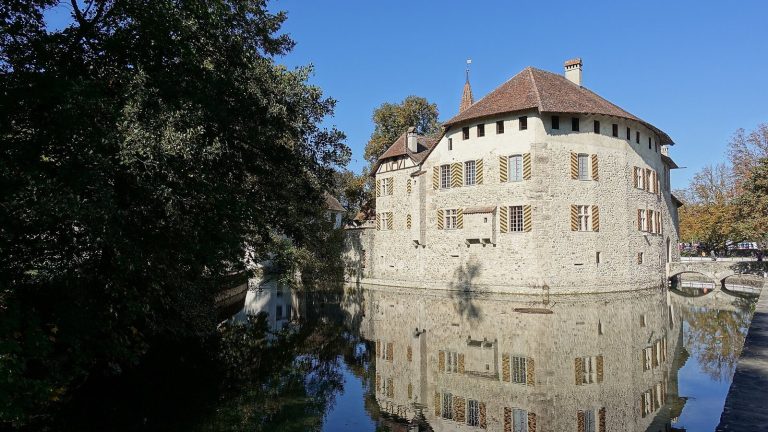
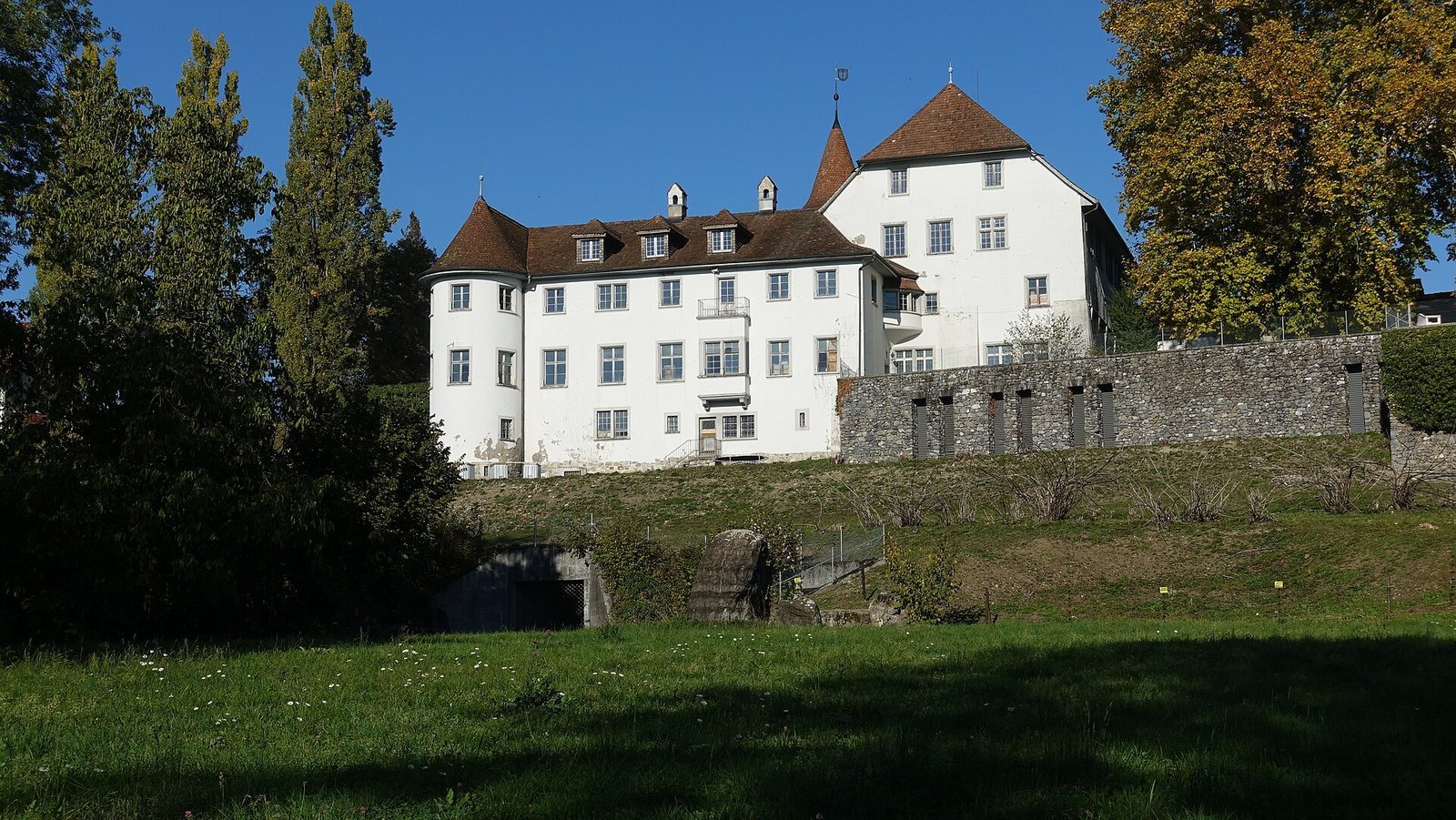
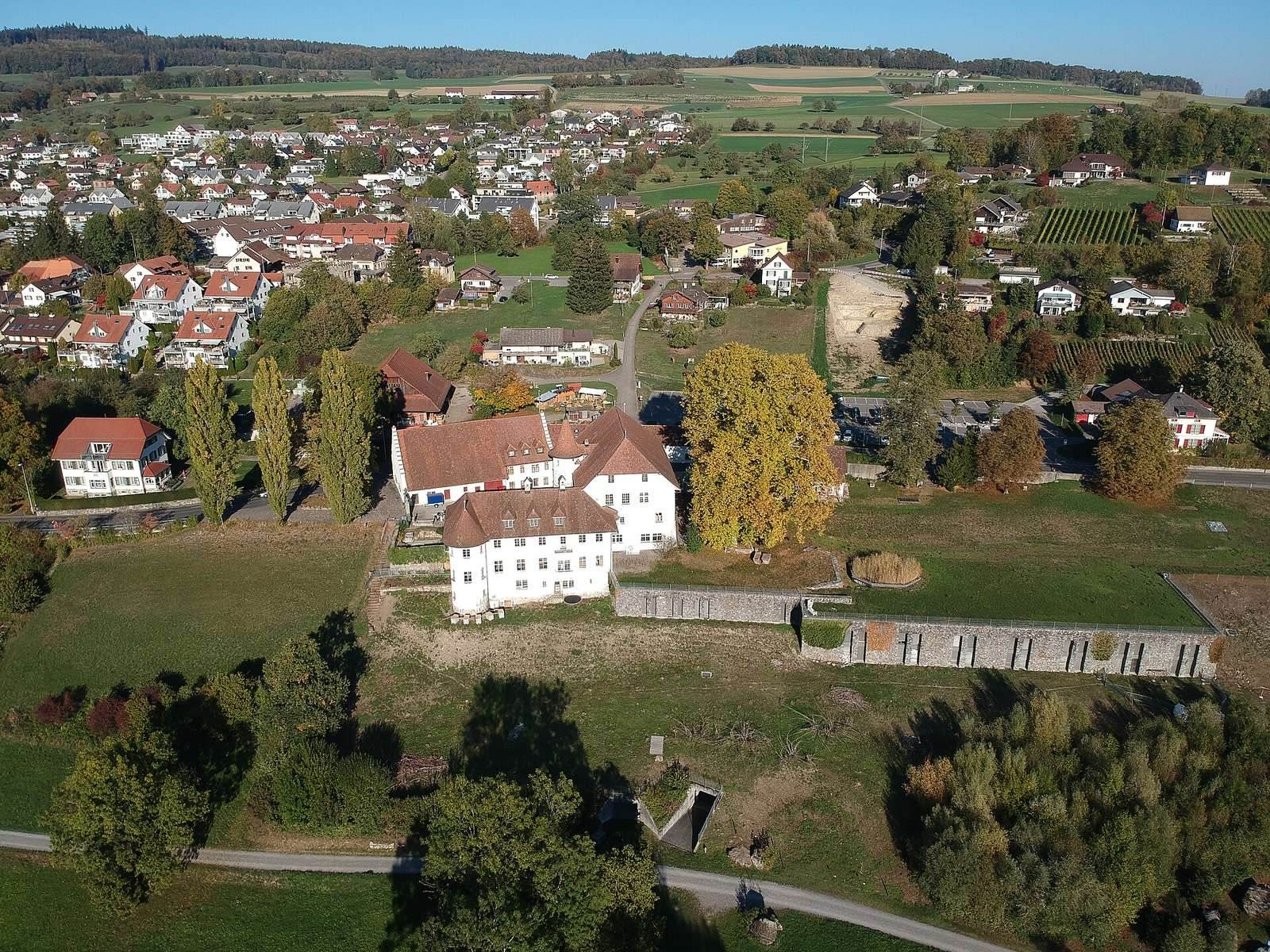
The property is arranged around a small, three-storey manor house, with a substantial farm building on the east side of its courtyard. The castle stands about 200 metres from the shore of Lake Hallwil.
The manor house
The house has a rectangular plan and a hipped roof, which slopes down on all sides. Its exterior combines continuous bands of stone at window level with carved, scroll-shaped ornaments. The timber roof was constructed without interior supports, and Hans Rudolf von Hallwyl’s coat of arms remains on the south façade. Inside, a round-arched doorway has Gothic framing, while an eighteenth-century ceiling is decorated with stucco, or ornamental plasterwork. A colored lithograph dated 1865 and attributed to J. August Aujourd’hui depicts the castle and Lake Hallwil.
Courtyard and spa features
The farm building occupies the east side of the courtyard. The spa complex included a garden hall with lounges and baths, while the hotel and spa had access to a private beach on Lake Hallwil.
Underground halls
Large storage halls lie beneath the castle. The building survives, although it fell into disrepair after the hotel closed.