Breitenbach Imperial Castle: A Medieval Royal and Episcopal Fortress in Germany


Site at a Glance
- Rating
- 3.8
- Popularity
- Very Low
- Country
- Germany
- Primary era
- Medieval
- Eras represented
- Medieval
- Civilizations
- Holy Roman Empire, Margraviate of Meissen
- Site type
- Military
- Remains
- Castle
On this page7 sections
History
Breitenbach Imperial Castle is the surviving rampart enclosure of a medieval imperial castle in Germany, at Breitenbach, now part of Wetterzeube in Saxony-Anhalt. It developed from a royal estate or court, with an older installation probably dating from the tenth or eleventh century. As a castle associated with royal authority, it belonged to the political world of the German king and emperor rather than beginning as the hereditary property of a local noble family.
Royal estate and the Breitenbuch family
A forged charter claims that King Conrad III owned the royal court at Breitenbach and its adjoining forest before allegedly selling them to the Bishop of Naumburg on 26 July 1138. From the middle of the twelfth century until the end of the thirteenth century, the Breitenbuch family developed a castle within the older enclosure. The castle became the family’s ancestral seat during this period.
Episcopal and margravial control
Breitenbach belonged to the Naumburg bishopric, a religious institution that also governed territory under the Bishop of Naumburg, and it changed hands several times between the bishop and the Margraves of Meissen. These margraves were high-ranking territorial rulers in medieval central Germany. In 1306, Margrave Dietrich transferred the castle to Count Simon of Stolberg. Around 1310, Albert Knut probably held it briefly as a fief, meaning land granted in return for service.
The castle was probably destroyed by two fires during the military conflicts of 1315. In 1317, Count Heinrich of Stolberg sold it to the Bishop of Naumburg. A younger residential tower, the Kempe, was then built directly beside the earlier rampart enclosure in the middle of the fourteenth century, using material taken from the ruins of the older castle.
Later transformation of the site
The slope below the rampart enclosure was later used by the National Socialists for a Thingplatz, an open-air site intended for ideological performances, assemblies, and ceremonies. This installation formed part of the twentieth-century political use of the castle’s surroundings.
Remains
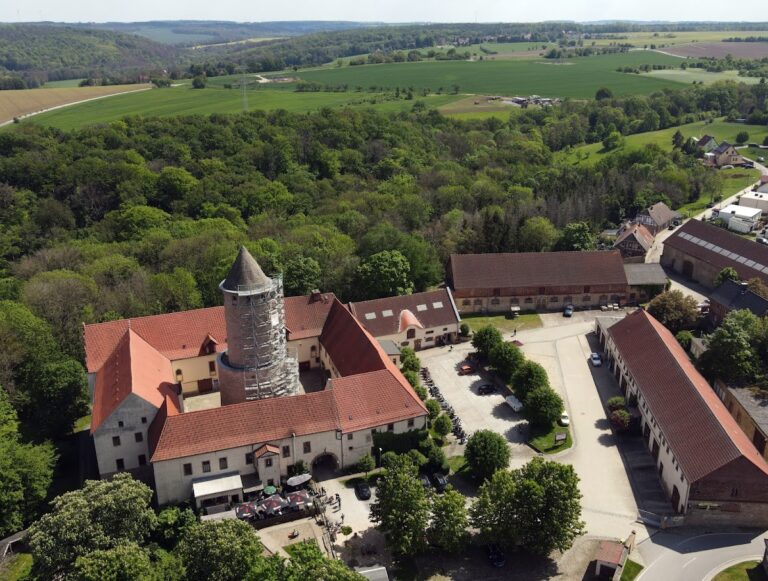
Breitenbach Imperial Castle is a lowland castle within the village of Breitenbach, at approximately 262 metres above sea level. Its principal surviving feature is an earthwork rampart enclosure, which marks the older castle area. Beside it stand the remains of the Gothic residential tower known as the Kempe, creating a physical relationship between the earlier fortified site and the later medieval building constructed from its ruins.
Rampart enclosure
The surviving enclosure consists chiefly of an earthwork rampart, the remaining principal structure of the imperial castle. Its form preserves the defensive boundary of the older installation, which probably originated in the tenth or eleventh century before the Breitenbuch family expanded the castle from the mid-twelfth century onward. The enclosure is therefore the main physical remnant of the castle’s earlier phases.
Kempe residential tower
The Kempe is a partially surviving Gothic residential tower built in the middle of the fourteenth century directly beside the rampart enclosure. It was constructed from material recovered from the earlier castle’s ruins. The name probably derives from Kemenate, a term for a residential or heated chamber building. Nineteenth-century publications also called the tower “Kämpfe,” possibly because of an older designation on a map. Only part of the tower remains, and the ruin is fenced because of the danger of collapse.
Nearby sites