Haynsburg Castle: A Fortified Castle and Agricultural Estate in Germany


Site at a Glance
- Rating
- 4.5
- Popularity
- Low
- Country
- Germany
- Primary era
- Medieval
- Eras represented
- Medieval, Early Modern, Modern
- Civilizations
- Holy Roman Empire
- Site type
- Military
- Remains
- Castle
On this page12 sections
History
Haynsburg Castle is a castle in Haynsburg, a district of Wetterzeube, Germany. Its free-standing keep, the oldest part of the complex, dates to the end of the eleventh century, while the castle first appears in written records in 1185. By 1238, a charter of Margrave Heinrich described Haynsburg as a fortified place.
Medieval Lords and Episcopal Rule
The first recorded lord was Conradus de Hagensberg, who appears in records until 1223. In 1295, the castle and its associated lands were sold to Frederick of Meissen, a margrave of the Wettin dynasty, the ruling house that dominated much of central Germany. Frederick relinquished ownership in 1305, after which the property passed to the Bishopric of Naumburg-Zeitz, a territory administered by the bishop.
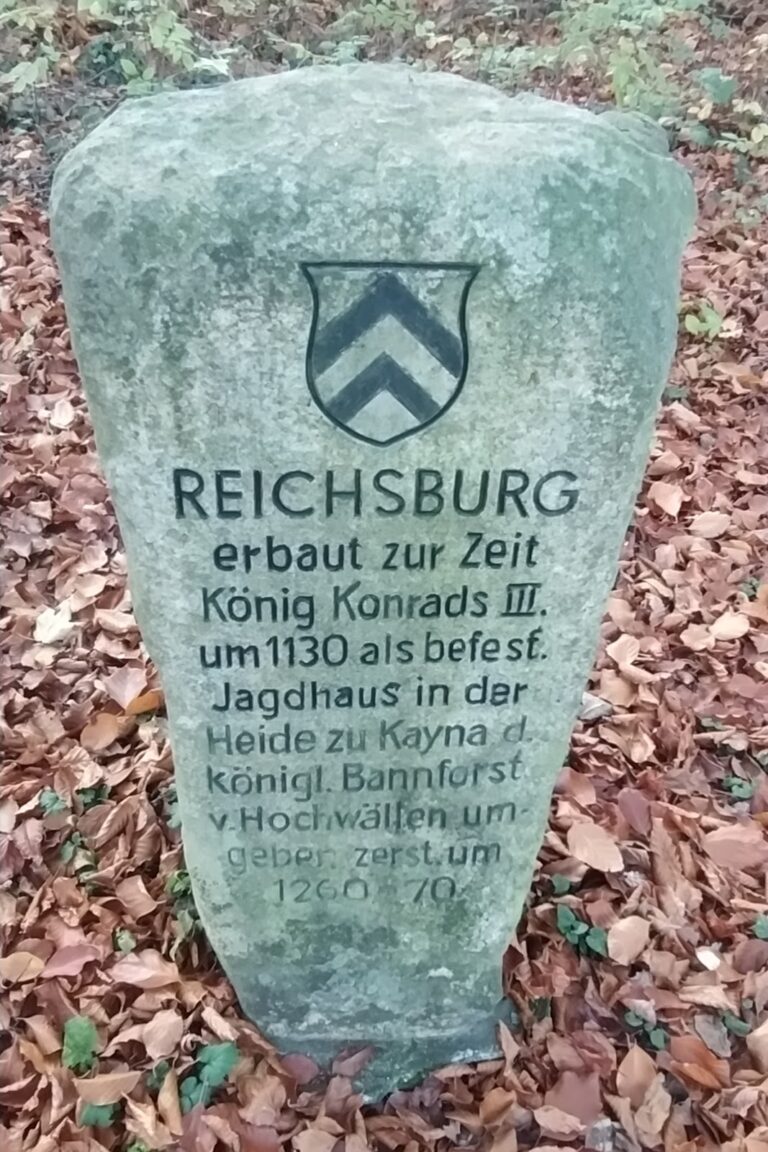
Haynsburg was regarded as the strongest fortification in the Bishopric of Zeitz-Naumburg. Its position protected the moated castle at Kayna, an imperial hunting residence, and allowed it to safeguard and control three ridge roads passing through Haynsburg. It also controlled the fords across the Elster.
Expansion and Early Agricultural Use
The castle could not be stormed during the Saxon Fratricidal War in 1450, a conflict between rival branches of the Saxon ruling house. Bishop Peter of Schleinitz subsequently ordered substantial expansion. Agriculture was already part of the castle’s use in the fifteenth century. In 1515, Bishop Johann III von Schönberg restored and further remodeled the complex, which remained in good condition.
State Domain and Modern Reuse
After the Bishopric of Naumburg-Zeitz was dissolved in 1549, Haynsburg became a state domain of Electoral Saxony, the territory ruled by the electors of Saxony. Following the decisions of the Congress of Vienna in 1815, it became a Prussian state domain and retained that status until 1945.
After the Second World War, the castle continued to serve agricultural purposes. It first became a provincial agricultural estate of Saxony-Anhalt and later, until the political transition of 1990, a state-owned agricultural enterprise. A kindergarten and nursery operated in the complex from 1972.
After 1990, Haynsburg was developed as a community center with exhibitions and an accessible keep. The keep was restored in 1990, and ownership passed gradually to the municipality of Wetterzeube between 1990 and 1999. This transfer was accompanied by extensive repairs and alterations, including work on the roofs. The core castle now contains the municipal office, the Zur Haynsburg castle tavern with guesthouse and apartments, a local-history room, and the Burgmäuse day-care center. Its wedding room is also used for concerts, while the barn, granary, and courtyards of the service yard accommodate events.
A museum of two-wheeled vehicles and technology occupies the ground and upper floors of an agricultural and service building attached to the northeast side of the castle. Its collection includes many motorcycles and mopeds, particularly vehicles from the former German Democratic Republic, the East German state that existed from 1949 to 1990.
Remains
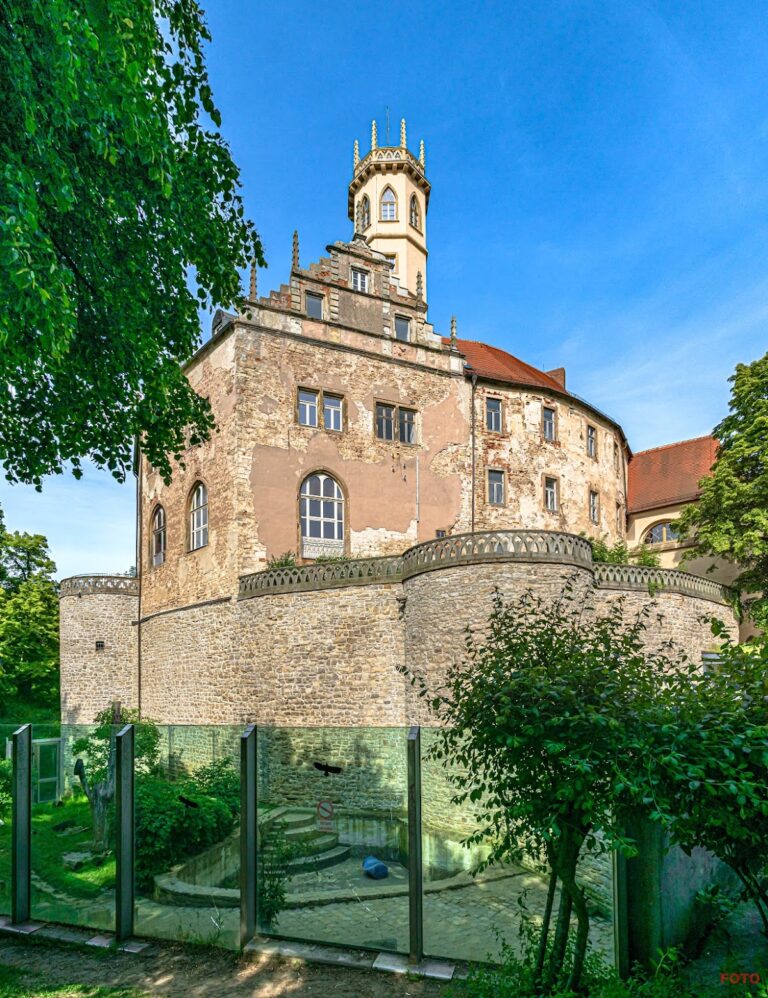
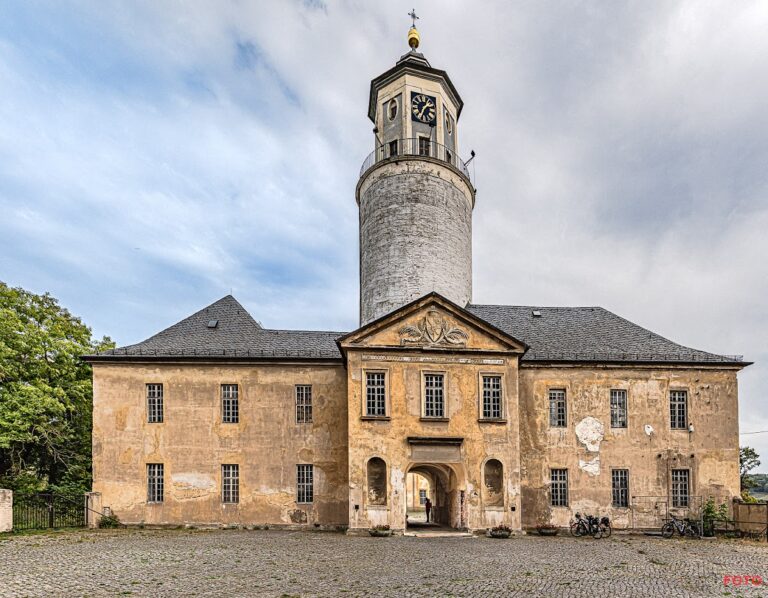
Haynsburg forms a quadrilateral enclosed by moats and buildings around a central castle courtyard. Functionally, the complex is arranged as four wings. The castle’s defensive character is concentrated in the free-standing keep near the courtyard’s northwest corner, the low defensive work at the southeast corner of the northeast wing, and the surrounding water defenses. A large service yard extends toward the town on the southeast side.
Defensive Structures
Sidonius Tower
The round keep, known as the Sidonius Tower, is approximately 24.43 meters high and 12.81 meters in diameter. Its sandstone ashlar walls are 4.18 meters thick, leaving an interior space only 4.45 meters across. The lower section rises 12 meters, and a cavity beneath it indicates a former dungeon, a secure prison or confinement space, closed by a beam ceiling. The upper section reaches the full height of 24.43 meters.
The tower originally had only a high entrance, an elevated doorway intended to make entry more difficult, probably reached by rope ladders or through an adjoining building. A ground-level entrance was added around 1880, and a continuous wooden staircase now runs through the tower. The upper floor contains a castle chapel. The name Sidonius Tower refers to Johann Sidonius, a custodian and canon of the collegiate church in Zeitz, a church served by a chapter of clergy known as canons. He was confined in the tower from 1685 to 1692 and died there on March 3, 1692, aged 64.
Stürze Defensive Work
A low flanking tower stands in front of the southeast corner of the northeast wing. It is essentially a rondel, a rounded defensive work designed to protect adjoining walls or buildings, and was historically called the Stürze.
Wings, Gables, and Service Buildings
Renaissance Gable
The western side of the northeast wing has a Renaissance decorative gable in its roof area. Facing the Elster valley, it is a stepped gable formed from quarter-circle arches and topped by a semicircular arch. Its blind arcades, decorative arches that do not open into a passage or interior, belong to a type of gable that has become rare.
Service Yard and Later Extension
The large service yard lies on the southeast, town-facing side of the castle. It includes separate elongated economic buildings, together with a barn and granary. After 1900, an additional economic wing was attached to the northeast castle wing and extended southeast. A free-standing, lantern-like structure in the service yard serves as a bat roost.
Mödelstein Outwork
A former outwork, a subsidiary fortification or estate building outside the main enclosure, stood at Mödelstein in the Elster floodplain northeast of Haynsburg, on the road from Raba to Sautzschen. It formerly belonged to Haynsburg Castle or to the Haynsburg administrative district and is now part of the municipality of Wetterzeube.
Nearby sites