Zeitz Cathedral St. Peter and Paul: A Romanesque and Gothic Church in Germany


Site at a Glance
- Rating
- 4.7
- Popularity
- Very Low
- Country
- Germany
- Primary era
- Medieval
- External website
- Open
- Eras represented
- Medieval, Early Modern
- Civilizations
- Holy Roman Empire
- Site type
- Religious
- Remains
- Cathedral
On this page16 sections
History
Zeitz Cathedral St. Peter and Paul is a Catholic parish church in Zeitz, Germany, whose origins lie in the Ottonian period of the tenth century. The church developed within a royal palace established during the first half of that century, and construction of the first cathedral began when Otto I and Empress Adelheid founded the Diocese of Zeitz in 968. The Ottonians, also called the Liudolfingians, ruled the East Frankish and early German kingdom during the tenth and early eleventh centuries. The cathedral served the bishops of Zeitz until 1029 and later became a collegiate church, a church served by a chapter of clergy rather than by a bishop. Its surviving core belongs to an important Romanesque building begun after 1028 and completed around 1100.
From bishop’s church to collegiate church
Only vague and inconclusive evidence has been found for the first cathedral beneath the present complex. After the episcopal seat moved to nearby Naumburg in 1029, the church continued as a collegiate foundation. A collegiate church retained a body of organized clergy, but no longer functioned as the cathedral of a resident bishop. The building was altered repeatedly over the following centuries. A polygonally ended chancel was added at the close of the thirteenth century, and during the fourteenth and fifteenth centuries the Romanesque basilica was remodelled as a Gothic hall church. In a basilica, a raised central nave dominates lower side aisles, while a hall church brings the aisles to approximately the same height and creates a more unified interior.
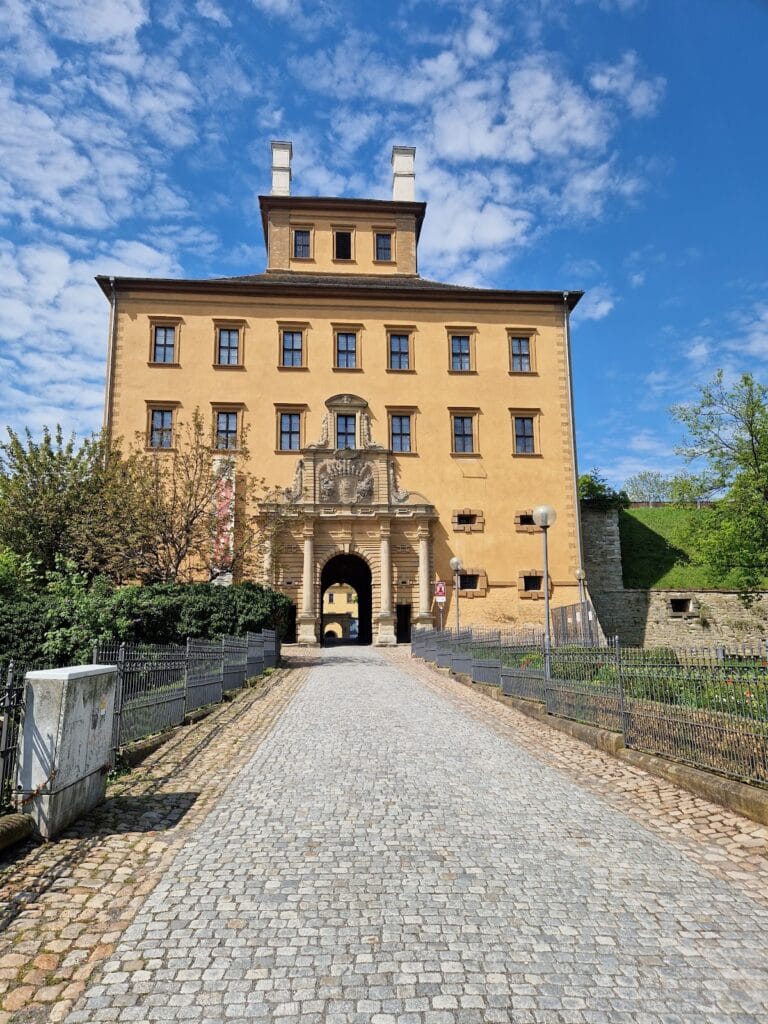
The Reformation subsequently made the church Lutheran. Zeitz again served temporarily as a bishops’ residence during the sixteenth century, but its institutional role changed decisively after 1656, when the town became the residence of the dukes of Saxe-Zeitz. Saxe-Zeitz was a secondary duchy created for a younger branch of the Wettin dynasty, a German ruling family. Duke Moritz of Saxe-Zeitz ordered the church converted into the castle chapel of Moritzburg Castle. Both medieval towers were demolished, and an elevated princely gallery was installed for the ruling family.
The ducal court and later decline
Beginning in 1666, the crypt became the hereditary burial place of the Wettin secondary line of Saxe-Zeitz. The church served as the family’s court church, and the princely burial space became an important monument of Baroque funerary culture in central Germany. The Baroque remodelling also brought a new altar retable in 1671, a pulpit in 1674, and the princely gallery into the church’s interior.
During the nineteenth century, the building lost its former importance and was temporarily used for secular purposes, including as a military hospital and a horse stable. On 1 January 1946, the city administration leased it to the greatly expanded Catholic congregation. The congregation’s parish church, built on Brückenweg in 1894, had become too small. The cathedral therefore returned to regular Catholic parish use and is dedicated to the Apostles Peter and Paul. It belongs to the Diocese of Magdeburg and forms part of the Romanesque Road, a cultural route through Saxony-Anhalt linking Romanesque churches and other monuments.
Damage and renewal
The church deteriorated severely during the period of the German Democratic Republic. On the night of 10–11 June 1982, the southwestern crossing pier collapsed and seriously damaged the Gothic vaulting. A crossing is the part of a church where the nave and transept intersect. Comprehensive renovation advanced only after German reunification. The Catholic congregation resumed use after the altar was consecrated on 13 December 1998 by Bishop Leo Nowak, and renovation was completed for the 2004 State Garden Show.
Remains
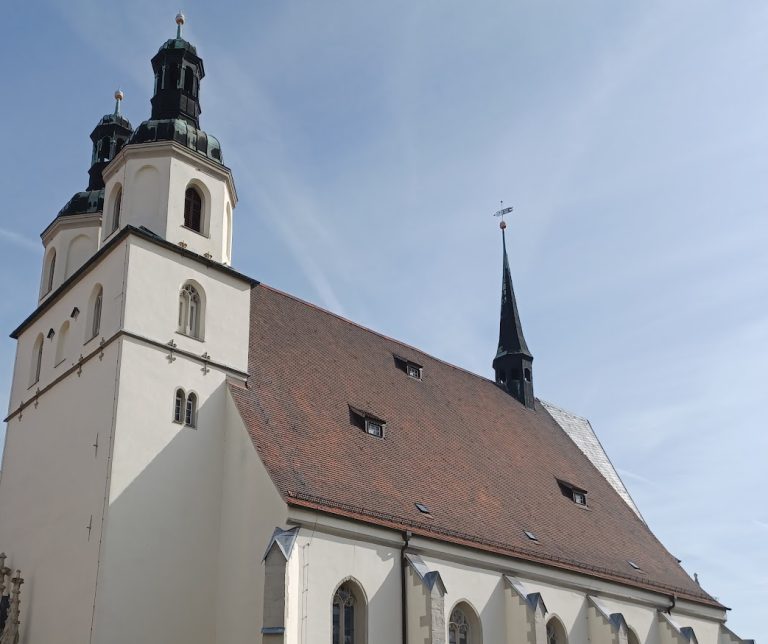
Zeitz Cathedral retains a three-aisled plan that began as a Romanesque basilica and later became a Gothic hall church. The building is now towerless because both medieval towers were removed during its seventeenth-century conversion into a castle chapel. The surviving fabric combines the Romanesque core, later Gothic alterations, parts of the former collegiate complex, and Baroque furnishings associated with the Saxe-Zeitz court.
Crypt and collegiate buildings
Romanesque crypt
A three-aisled hall crypt lies beneath the choir square and extends westward into the crossing square. A crypt is a lower church or burial space beneath the main church. Recent building research places this crypt in the same period as the mid-eleventh-century church. Earlier masonry openings show that it originally had four round-arched windows and two entrances, although the windows visible today were inserted later. Eight columns support the vault. The capitals of the two western columns carry volutes, while the six eastern columns are undecorated. The eastern supports may have come from the Ottonian predecessor, but the different profiles do not securely demonstrate separate building phases, apart from Gothic changes to the western row.
Former collegiate complex
Part of the former collegiate complex survives on the southern side of the church. It includes Romanesque building remains and sections of a cloister dating from around 1400. These elements preserve the relationship between the church and the community of clergy that served it after the episcopal seat moved to Naumburg.
Gothic interior and memorials
Wall paintings and apostle sculptures
Numerous Late Gothic wall paintings remain inside the church. One representation of Christ dates from around 1440 and was partly painted over during later alterations, including work connected with the princely gallery. Life-size sculptures of the Apostles from the first half of the fifteenth century stand beside the piers of the central nave.
Tombs and epitaphs
Most of the surviving tomb monuments and bronze tomb slabs date from the fifteenth and sixteenth centuries. They include a fragment of the tombstone of Hugo, identified as the first bishop of Zeitz, along with bronze slabs for Bishop Johann II of Schleinitz and Georg von Haugwitz. Inscription frames belong to Provost Reinhold von Weißenbach and Chancellor Heinrich von Schmidburg. An epitaph commemorates Julius von Pflug, the last Bishop of Naumburg. Georgius Agricola, the sixteenth-century German scholar regarded as a founder of modern mineralogy, is buried in the church.
Princely crypt
The princely crypt contains thirteen coffins belonging to members of the ducal family, including eight children’s coffins. The burials include Johann Georg, Maria Sophia, Magdalena Sybilla, Dorothea Maria of Saxe-Weimar, Duke Moritz of Saxe-Zeitz, Sophie Elisabeth of Schleswig-Holstein-Sonderburg-Wiesenburg, Friedrich Wilhelm, Caroline Amalia, Sophie Charlotta, Sophie Angelika of Württemberg-Oels, Dorothea Charlotte, Friedrich August, and Duke Friedrich Heinrich of Saxe-Zeitz-Pegau-Neustadt. The coffins are made of wood or lead-tin alloys. Coats of arms, inscriptions, and bandelwerk ornament survive on them. Bandelwerk is a Baroque decoration made from interlacing strap-like forms.
Baroque furnishings and organs
Altar, pulpit, and gallery
The large wooden altar retable dates from 1671 and was made by Johann Caspar Sandmann. A retable is an ornamental structure placed behind an altar. Its central painting shows the Crucifixion by Christian Schäfer, while a carved monogram for Jesus appears above it within a cloud frame. The initials of Duke Moritz and his second wife are placed at the sides as the donors’ initials. The Baroque pulpit and its stairway date from 1674. Acanthus carving covers the pulpit, and angel wings decorate its massive sounding board, which is crowned by an angel. The sounding board is the canopy above a pulpit, designed to project the speaker’s voice. The high altar, pulpit, and princely gallery belong to the same Baroque remodelling.
Organ galleries
The cathedral’s organ history reaches back to the fifteenth century. An organ apparently existed by the time of the cathedral fire of 1429. An instrument probably made in the mid-fifteenth century was remodelled and enlarged in 1583–1584 by Georg Koch of Glauchau. During Heinrich Schütz’s period as chapel master in Zeitz, two small galleries were built on the crossing piers. Each received an organ case, although one case initially remained empty. Schütz was a major seventeenth-century German composer and chapel master.
Böhme and Winter of Zeitz built a new organ in 1849–1850, reusing some pipe material from the earlier instrument. In 1934, the Liebig harmonium factory of Zeitz installed a two-manual reed organ in the previously empty case. Lothar Heinze of Stadtilm installed a new three-manual instrument in the two cases in 1961, but roof water soon damaged it, and the collapse of the southwestern pier in 1982 largely destroyed it. Hermann Eule Orgelbau of Bautzen replaced it with a two-manual instrument in 1999–2001, designed with reference to the early Baroque work. The opposite gallery holds a Rodgers electronic organ with sixteen-channel sound projection. It was acquired for use during restoration of the pipe organ and remains in service, with forty-three stops, three manuals, and pedals.
Historical bells
Three church bells are available, two of them historical. The bells cast in 1439 and 1466 bear rare incised drawings. The 1439 bell shows the Apostles Peter and Paul, a bishop in bust form, and a large Crucifixion group. The 1466 bell depicts a bishop with a sword, a small crucifix, the Zeitz episcopal arms, and a seated monkey holding a jug.
Nearby sites