Borl Castle: A Medieval Hilltop Fortress in Slovenia


Site at a Glance
- Rating
- 4.1
- Popularity
- Low
- Country
- Slovenia
- Primary era
- Medieval
- External website
- Open
- Eras represented
- Medieval, Early Modern
- Civilizations
- Duchy of Styria, Habsburg, Holy Roman Empire
- Site type
- Military
- Remains
- Castle
On this page8 sections
History
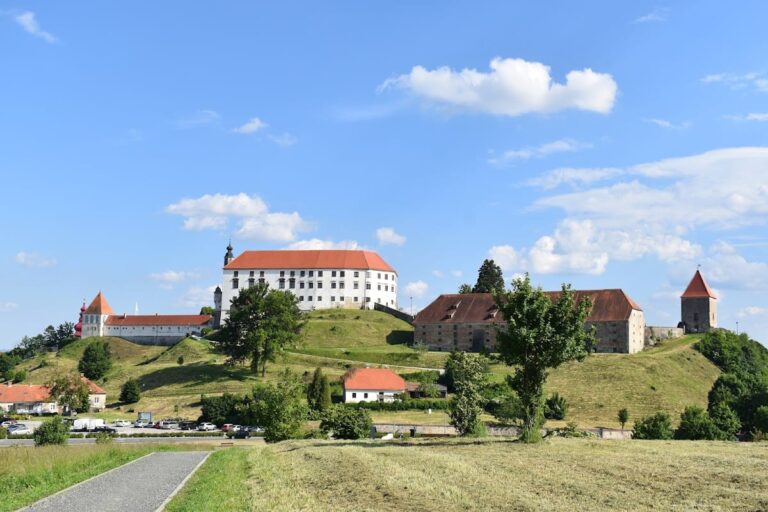
Borl Castle, also known as Ankenstein, is a medieval hilltop fortress in Slovenia, probably established around 1200 beside an important crossing of the Drava on the former Styrian-Hungarian border. Rising above the Drava valley, it became a major feudal stronghold in the Haloze region and later served as the seat of the regional land court.
Medieval fortress and changing allegiance
The castle is first documented in 1255, when Béla IV, the thirteenth-century king of Hungary, granted Friedrich of Pettau a feudal charter for Ankenstein and two other castles. Such a charter assigned land or a fortified property within the medieval system of lordship and service. In 1337, during the exchange known as the Peace of Pressburg, Ankenstein passed from Austria to Hungary in return for Schwarzenbach, which went from Hungary to Austria.
Borl Castle changed hands repeatedly. Its owners included the Lords of Pettau, the Herberstein family, the Thurn family, the Sauer family, and Matthias Corvinus, the fifteenth-century king of Hungary known for military expansion in Central Europe. Corvinus severely damaged the fortress during its conquest.
The Sauer family and the land court
Johann Hans Karl, Baron von Sauer, bought the castle in 1639 and was raised to the rank of count in 1668. The Sauer family kept Borl until 1801, when it was sold to Prince Stanislav Poniatowski of the Polish Poniatowski family. From the thirteenth century until 1850, a land court operated at the castle. This judicial institution administered territorial law and heard cases within the surrounding lordship or district.
Wartime prison and later history
During the Second World War, Borl lost much of its interior furnishings. Between 1941 and 1943, its stables and later the main building were used by the Gestapo, Nazi Germany’s secret state police, as a prison for confining, interrogating, and torturing suspects. A German camp was also housed at the castle.
After the war, the complex became a holiday resort. That use ended after the old wooden bridge over the Drava collapsed. A memorial room opened at Borl and a commemorative plaque was unveiled in 1956. The Republic of Slovenia now owns the castle, which is protected as a cultural monument of national significance. The castle and the municipality of Cirkulane bear the Herberstein family coat of arms.
Names and legends
The name Ankenstein has been explained in two ways. One interpretation connects it with an obsolete German word for butter, once used in the names of mountains and hills. Another proposes a link with an anchor and the river crossing. The Hungarian name Bornyl has been interpreted as meaning “river crossing.”
Local tradition tells of a tunnel beneath the Drava connecting Borl Castle with Muretinci Castle, although no such tunnel has been found. Other legends associate Borl with Parzival, the legendary knight of Arthurian literature, and with the search for the Holy Grail. An older tradition recorded in 1938 placed Ankenstein on the summit of Schwarzenbach Castle Hill, but its relationship to Borl Castle remains uncertain.
Remains
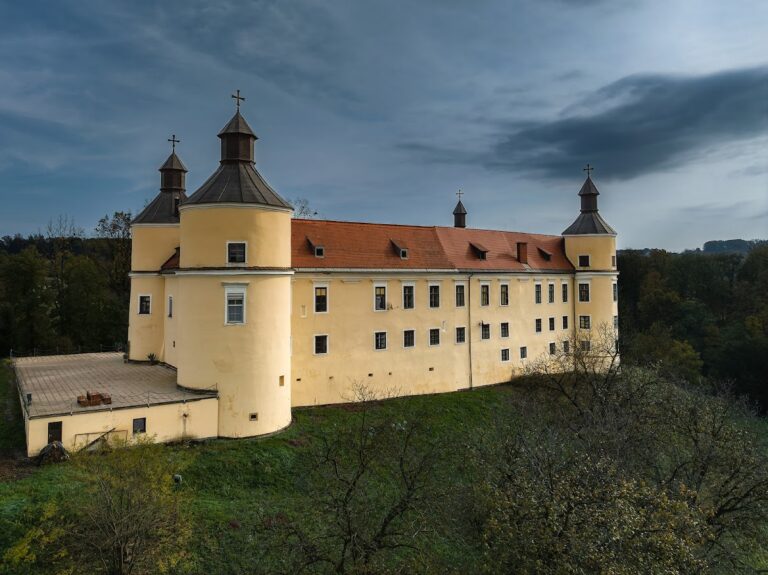
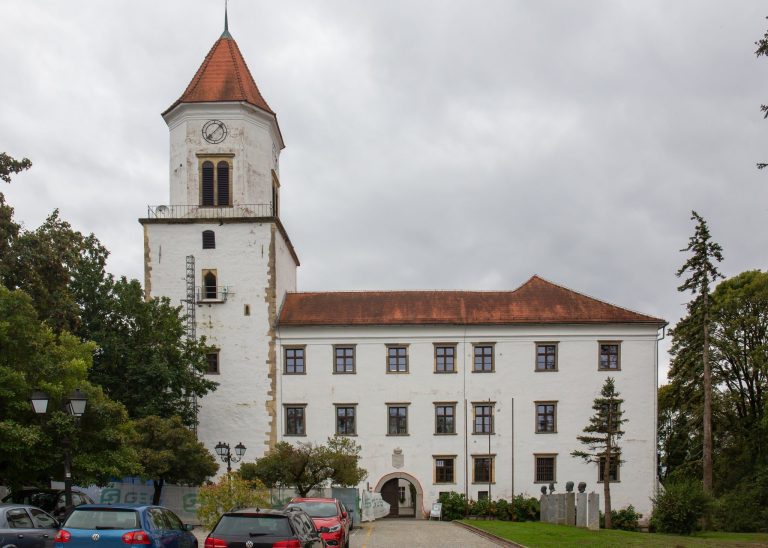
Borl Castle occupies a rocky height approximately 60 metres above the Drava valley, north of Cirkulane, northeast of Dolane, and east of Ptuj. The complex is a hill castle whose defensive core is formed by a tower and a stone wall approximately 12 metres thick. It is described as the largest and most prominent feudal building in the Haloze region, and as having the thickest castle wall in this part of Europe.
Fortified core and courtyard
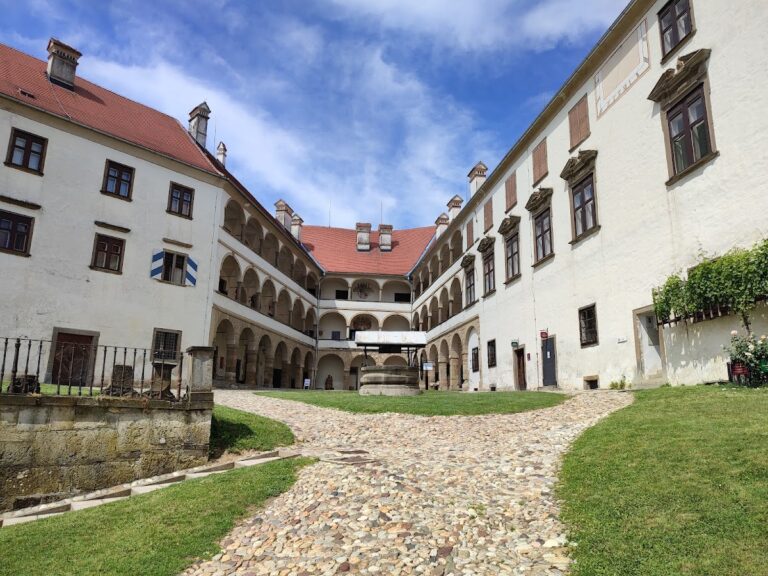
The castle’s base is formed by the tower and its massive stone defenses. Within the complex, an inner arcade courtyard contains a Baroque cistern, a water-storage reservoir made during the Baroque period and carved directly into the natural rock. The cistern remains an integral feature of the courtyard’s construction.
Seventeenth-century interiors
The Chapel of the Holy Trinity and the Knights’ Hall were added in the seventeenth century. The chapel has since been renovated. The renovated castle retains some wall paintings, sculpture, and interior furnishings, preserving elements of its later interior decoration alongside the medieval defensive fabric.