Burg: A Ruined Hilltop Castle near Gössenheim


Site at a Glance
- Rating
- 4.8
- Popularity
- Low
- Country
- Germany
- Primary era
- Medieval
- Eras represented
- Medieval
- Civilizations
- Holy Roman Empire
- Site type
- Military
- Remains
- Castle
On this page10 sections
History
The Lords of Homburg
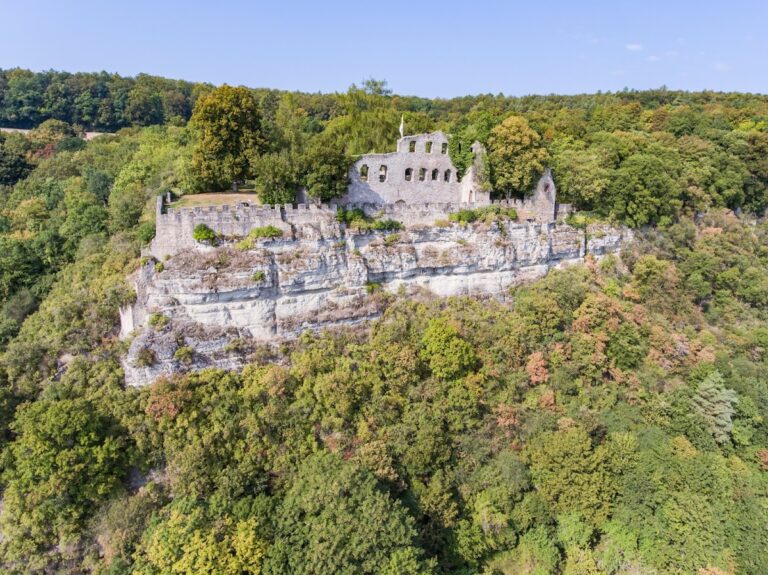
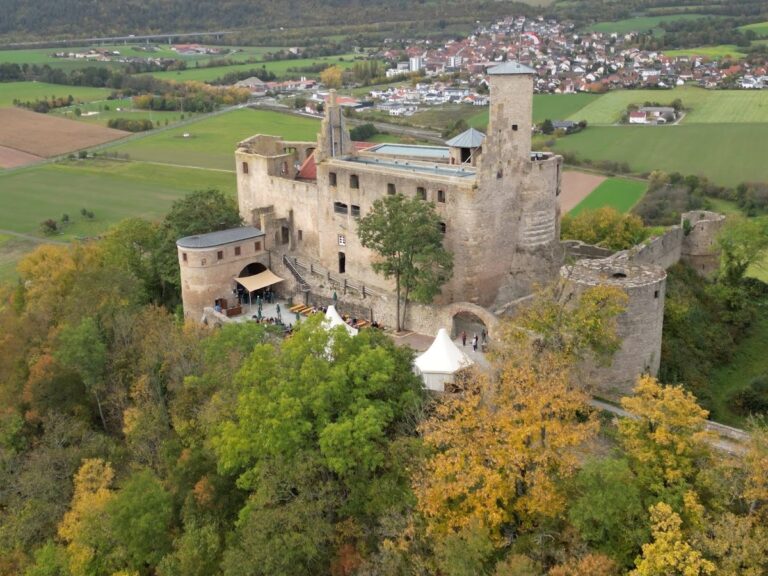
Burg, also known as Homburg, is a ruined hilltop castle in Germany near Gössenheim. The castle was built by the Lords of Homburg, or Lords of Hohenburg, medieval service nobles who held offices and property while serving the Bishopric of Würzburg. A later tradition attributes its foundation to Reinhard of Hohenberg between 1028 and 1031, but this story cannot be verified and was probably invented at a later date. The first historically documented lord of the family was Dietrich of Hohenberg in 1170.
Homburg stood in a border region shaped by several neighboring powers, including the Bishopric of Würzburg, the Counts of Rieneck, the Counts of Henneberg, and Fulda Abbey. The Bishopric of Würzburg was both an ecclesiastical authority and a territorial principality ruled by the Bishop of Würzburg. A member of the Homburg family, Dietrich of Homburg, held that office from 1223 to 1225.
Inheritance and Würzburg Administration
In 1381, Dietrich of Hohenberg died as the last male member of his line, bringing the Reinhard branch to an end. His daughter Christine and her husband, Konrad IV of Bickenbach, inherited the Hohenberg possessions, including Homburg. The property therefore passed to the House of Bickenbach, whose seat was at Clingenburg.
In 1469, the House of Bickenbach sold all of the former Hohenberg possessions to the Bishopric of Würzburg. The acquisition was represented by Prince-Bishop Rudolf II of Scherenberg, who combined episcopal authority with secular rule over the territory. Homburg became the administrative seat of the Homburg an der Wern administrative office in 1492, when an official administrator was appointed.
Fire and Decline
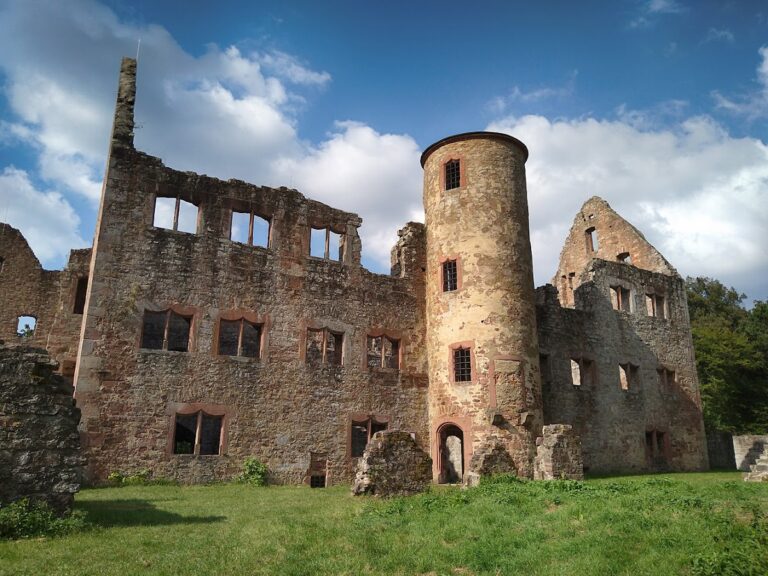
The castle survived the Peasants’ War of 1525, a widespread uprising in the German lands, without damage. A fire in the manor house in 1680 marked a change in the site’s history. Afterward, the buildings gradually fell into decay, leaving the castle as a ruin regarded as among the largest castle ruins in Franconia.
Remains
Hilltop Defenses
Burg occupies a spur position near Gössenheim in the Main-Spessart district of Lower Franconia, at approximately 300 metres above sea level. The surviving castle is arranged around an outer bailey and a zwinger, an outer defensive enclosure or passage between fortification lines intended to hinder attackers. These elements belong to the Early Gothic period, a transitional medieval phase before fully developed Gothic architecture, and date to around 1235.
Later Defensive Expansion
Outer Bailey and Zwinger
The zwinger area was expanded from 1470 onward, adding to the defensive organization of the outer part of the castle. The site now survives in ruined form, while the 1680 fire specifically affected the manor house before the buildings entered their prolonged period of decline.
Heraldic Remains
Coat-of-Arms Stone
A coat-of-arms stone associated with the Lords of Grumbach survives among the ruins. It provides a heraldic element within the remaining castle fabric and connects the site with the aristocratic families represented at the stronghold.