Ptuj Castle: A Medieval Fortress and Museum in Slovenia


Site at a Glance
- Rating
- 4.7
- Popularity
- Medium
- Country
- Slovenia
- Primary era
- Medieval
- External website
- Open
- Eras represented
- Medieval, Early Modern
- Civilizations
- Carolingian, Holy Roman Empire
- Site type
- Domestic
- Remains
- Castle
On this page11 sections
History
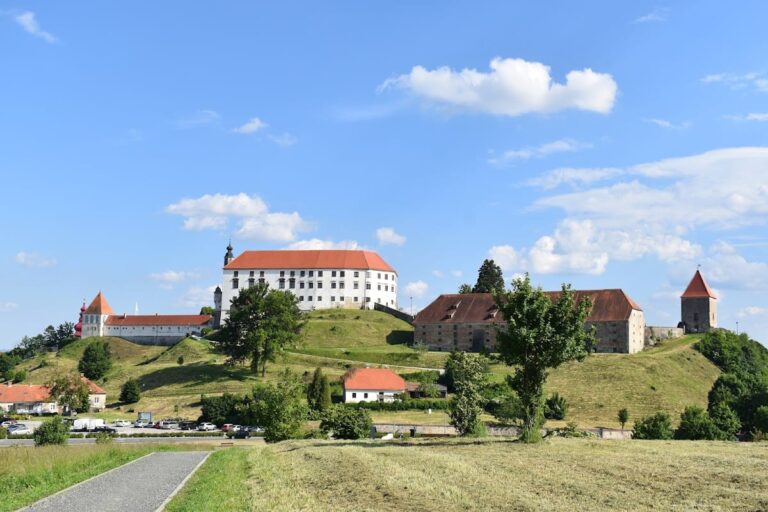
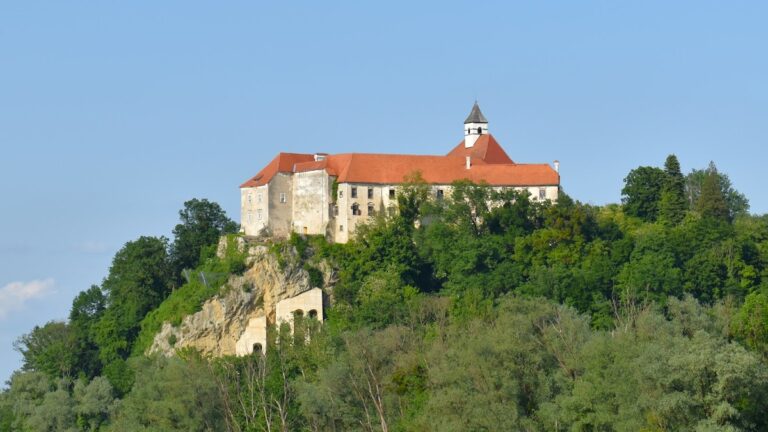
Ptuj Castle is a historic hilltop castle in Ptuj, Slovenia, developed on the site of a Roman fort. Its fortification was rebuilt in the ninth century, and the complex later evolved through Romanesque, Renaissance, and Baroque phases. The castle’s position above the Drava River helped make it a defensive stronghold, an aristocratic residence, and eventually the home of a regional museum.
Early fortification and the Counts of Pettau
People sought refuge on the hill in prehistoric times, and remains of a Celtic settlement have also been found there. A fortification was rebuilt in the ninth century. In the eleventh or twelfth century, Archbishop Konrad I of the Salzburg Archdiocese ordered its renewal. At that time, Pettau and the castle belonged to the archdiocese, a major ecclesiastical principality whose authority extended into political and feudal administration.
During the first third of the twelfth century, the Counts of Pettau acquired the castle, enlarged it, and made it their residence. A major building phase in the twelfth century was at least partly intended to protect the site against Hungarian attacks while Ptuj remained within the Salzburg Archdiocese. During the counts’ several-century rule, Franciscan and Minorite monasteries were established in the town. A pilgrimage church was also built on the castle hill.
Changing lordships and military decline
In later centuries, control of the castle passed successively to the Hungarian king, the Bohemian king, the Teutonic Order, and once again the Lords of Pettau. The Teutonic Order was a medieval religious-military institution that also held territorial possessions. From 1438, Salzburg authorities administered the complex, and in 1479 it came under Hungarian occupation.
The castle was later owned for a period by the Jesuits of Zagreb. After the Turkish invasions ended, it lost much of its defensive purpose and was converted into a rural residence and the seat of a landed estate. Major rebuilding began in the mid-seventeenth century under Walter Leslie, a Scottish-born military commander and field marshal in the Holy Roman Empire, who purchased the estate in 1656. His descendants retained it until 1802. After the Leslie line became extinct, ownership passed to the House of Dietrichstein, which became extinct in 1864.
The Herberstein estate and nationalization
Countess Theresia von Herberstein, the eldest daughter of Joseph Franz, Prince of Dietrichstein, bought the castle in 1873. The Herberstein family retained it until 1945, when the family was expropriated and the castle was nationalized at the end of the Second World War.
The Herbersteins renovated the complex in 1912 and established a small museum there. Since 1945, the castle buildings have served as a museum. The Yugoslav state converted them into a regional museum, and the institution received the name Regional Museum of Ptuj in 1963. It is now the Regional Museum Ptuj-Ormož, with archaeological, historical, cultural-historical, and ethnographic departments, restoration workshops, and related services. The castle is protected as a Slovenian cultural monument of national importance. Extensive restoration of the complex took place at the end of the twentieth century.
Origins of the museum
The museum’s institutional history reaches back to 1893, when a museum society was founded in Ptuj and archaeological finds were displayed in the former lower gymnasium hall. Extensive donations enlarged the collection in 1895, and the institution was then called the Municipal Ferk Museum in honor of donor Franz Ferk. As the exhibition space became too small, the museum moved to the former Dominican monastery in 1928. The castle has remained its principal setting since 1945.
Remains
Fortifications and courtyard
Ptuj Castle occupies a hill alongside the Drava River overlooking Ptuj. Its defensive character survives in the stone perimeter wall and in recognizable remains of a bastion, a projecting defensive platform. The west tower in the outer courtyard is the only tower identified with the castle’s first building phase. The early fortification also included a keep known as Konrad Tower and small watchtowers positioned on a natural-stone wall.
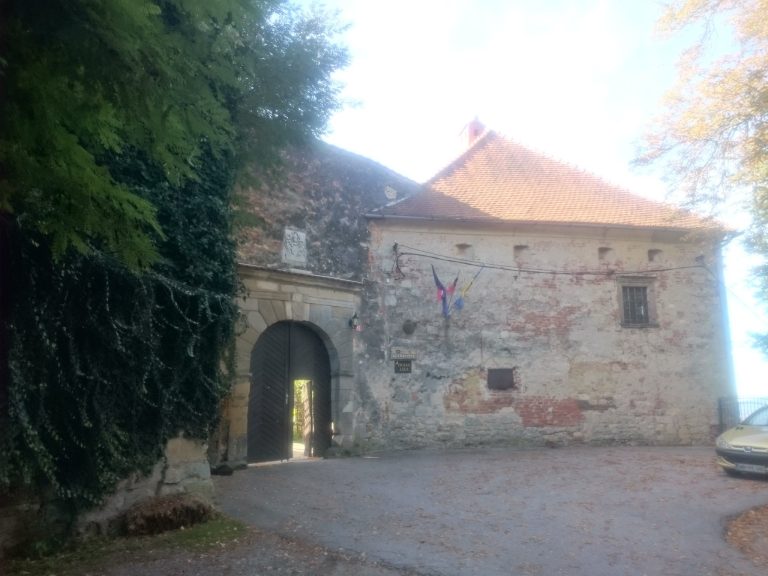
The plateau contains a grain store and former stables in addition to the principal castle buildings. A deep well stands at the center of the freely accessible courtyard. Gates lead into the courtyard and toward the museum entrances, including gates designed by Italian architects and decorated with coats of arms belonging to former owners.
Palatial wings
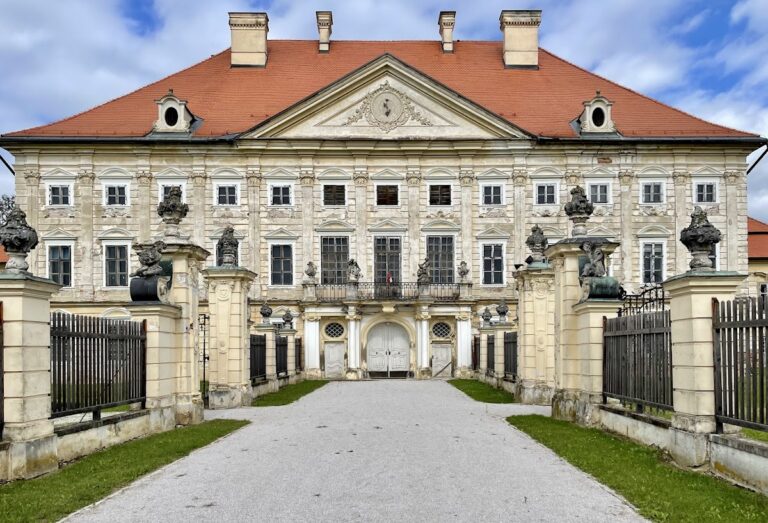
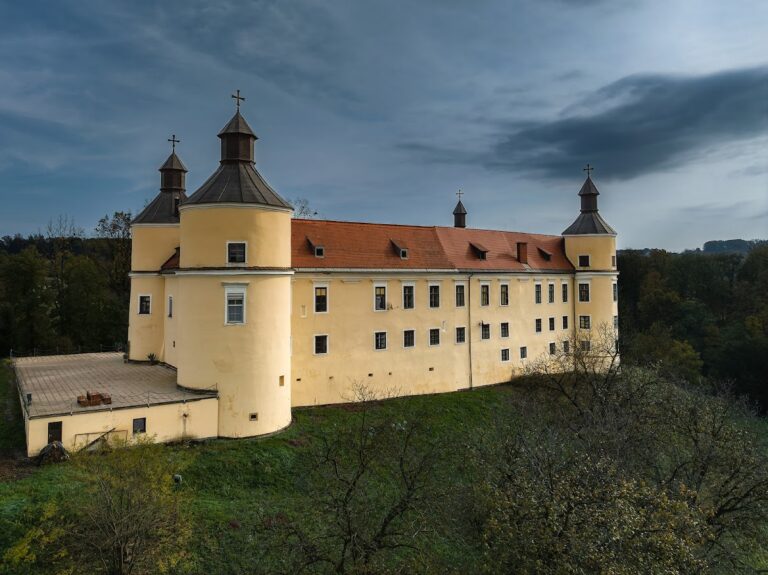
The principal residential building, or palas, is a horseshoe-shaped structure dating from the fourteenth century. The present castle is an open three-wing complex that combines Romanesque, Renaissance, and Baroque elements. Its connected wings rise three storeys and have open arcaded galleries on the courtyard side. An arcaded gallery is a covered passage formed by a series of arches. The palas ensemble is covered by a tiled lean-to roof, reflecting the complex’s transformation from a primarily defensive stronghold into a residence.
Church and preserved furnishings
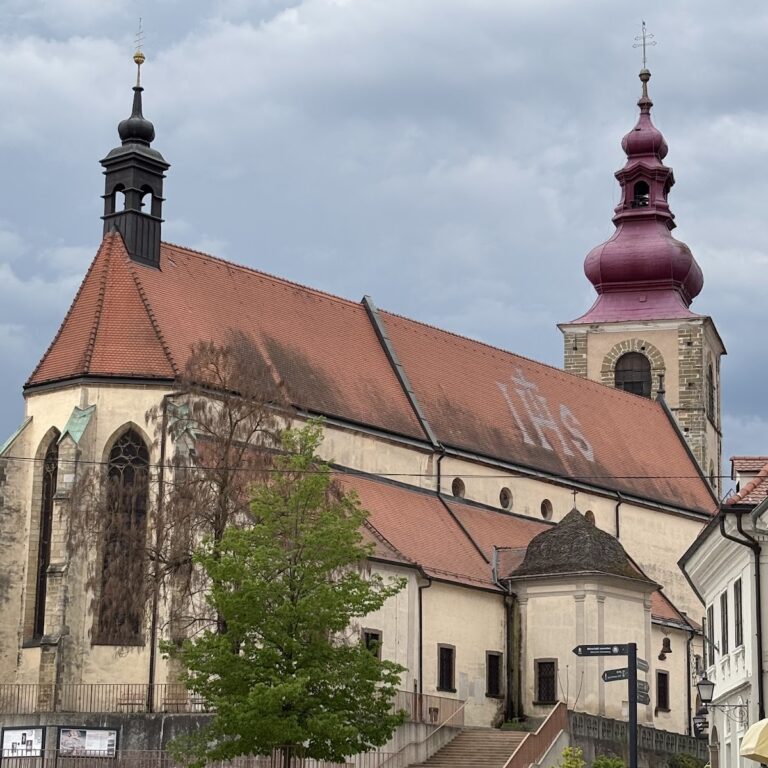
A monastic church is attached to one of the wings. It developed from the former pilgrimage church on the castle hill and, after rebuilding and enlargement, became the Church of the Assumption. Beneath the ground-floor arches, furnishings from one of the former monasteries include marble or sandstone sculptures of Saint Dominic, the Virgin Mary with the Christ Child, and the Immaculate Conception. Saint Dominic was the founder of the Dominican Order, while the Immaculate Conception is a Catholic doctrine concerning the Virgin Mary. A brightly painted nineteenth-century sedan chair is also preserved in this area.
Museum collections
The castle buildings house collections that connect the site’s setting with the wider history of the region. They include approximately 500 weapons, furniture and clothing, traditional carnival costumes and masks, around 300 folk-music instruments, paintings, reverse-glass paintings, and everyday objects. The museum also maintains an educational service used by school classes, together with restoration workshops and its archaeological, historical, cultural-historical, and ethnographic departments.
Among the ethnographic holdings are masks used in kurentovanje, a traditional Central European carnival custom associated with masked performers known as kurents. Their masks and rituals form part of the museum’s presentation of local cultural traditions.
Vines and the perimeter wall
In 2015, two grapevines were replanted on the south side of the perimeter wall. One, Seebodner Rosentraum, came from Ptuj’s Austrian partner town. The other, Modra kavčina, was propagated from the oldest grapevine in Maribor’s Lent district. Their planting added a modern horticultural feature to the surviving castle enclosure while retaining the wall as part of the historic complex.