Bishop Ciolek Palace: A Historic Episcopal Residence and Museum in Kraków


Site at a Glance
- Rating
- 4.7
- Popularity
- Low
- Country
- Poland
- Primary era
- Early Modern
- External website
- Open
- Eras represented
- Early Modern
- Civilizations
- Kingdom of Poland
- Site type
- Religious
- Remains
- Palace
On this page9 sections
History
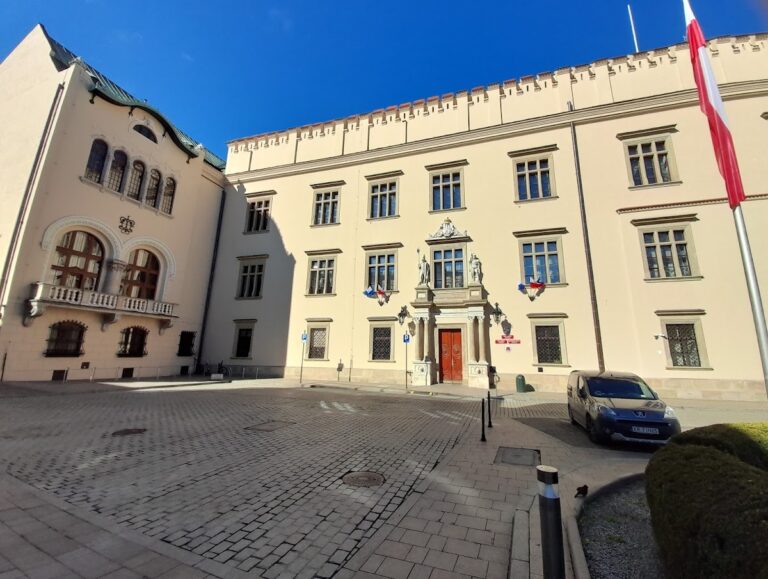
Bishop Ciolek Palace is a historic episcopal residence in Kraków, Poland, created in 1505 in a combination of late Gothic and Renaissance forms. Bishop Erazm Ciolek of Płock joined two burgher houses to create a large residence known as a curia ampla, or “great court.” The palace became associated with Kraków’s ecclesiastical elite and later developed through the interventions of Bishop Piotr Tomicki and Cardinal Jerzy Radziwill.
Formation and episcopal rebuilding
The first major transformation took place when Ciolek united the two existing houses into one residence. Later occupants enlarged and rebuilt the complex. Side outbuildings were added, and the main building was raised to three storeys. During the second half of the sixteenth century, the complex also acquired a defensive wall and an artillery tower, giving the residence additional fortified elements.
The palace’s entrance preserves the memory of its relationship with the Polish monarchy. A Renaissance gate carries a cartouche with a crowned royal eagle and the intertwined letter “S,” identified as the initial of King Sigismund I the Old. Renaissance wall-painting fragments inside the north wing include the Łodzia coat of arms of Bishop Piotr Tomicki.
Austrian administration and deterioration
The residence remained substantially intact until the nineteenth century, when Austrian authorities took it over. The building was then used by the Old Town district recruiting commission and the Kraków Assay Office, as well as by other offices. These new functions caused substantial damage. Architectural details were removed, harmed, or covered with plaster during the Austrian period, changing the appearance and condition of the former palace.
The building was not renovated after either of the two world wars. By the late twentieth century, its technical condition had become very poor. In 1965, it was entered in the register of cultural monuments of the Lesser Poland Voivodeship under registration number A-151.
Restoration and museum use
In 1996, the damaged palace was transferred to the National Museum in Kraków. Extensive restoration and conservation followed from 1999 to 2006, with a conservation project planned for 2003 to 2007 in consultation with Andrzej Fischinger. The work recovered and conserved architectural details, adapted the building for museum use, and retained part of its palace character.
Since 2007, Bishop Ciolek Palace has been a branch of the National Museum in Kraków. Its permanent displays are the Gallery of Ancient Polish Art, covering the twelfth to eighteenth centuries, and the Gallery of Orthodox Art of the Former Polish Commonwealth. The building also accommodates a lapidarium, a conservation studio for paintings and polychrome sculpture, and museum storage areas.
Remains
Palace buildings and surviving decoration
The palace consists of two connected former burgher houses, expanded with side outbuildings and a three-storey main building. Its architectural fabric combines late Gothic and Renaissance elements. The monumental late Gothic entrance hall was originally divided into two naves by a colonnade. After the colonnade had been walled up, it was rediscovered and reopened during the restoration. Courtyard arcades that had previously been sealed were uncovered in 1977.
The southern outbuilding retains fragments of a viewing loggia that crowned the rear building during the final years of the sixteenth century. Late Gothic and Renaissance window surrounds were reconstructed from authentic surviving fragments. Traces found during investigation made it possible to reconstruct the facade’s colour scheme, while the palace’s stone architectural elements were conserved. The surviving Renaissance wall paintings in the north wing include Bishop Piotr Tomicki’s Łodzia coat of arms.
Art collections
Gallery of Ancient Polish Art
The Gallery of Ancient Polish Art occupies part of the palace and presents painting, sculpture, and artistic crafts from the late Middle Ages through the late Baroque. Its oldest works include late Romanesque capitals from the Cistercian abbey at Jędrzejów, dated to 1195–1245. The Gothic collection contains panel paintings, altar retables and panels from retables, together with individual sculptures. Among the named works are the two surviving panels of the Trzebunia Triptych, showing a pair of saints and dated to 1400–1430, the Epitaph of Wierzbięta of Branice from around 1430, the Madonna of Krużlowa made after 1410, and the Crucifixion from Korzenna from around 1440–1450.
Other Gothic works include the Man of Sorrows from Krauszów, made around 1440, and the Madonna and Child from Regulice. The gallery also contains the Dominican Polyptych from around 1460, the Augustinian Polyptych, the Three Marys at Christ’s Tomb attributed to Mikołaj Haberschrack, the Apostle-Dispatch Triptych, the Annunciation from Cięcina, and paintings from the Furriers’ Altarpiece of St. Mary’s Church in Kraków associated with Jan Wielki. The sculpture Christ on the Donkey from Szydłowiec, dated to around 1501–1525, was formerly used in Palm Sunday ceremonies.
Works by Veit Stoss and artists from his circle include Christ in the Garden of Gethsemane, a wooden crucifix by Stoss, figures of Saints Catherine and Margaret from Iwanowice, and figures of holy hermits from the Kraków Augustinian church. The transition between late fifteenth- and early sixteenth-century Gothic appears in the Lusina Polyptych, the Dobczyce Triptych, the Polyptych of Saint John the Almsgiver from St. Catherine’s Church in Kraków, dated to 1502–1504, and Saints Bonaventure, Bernard, Augustine, and Benedict from around 1500.
The collection further includes the Holy Family from Ołpiny, made around 1510, Saint Stanislaus from Tarnobrzeg from around 1515, and the 1532 epitaph of Grzegorz Nożownik from Kraków’s Church of St. Stephen. Ceiling boards from the church at Kozy near Bielsko-Biała date to around 1520. Other sculptures include the Madonna from Kraków’s Corpus Christi Church, the Madonna from Barczków, and a group of figures from the church at Rzepiennik Biskupi, dated to around 1500.
Renaissance works represent both the northern Renaissance, including paintings by Hans Dürer, and the Italian Renaissance, including works by Jan Maria Padovano. Baroque holdings include Counter-Reformation art, associated with Catholic responses to the Protestant Reformation, coffin portraits connected with seventeenth-century funerary customs, and portraits in the tradition of Old Polish portraiture. The Hall of Virtues contains a cycle depicting members of the nobility. Named Baroque works include Tomasz Dolabella’s Mass of Blessed Henry Suso from 1638 and Tadeusz Kuntze’s Miracle of Saint John Cantius from 1767. Hans Dürer’s Penitent Saint Jerome, dated to 1526, and the Adoration of the Magi, a fragment of the Augustinian Polyptych from St. Catherine’s Church in Kazimierz made before 1468 and attributed to Mikołaj Haberschrack, are also displayed.
Gallery of Orthodox Art
The Gallery of Orthodox Art of the Former Polish Commonwealth occupies the ground-floor rooms. It presents paintings and artistic crafts connected with the Eastern Church. Most of the works come from Podkarpacie and Red Ruthenia, while others originated in Novgorodian Rus, Kievan Rus, the Balkans, Greece, and Bulgaria.
The icons include the fifteenth-century Saint Paraskeva the Great Martyr with Scenes from Her Life and Passion, Saint Nicholas of Myra from the end of the fifteenth century, and The Hodegetria with the Prophets and Saints Joachim and Anne from the first half of the sixteenth century. The fifteenth-century Face of Christ on a Cloth is an acheiropoietos, an image traditionally regarded as not made by human hands, and shows the archangels Raphael and Michael. The Protection of the Mother of God, from the last quarter of the seventeenth century, depicts John III Sobieski and Marysieńka.
Further works include the eighteenth-century Greek Saint George Fighting the Dragon, the Russian Saint Nicholas the Wonderworker from the turn of the sixteenth and seventeenth centuries, and The Passion of Christ, a cycle made in the Rybotychi workshop at the turn of the seventeenth and eighteenth centuries. The sixteenth-century Venetian Sacra Conversazione shows the Madonna and Child with Saints Catherine and Roch. An icon of the Holy Trinity from the second half of the sixteenth century combines Latin and Greek traditions in its depiction of the Father, Son, and Holy Spirit. Jerzy Nowosielski’s Saint Paraskeva dates to 1974.
The gallery also contains a complete eighteenth-century iconostasis from Lipovets in the Bratslav region. An iconostasis is a screen of icons separating the sanctuary from the main worship space in an Eastern Christian church. Other displayed objects include carved royal doors, Old Russian processional, hand-held, and ritual crosses, Old Believer plaques, reliquary crosses known as enkolpions, textiles called plaschanitsy used during Holy Week rites, liturgical vestments, and banners.
Nearby sites