Church of St. Giles in Kraków: A Gothic Dominican Church


Site at a Glance
- Rating
- 4.7
- Popularity
- Low
- Country
- Poland
- Primary era
- Medieval
- External website
- Open
- Eras represented
- Medieval, Early Modern
- Civilizations
- Kingdom of Poland, Polish–Lithuanian Commonwealth
- Site type
- Religious
- Remains
- Church
On this page13 sections
History
The Church of St. Giles in Kraków, Poland, is a Gothic Roman Catholic church built in the early fourteenth century at the foot of Wawel Hill. Its traditional foundation story reaches back to the late eleventh century and connects the church with Duke Władysław I Herman, the birth of his son Bolesław III, and devotion to Saint Giles, a Christian saint associated with healing and protection.
The foundation tradition
According to tradition, Władysław I Herman founded the church in thanksgiving for the birth of Bolesław III, whose mother was Judith of Bohemia. The birth was believed to have followed prayers and gifts sent to the Provençal abbey of Saint-Gilles through Saint Giles’s intercession. This account remains uncertain. No Romanesque remains have been found beneath the present church, and one historical interpretation places the original dedication to Saint Giles at the present Church of Saint Andrew instead, suggesting that the first church on this site may already have been Gothic.
A limited archaeological investigation in 2015 uncovered a stone pavement that had been used for a long period beneath the current floor. Its connection with an earlier building is uncertain, although the lack of typical layers formed by accumulated refuse may indicate that the area had a sacred function.
Gothic construction and Dominican use
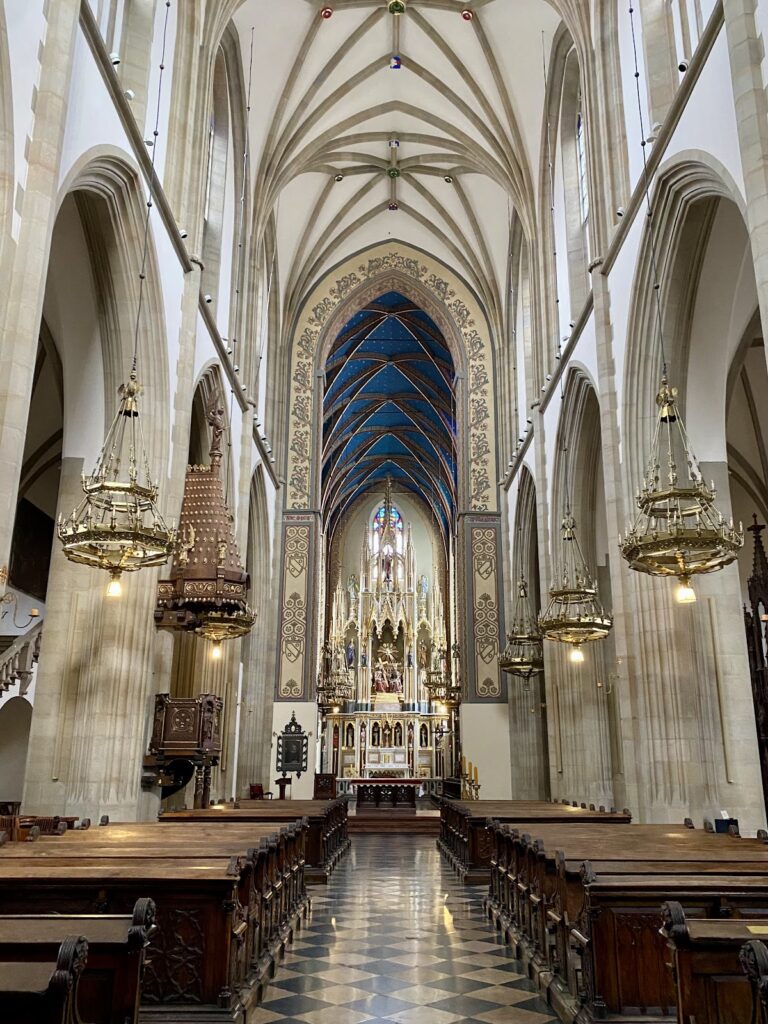
The present church was constructed in the early fourteenth century. It initially stood under Benedictine patronage, meaning that it was associated with monks following the Rule of Saint Benedict. After its transfer to the Dominicans, a Catholic preaching order founded in the thirteenth century, the building was remodelled in 1595. By the seventeenth century, its interior had acquired a Baroque character. The church continued as a Dominican church and remains an active Roman Catholic church associated with the All Saints parish.
Changes around the church
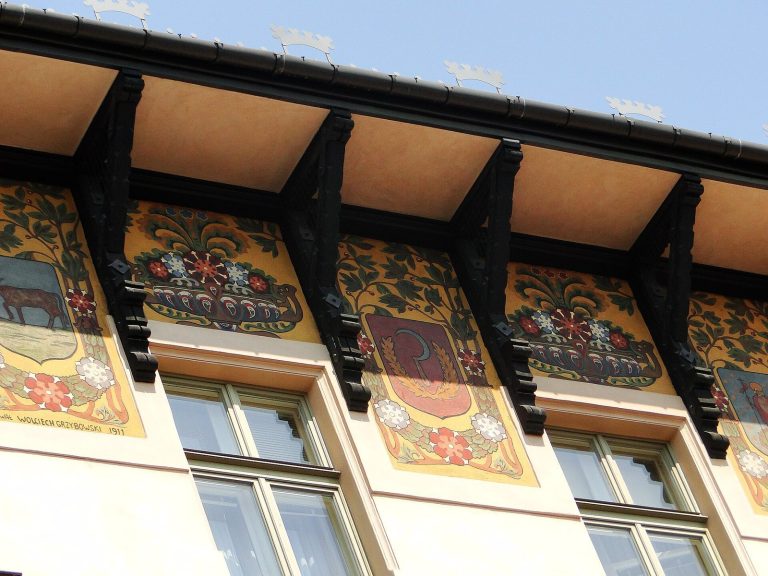
Seventeenth- and eighteenth-century annexes gradually accumulated around the building. Many were removed during the nineteenth century. Around 1905, Kraków’s municipal council proposed further demolition as part of an urban reorganisation scheme. The proposal led to a major dispute with heritage advocates, among them Stanisław Wyspiański, Leon Wyczółkowski, Konstanty Laszczka, Stanisław Tomkiewicz, Jerzy Mycielski, Marian Sokołowski, Józef Muczkowski, Leonard Lepszy, Klemens Bąkowski, and Stanisław Krzyżanowski.
Helfert, president of the Supreme Central Commission in Vienna, intervened in a letter dated 24 November 1905, helping bring about the withdrawal of the municipal resolution. Count Jerzy Mycielski may also have influenced the decision privately through his friendship with Archduke Franz Ferdinand. Some derelict buildings around the church were nevertheless demolished, while an eighteenth-century house survived and was connected to the church by arcaded passages.
During the Second World War, German occupation authorities demolished two large tenements beside the church on Grodzka Street as part of an urban reorganisation of the area around Wawel. Father Adam Studziński directed repairs during the 1980s, while the archaeological work of 2015 helped clarify the building’s original layout. The church forms part of the Historic Centre of Kraków, inscribed on the UNESCO World Heritage List in 1978, and the Kraków historic urban complex was designated a Historic Monument of Poland in 1994.
Modern commemorations
A bronze plaque installed in 1987 commemorates the oath taken by Kraków scouts during the year of Pope John Paul II’s pilgrimage to Poland. In 1990, the Katyń Cross was erected in the square before the church to remember Polish victims of the Katyń massacre, the 1940 killing of thousands of Polish military officers and other citizens by the Soviet security apparatus.
Remains
The church stands at 67 Grodzka Street in Kraków’s Old Town, in the historic Okół area at the foot of Wawel Hill. It is an oriented brick building whose surviving fabric combines Gothic, late Renaissance, and Baroque elements. The present interior is single-naved, although a foundation remnant found beneath the middle of the nave in 2015 confirmed that the Gothic building was originally arranged with two naves and a single central pillar supporting the vault.
Church structure
The Gothic presbytery, the part of the church containing the main altar and reserved for the clergy, survives together with the sacristy, a room used for liturgical objects and preparation for worship. The building has one tower in the form of a roof bell turret, three altars, and an organ with seven stops, one manual, and a pedal division. The side altars are dedicated to Jesus in the Crown of Thorns and to the Virgin Mary.
Interior furnishings
Choir stalls
The choir stalls are made from various coloured marbles, Pińczów limestone, sandstone, and alabaster. They are remnants of the tomb of Saint Hyacinth, a thirteenth-century Polish Dominican friar and missionary venerated as a saint. The tomb came from his chapel in the Dominican church and was made in the sixteenth century by Jan Michałowicz of Urzędów, a Polish Renaissance sculptor.
Crucifix, coats of arms, and sacred images
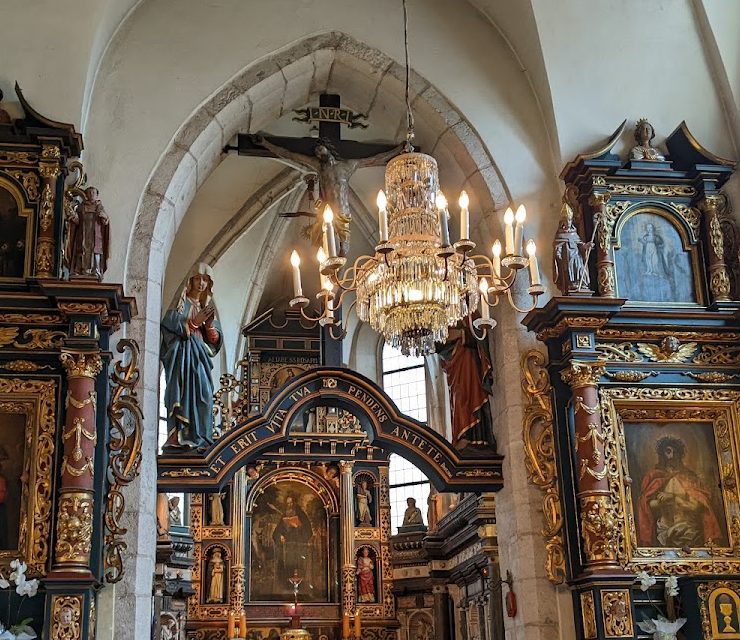
A late Gothic crucifix occupies the chancel arch, which separates the presbytery from the nave. Sixteenth-century coats of arms belonging to the Tęczyński family appear on the vault. The interior also contains an altarpiece painting of Saint Giles and several medieval wooden icons. The Saint Giles painting was formerly regarded as miraculous, and until the early twentieth century pilgrims placed gifts there to commemorate healings attributed to the saint’s intercession.
Surrounding buildings and memorials
Eighteenth-century house
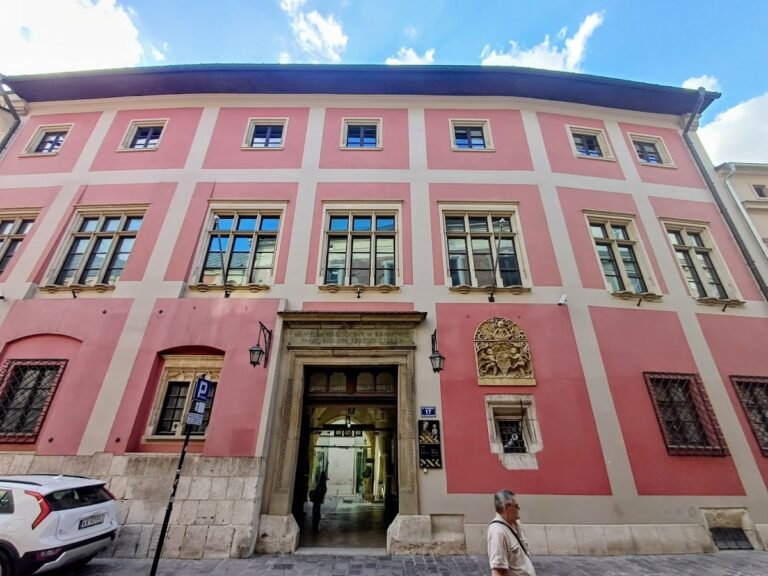
An eighteenth-century house retained beside the church has a broken roof. Arcaded passages connect it with the church, preserving part of the built relationship created after surrounding buildings were demolished.
Katyń Cross and commemorative plaque
The Katyń Cross stands in the square before the church. The 1987 commemorative plaque is a bronze tablet located near the exit, marking the oath taken by Kraków scouts during the year of Pope John Paul II’s pilgrimage to Poland.