Wawel Cathedral: Poland’s Royal Coronation Church and National Pantheon



Site at a Glance
- Rating
- 4.8
- Popularity
- Very High
- Country
- Poland
- Primary era
- Medieval
- External website
- Open
- Eras represented
- Medieval, Early Modern, Modern
- Civilizations
- Kingdom of Poland, Polish–Lithuanian Commonwealth
- Site type
- Religious
- Remains
- Cathedral
On this page19 sections
History
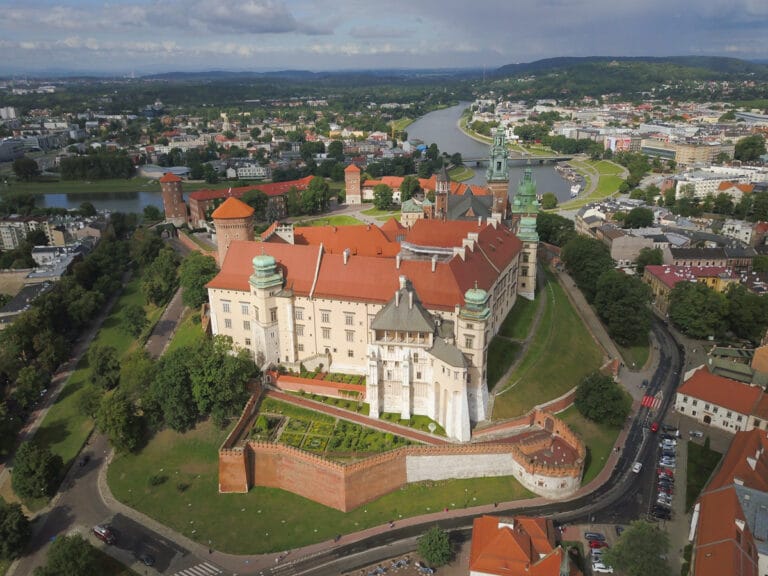
Wawel Cathedral, formally the Archcathedral Basilica of Saint Stanislaus and Saint Wenceslaus, is a Roman Catholic cathedral in Kraków, Poland, built principally by medieval Polish ecclesiastical and royal authorities in the Gothic style during the fourteenth century. It forms part of the Wawel Castle complex and serves as the principal church of the Archdiocese of Kraków, a national sanctuary, and a major monument of Polish statehood, faith, and culture.
Origins and Romanesque predecessors
The cathedral’s origins followed the establishment of the Diocese of Kraków around AD 1000, after the Christianization of Poland under Duke Mieszko I. Archaeological evidence beneath the present building points to earlier pre-Romanesque foundations. The earliest church on Wawel may have been a wooden structure or a modest stone rotunda, probably dating from around AD 970.
The first stone cathedral, conventionally known as Wawel I, was built around AD 1000 in the Romanesque style. Romanesque architecture used massive walls, rounded arches, and strongly articulated masonry. The church was destroyed during the raid led by Břetislav I, Duke of Bohemia, in 1038–1039.
Duke Władysław I Herman then initiated a larger Romanesque successor, Wawel II. Consecrated in 1142, this cathedral was destroyed by fire in 1305. Parts of its fabric survived, including the Saint Leonard Crypt and the Silver Bells Tower.
The Gothic cathedral and royal ceremonies
After the fire, King Władysław I, known as Ladislaus the Short, ordered the construction of the present cathedral. Bishop Nanker played a leading role in the undertaking. The new building was consecrated in 1320, the year of Władysław’s coronation, and was completed during the fourteenth century. A further consecration took place in 1364 under King Casimir III the Great.
Władysław I was the first monarch crowned and buried in the present cathedral. From 1320 until 1734, Wawel served as the ceremonial coronation church of the Polish monarchs. Coronations took place before the high altar, while the Polish Crown regalia, the ceremonial objects used in royal coronations and representation, were kept in the cathedral treasury.
During the reign of Casimir III, the cathedral was dedicated in 1364 to Saint Stanislaus of Szczepanów and Saint Wenceslaus I of Bohemia. Saint Stanislaus was a bishop of Kraków and martyr who became a patron saint of Poland, while Saint Wenceslaus was the medieval duke of Bohemia to whom the cathedral was also dedicated. Casimir commissioned the first royal funerary monument in the building, the tomb of his father, Władysław I.
From the fourteenth to the eighteenth century, the cathedral served as the burial church of most Polish kings and their families. Monarchs were initially buried in the nave, but burial in crypts became customary from the sixteenth century. Later, the crypts and chapels received national heroes, generals, statesmen, bishops, poets, and artists, giving the cathedral the character of a national pantheon.
Royal power and later transformations
From the eleventh through the sixteenth century, Wawel was a center of both ecclesiastical and monarchic power in Poland. Kraków remained the country’s capital until the royal court moved to Warsaw. Royal and episcopal patrons continued to add chapels, altars, monuments, and decoration through the medieval, Renaissance, Baroque, and later periods.
The seventeenth and eighteenth centuries brought Baroque additions influenced by the Counter-Reformation, the Catholic renewal that followed the spread of Protestant movements in Europe. The Swedish invasion of 1655–1657 caused looting and structural deterioration on Wawel Hill. Bishop Andrzej Trzebicki and his successors subsequently supported repairs to the roof, towers, and interior furnishings. Bishops including Jan Aleksander Lipski and Kajetan Sołtyk continued the restoration and embellishment of the cathedral.
In the nineteenth century, when Poland no longer existed as an independent state, Wawel Cathedral became a national pantheon and an important focus of patriotic identity. Tadeusz Kościuszko, Józef Antoni Poniatowski, Adam Mickiewicz, and Juliusz Słowacki were among the national heroes, writers, and artists buried there. Under Austrian rule, the building’s preservation depended substantially on ecclesiastical custodianship and local patriotic support.
Restoration campaigns in the nineteenth and twentieth centuries, associated with architects including Zygmunt Hendel and Sławomir Odrzywolski, sought to stabilize the cathedral and recover its medieval character. The building survived both World Wars with minimal structural damage. Wawel Cathedral and the historic center of Kraków were inscribed on the UNESCO World Heritage List in 1978. The cathedral is also part of the Kraków historic city complex designated a Historic Monument of Poland in 1994.
Religious and national memory
Karol Wojtyła celebrated his first Mass as a priest in the Saint Leonard Crypt on 2 November 1946. He served as Archbishop of Kraków from 1964 to 1978, after being ordained auxiliary bishop of Kraków in the cathedral on 28 September 1958, and became Pope John Paul II in 1978.
The cathedral remains an active place of Roman Catholic worship, religious observances, national commemorations, and annual celebrations. It is also the official seat of the Archbishop of Kraków. Its royal and national burials include Władysław I, Casimir III the Great, Hedwig I, Władysław II Jagiełło, Casimir IV Jagiellon, Elizabeth of Austria, and John I Albert. Władysław III Jagiełło is commemorated by a cenotaph, a memorial monument without the person’s body.
The royal crypts contain, among others, Stephen Báthory, Sigismund I the Old, Sigismund II Augustus, Anna Jagiellon, Sigismund III Vasa, Władysław IV Vasa, John II Casimir Vasa, John III Sobieski, Maria Casimire, Michael I Wiśniowiecki, and Augustus II the Strong. The national crypts contain or commemorate Józef Piłsudski, Tadeusz Kościuszko, Józef Antoni Poniatowski, Władysław Sikorski, Adam Mickiewicz, Juliusz Słowacki, and Cyprian Kamil Norwid.
Piłsudski was first buried in the Saint Leonard Crypt in 1935–1937 and was later transferred to the crypt beneath the Silver Bells Tower. Władysław Sikorski was interred in the royal necropolis in 1993. An urn containing a bone of Stanisław I Leszczyński has been in the Sigismund Crypt since 1938, while the poets’ crypt contains an urn with earth from Norwid’s burial place near Paris. A memorial plaque and an urn containing soil from Katyń commemorate the Katyń massacre in the Vasa and Silver Bells crypt areas.
Remains
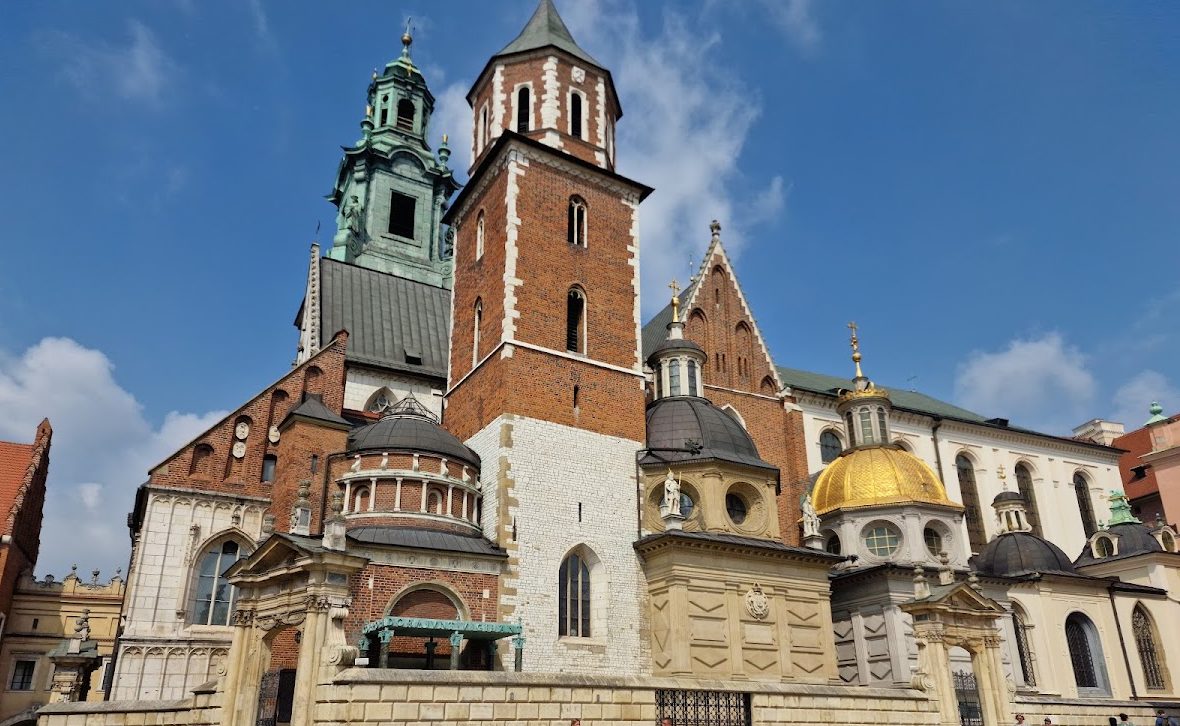
Wawel Cathedral stands on limestone Wawel Hill, approximately 25 metres above the Vistula. The present church is principally a fourteenth-century Gothic building of brick and stone, arranged on a Latin-cross plan with pointed arches and rib-vaulted ceilings. Its nave, side aisles, transepts, choir, apse, ambulatory, and radiating chapels form a compact ensemble shaped by the limited space available on the hill. Later chapels surround the medieval core and give the exterior its irregular outline. Renaissance, Baroque, Neoclassical, and Neogothic elements were added over time.
Exterior, entrance, and principal spaces
Entrance and towers
A Baroque porch was added in 1619. The wooden entrance door, dated 1636, is covered with iron sheet bearing the crowned monogram of Casimir III the Great and is set within a black-marble frame. Mammoth bones suspended on heavy iron chains above and to the left of the entrance have been preserved since the Middle Ages. Local tradition holds that Kraków will be destroyed when they fall.
The cathedral includes the Sigismund Tower and the Silver Bells Tower, together with the treasury, sacristy, choir, main altar, Saint Stanislaus Mausoleum, and numerous chapels. These include the Holy Cross, Potocki, Szafraniec, Vasa, Sigismund, Jan Konarski, Jakub Zadzik, John I Albert, Andrzej Załuski, Trinity, Czartoryski, Samuel Maciejowski, Lipski, Skotnicki, Andrzej Zebrzydowski, Piotr Tomicki, Virgin Mary, Piotr Gamrat, and Queen Sophie chapels.
Sigismund Bell
The bronze Sigismund Bell was installed in the Sigismund Tower in 1521. It weighs nearly 13 tons and bears inscriptions commemorating the reign of Sigismund I. The bell is sounded on occasions of national importance, major religious feasts, and state anniversaries.
Chapels, choir, and altars
Holy Cross and Sigismund Chapels
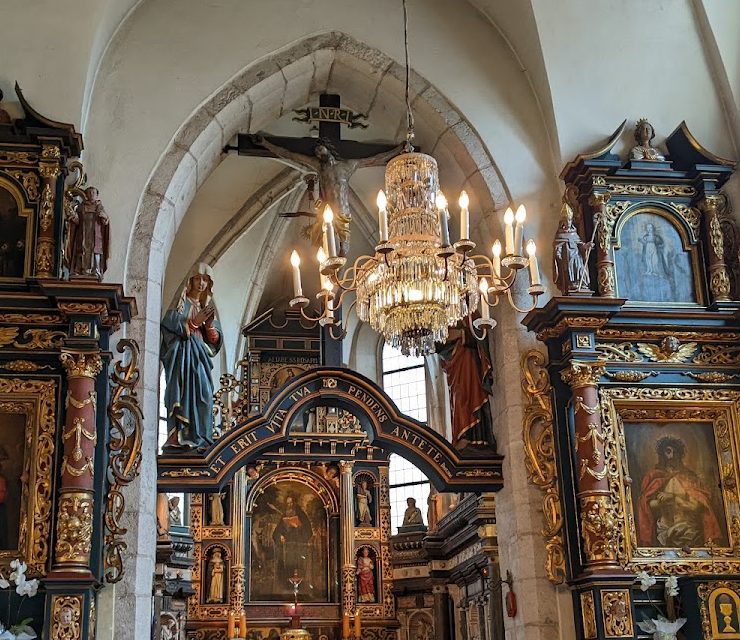
The Holy Cross Chapel retains Gothic walls and vaults covered in 1470 with paintings by Ruthenian artists from Pskov. On the cathedral’s south side, the Sigismund Chapel was built between 1517 and 1533. It has a square plan, a gilded dome, Tuscan pilasters, and Renaissance sculptural decoration. Its tomb monuments commemorate Sigismund I the Old, Sigismund II Augustus, and Anna Jagiellon.
Bartolommeo Berrecci of Florence designed and built the chapel for Sigismund I the Old. Italian artists including Giovanni Cini, Giovanni Maria Padovano, Niccolo da Castiglione, Antonio and Filippo de Fiesole, Bernardino di Zanobi Gianottis, and Giovanni Soli contributed to its decoration. The Vasa Chapel, commissioned by Sigismund III Vasa, closely follows its design. It is larger but simpler and was later fitted with black marble.
Saint Stanislaus Mausoleum
A chapel-mausoleum erected at the crossing between the nave and choir in 1628–1630 replaced a Gothic altar. Designed by Giovanni Battista Trevano, it contains the altar and tomb of Saint Stanislaus, bishop of Kraków and martyr. The present silver coffin dates from 1669–1671 and was made by Peter von der Rennen of Gdansk. It replaced a coffin donated by Sigismund I the Old in 1512 and stolen by Swedish troops in 1655.
The Saint Stanislaus altar became known as the Altar of the Homeland. Its national-religious meaning comes from the Polish kings who deposited captured battle standards there, including standards taken at Płowce in 1331, Grunwald in 1410, and Vienna in 1683.
Choir and main altar
The choir contains stalls and a late-Renaissance pulpit made by the cabinetmaker Jan Szabur around 1620. The Baroque main altar dates from the seventeenth century. Bishop Piotr Gembicki founded it around 1650, and Giovanni Battista Gisleni made it. Its seventeenth-century painting of the Crucified Christ is by Marcin Blechowski. A tall black-marble canopy supported by four pillars was designed by Giovanni Battista Trevano and Matteo Castelli between 1626 and 1629.
Crypts and funerary monuments
Saint Leonard Crypt
Built between 1090 and 1117, the Saint Leonard Crypt is a well-preserved Romanesque interior supported by eight columns. It contains royal and national burials, including sarcophagi associated with John III Sobieski and Maria Casimire, Michael Wiśniowiecki, Tadeusz Kościuszko, Józef Antoni Poniatowski, and Władysław Sikorski.
Royal dynastic crypts
The Stefan Batory Crypt lies beneath the Virgin Mary Chapel and contains the tomb of Stephen Báthory. Goldsmiths in Gdansk made his sarcophagus, while the Italian sculptor Santi Gucci created his funerary monument in the Virgin Mary Chapel around 1594.
The family crypt of Władysław IV Vasa contains the tombs of the king, his wife Cecilia Renata of Austria, and their children Zygmunt Kazimierz and Maria Anna Isabella. Craftsmen from Torun made the gilded-copper sarcophagi of Władysław IV and Cecilia Renata.
Beneath the Sigismund Chapel, the Sigismund Crypt contains the remains of Sigismund I, his first wife Barbara Zápolya, Sigismund II Augustus, Anna Jagiellon, Anne of Austria, Anne Marie Vasa, Alexander Charles Vasa, and Augustus II the Strong, as well as the urn containing a bone of Stanisław I Leszczyński. The Vasa Crypt contains the coffins of Sigismund III Vasa, Constance of Austria, Cardinal Johann Albert Vasa, Louise-Marie Gonzaga, John II Casimir Vasa, and Jan-Zygmunt Vasa. The sarcophagus of John II Casimir was made in Gdansk and decorated with figures of biblical heroes and kings.
National crypts
The crypt beneath the Silver Bells Tower contains the tomb of Józef Piłsudski and an urn with soil from the grave of his mother, Maria Piłsudska, near Vilnius. The same crypt contains the sarcophagi of President Lech Kaczyński and his wife Maria Kaczyńska, who died in the 2010 presidential aircraft crash at Smolensk. A wall plaque in the vestibule commemorates the victims of Katyń.
The crypt of the national poets contains Adam Mickiewicz, placed there in 1890, and Juliusz Słowacki, placed there in 1927. Cyprian Kamil Norwid is commemorated by a bronze urn containing earth from the common grave in France where he was buried. A white-marble medallion commemorating Frédéric Chopin was installed in 2010. It copies the medallion on Chopin’s grave in Paris and bears the inscription, “To the great artist, the nation.”
Royal tomb monuments
Casimir IV Jagiellon’s funerary monument, made in red Hungarian marble at the end of the fifteenth century, is attributed to Wit Stwosz. Władysław II Jagiełło’s tomb stands to the right of the main entrance and has a Renaissance canopy supported by eight columns. Giovanni Cini of Siena made it. The tomb of Casimir III the Great is made of red marble and richly carved with figures and inscriptions. A canopy on slender columns surmounts the monument, which is attributed to Hungarian sculptors influenced by French art.
Organ and funerary furnishings
The cathedral’s first large organ was built by Stanisław Komorowski between 1502 and 1506, probably in the main nave. Its later history is unknown. The present organ was built by Ignacy Ziernicki in 1785–1788 after a late-Baroque music gallery had been installed in 1756–1758. Ignacy Wojciechowski altered or repaired it in 1870–1871, followed by work by Kazimierz Żebrowski in 1912 and Wacław Biernacky in 1934. Adam Kołpanowicz renovated it in 1986. The instrument has 32 stops on two manuals and a pedal.
Across the cathedral, Gothic through Baroque sarcophagi and tomb monuments form a substantial record of Polish funerary art. The richly carved royal sarcophagi of the Jagiellonian and Vasa dynasties preserve the material expression of successive ruling houses and their continuing presence within the cathedral.
Nearby sites