Birka: A Viking Age Trading Port in Sweden
Site at a Glance
- Popularity
- Very High
- Country
- Sweden
- Primary era
- Medieval
- Eras represented
- Medieval
- Civilizations
- Norse
- Site type
- City
On this page16 sections
History
Foundation and trade
Birka was a Scandinavian trading settlement on Björkö in Lake Mälaren, Sweden, founded around AD 750 during the Viking Age. It flourished for more than two centuries and became one of Scandinavia’s earliest urban centers. It is generally regarded as Sweden’s oldest town.
Goods reached Birka from Scandinavia, Finland, continental Europe, and western Asia. The port connected Baltic exchange with routes through Ladoga and Novgorod toward the Byzantine Empire, the eastern Roman state centered on Constantinople, and the Abbasid Caliphate, a major Islamic empire based in the Middle East. Birka probably traded furs acquired from Sámi, Finns, people in northwestern Russia, and local trappers, along with iron goods, crafted wares, reindeer antlers and combs, walrus tusks, amber, and honey. Its population is estimated at 500 to 1,000 people, perhaps around 700 at its height.
Christianity and political life
The missionary Ansgar first reached Birka in 829. In 831, he established Sweden’s first known Christian congregation there, although his initial attempt to convert the settlement from Norse religion, the pre-Christian beliefs of Scandinavian peoples, did not succeed. Christianity later had followers alongside traditional Norse beliefs. Ansgar returned in 852, meeting King Björn on his first visit and King Olof on the second. The ninth-century kings Björn, Anund, and Olof spent time at Birka, but none is said to have kept a residence there. Swedish kings and their attendants moved between royal estates.
On Olof’s visit, he said that he would consult the gods by casting lots and seek the people’s approval before permitting Ansgar’s mission. At a public assembly, or thing, Birka’s people unanimously favored the proposal. Olof nevertheless said he would also ask people elsewhere in the kingdom. That wider gathering may have been the Thing of all Swedes at Uppsala, where shared decisions bound the king and the lawspeaker of Tiundaland, an official who recited or interpreted the law, held greater authority than the king.
Herigar, a local official called a prefect, built a church on his ancestral property. During a Danish attack accompanied by the deposed King Anund Uppsale, residents fled to a neighboring settlement, probably a nearby fortress. The Danes eventually left without destroying Birka.
Archbishop Unni died at Birka in 936, and Adam of Bremen later placed his tomb there. The Hamburg-Bremen archbishopric directed Scandinavian missionary work until 1103. In the 1060s, it consecrated several bishops for Sweden, including one intended for Birka. Adam also wrote that the abbot Hiltin was ordained for Birka under the name John.
Decline and written accounts
Coin evidence indicates that Birka had largely declined by about 960; its abandonment is dated to around 975. Around this time, Sigtuna was founded as a Christian town about 35 km northeast and became the leading trading center in the Mälaren area. Birka’s decline has no settled explanation. Suggested factors include Sigtuna’s growth, Gotland’s increasing importance and strategic position on trade between the Rus’ communities of eastern Europe and Byzantium, postglacial changes that made Baltic access more difficult, and a possible enemy attack. Varangian trading settlements in Russia also declined around this period.
Two medieval works preserve accounts of Birka. Rimbert, a monk who later became archbishop of Hamburg-Bremen, wrote about Ansgar’s mission around 865. Adam of Bremen’s history of church affairs, first issued in 1075–76 and expanded into the 1080s, also describes the settlement, though Adam did not visit it. His original text presents Birka as a functioning town; a later addition describes it as lonely, with few traces and no readily found tomb of Unni. The timing of the destruction implied by that addition is unclear. The settlement’s original Norse name is unknown. The medieval Latin form was Birca, while Birka is the modern Swedish name. The Latin form may derive from an Old Norse word for “marketplace,” related to Scandinavian laws governing markets.
Identification and archaeological study
A Swedish chronicle proposed that Birka was on Björkö around 1450. Medieval descriptions later prompted debate about the identification, but most scholars now place Birka there because the island contains remains of a settlement of comparable importance. Johan Hadorph made the first known attempt to excavate Björkö in the late seventeenth century. In the late nineteenth century, entomologist Hjalmar Stolpe found unusually large quantities of amber while investigating fossil insects and concluded that the island had been a trading center. His excavations from 1871 to 1895 revealed a major settlement.
Agnes Geijer published a detailed study of Birka’s textiles in 1938. Excavations in the dark-earth area, a zone of dark soil associated with past human activity and believed to contain the main settlement, took place from 1990 to 1995. Birka and Hovgården have together been a UNESCO World Heritage Site since 1993, recognized for illustrating Viking Scandinavian trade networks and their influence on later European history.
Remains
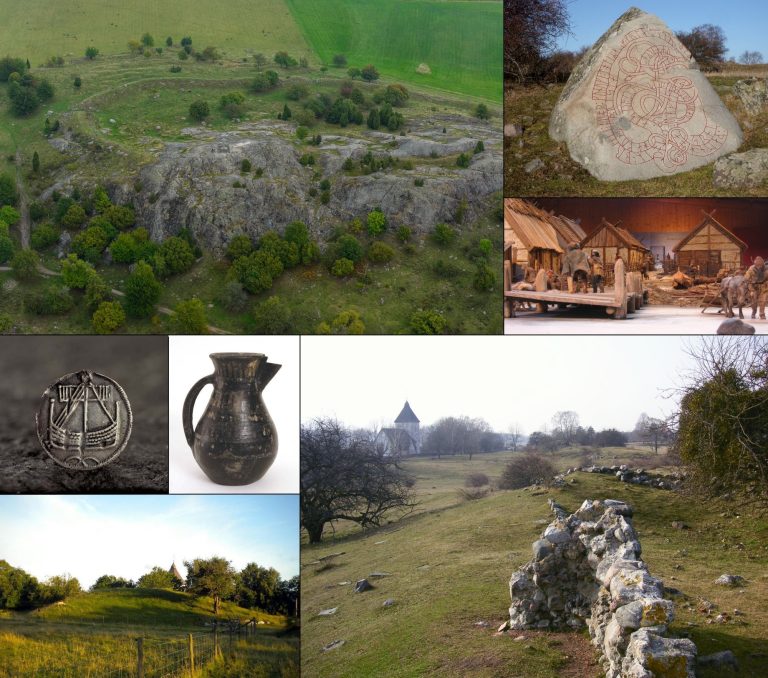
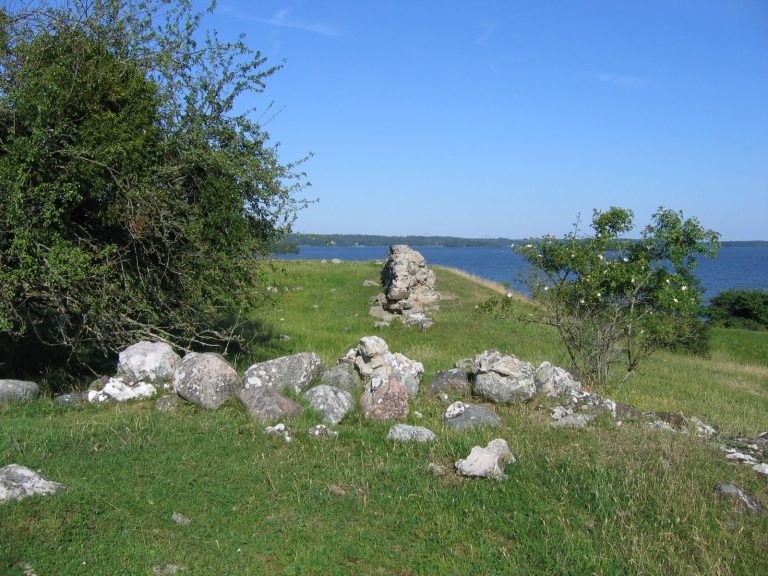
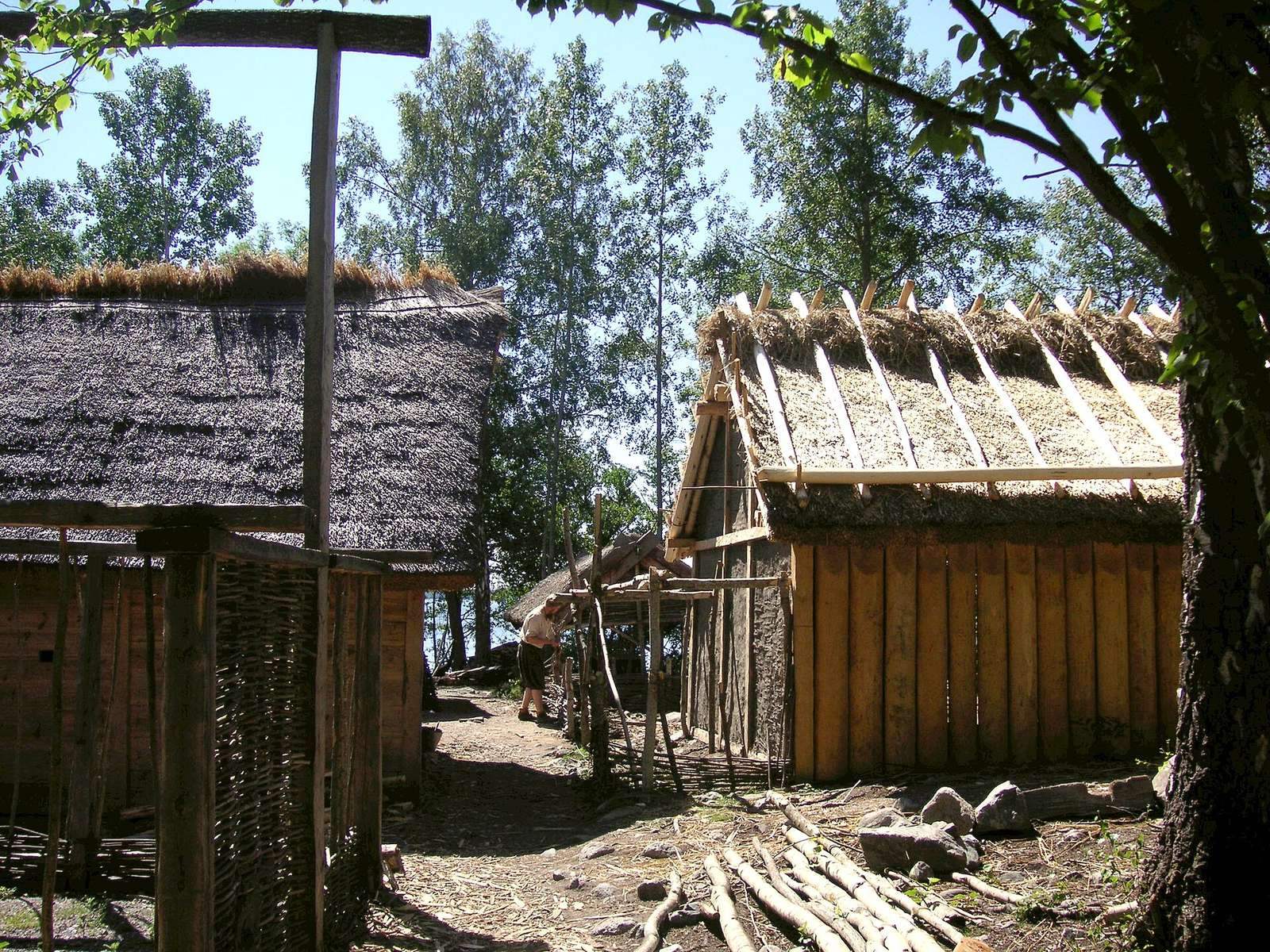
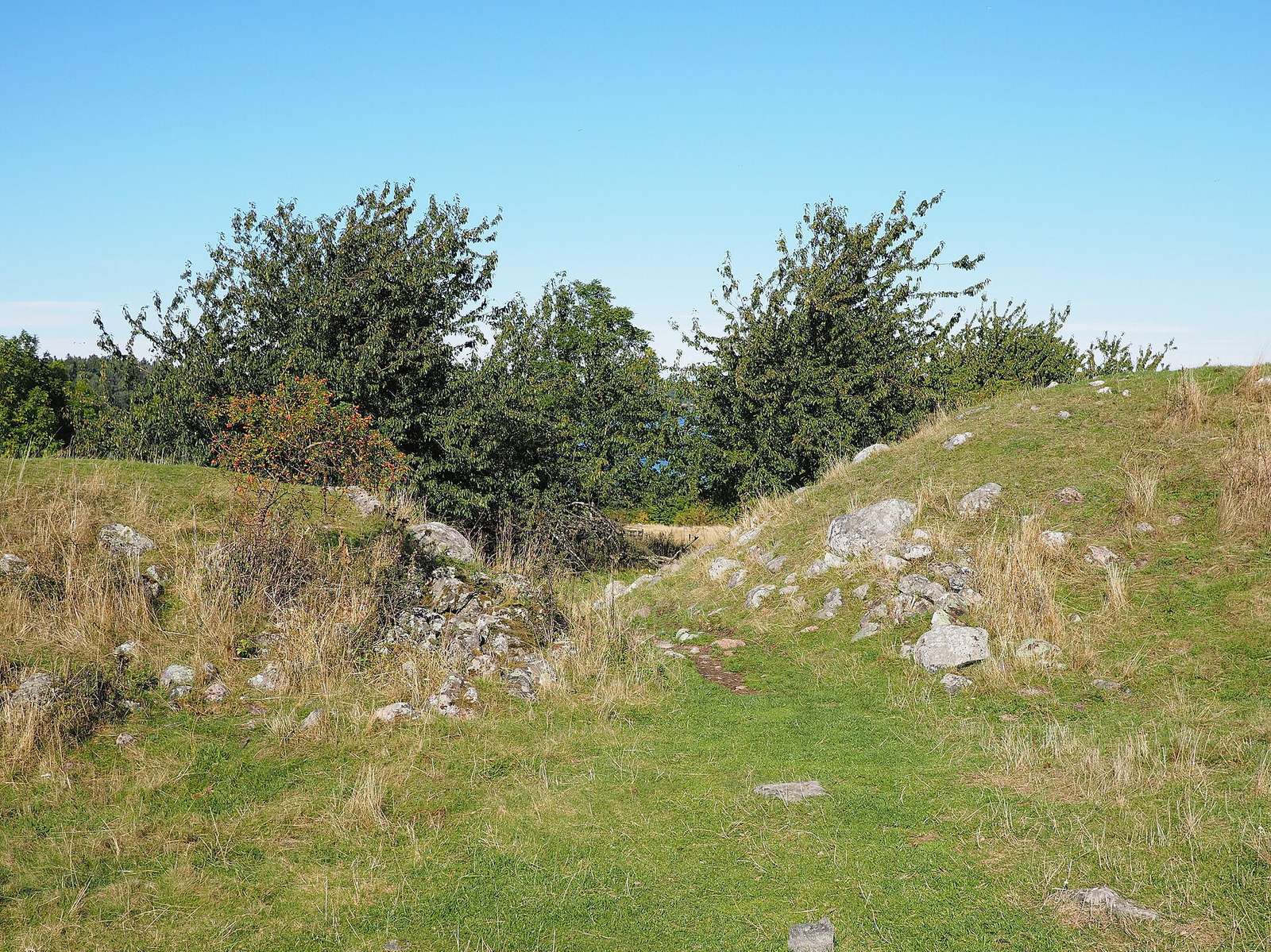
The archaeological remains cover about seven hectares in northern Björkö, an island in Lake Mälaren roughly 30 km west of Stockholm. Buildings and burial grounds form the principal features of the site. Wood was the main building material.
Settlement landscape and harbor
Buildings, fort, and harbor
A fortified enclosure called Borgen lies in the southern part of the archaeological area. Birka also had a harbor facing north. Adam of Bremen described its inlet as sheltered but hazardous because submerged rocks extended along it for more than 18 km. He portrayed the anchorage as a gathering place for trading ships from among the Danes, Norwegians, Slavs, and other peoples.
Assembly ground and Hovgården
An open plain at Birka served for public meetings, with a raised platform arranged for a council. Herigar’s church stood near this gathering place. Across the water on neighboring Adelsö are the remains of Hovgården, an estate where the king’s attendants stayed during visits. Birka’s administrative center is thought to have been outside the settlement, on Adelsö.
Burial grounds and finds
More than 3,000 graves have been identified at Birka, including cremations, coffin burials, and burials in constructed chambers. Skeletal evidence and grave goods have led researchers to identify most of the burials as female. Nancy L. Wicker has suggested that the pattern may partly reflect differences in how confidently graves can be classified from their contents.
Textiles
Excavations recovered about 4,800 textile fragments, most from chamber graves. Geijer’s 1938 study examined around five percent of them. The fabrics, chiefly wool and flax, range from coarse to fine and include plain weave, diagonal-ribbed twill, and narrow bands made with weaving tablets. One three-end twill pattern, woven with three lengthwise threads, has not been found elsewhere in Northern Europe. Geijer proposed that some textiles were imported and that fragments incorporating silk and gold or silver wire might have come from the East, possibly China.
In 2017, textile researcher Annika Larsson interpreted one fragment as bearing the Arabic words “Allah” and “Ali,” repeating the interpretation in 2020. Stephennie Mulder instead identified a geometric design, arguing that the proposed square Kufic, a geometric style of Arabic writing, was not used before the fifteenth century, while the textile dates to the tenth. Larsson also proposed that the woven band extended beyond Geijer’s drawing. Textile specialist Carolyn Priest-Dorman argued that its finished edges made such an extension implausible, and physical evidence did not support the proposed expansion.
Imported goods and personal objects
Graves contain glass and metalware, pottery from the Rhineland, Chinese silk, Byzantine embroidery made with very fine gold thread, gold-decorated brocades, and finely plaited cords. These objects may have been imported luxuries or belongings of people from abroad who were buried at Birka. A 45 mm decorative dragonhead made from tin alloy was also found. Sven Kalmring and Lena Holmquist argue that it was cast in a carved soapstone mold, based on casting traces and comparable molds from the site. Similar dragonheads occur around the Baltic and may have been worn as dress pins.
Religious objects
Ten small silver crosses have been recovered from graves. Small pendants shaped like Thor’s hammer, a religious object associated with the Norse god, occur in 27 graves and date to around the tenth century. Together, the crosses and pendants show that Christian and traditional Norse religious objects were present at Birka.
A child’s burial
Grave Bj 463 held a girl from the mid-tenth century in a coffin. Her grave goods included a small round copper-alloy brooch decorated with animal motifs, glass beads, and a needle case. Her teeth indicate that she was about five or six years old, and analysis suggests that her diet resembled that of male warriors more than a typical child’s diet. Marianne Hem Eriksen has described the burial as an unusual high-status burial of a child, since children were seldom buried with identifiable goods. Comparable animal-decorated brooches from Birka are associated with women’s burials and jewelry.
Coins
Silver dirhams, coins used in the medieval Islamic world, make up most of the coins found at Birka. English and Carolingian coins are rare; coins from Haithabu, a major Viking Age trading settlement in what is now northern Germany, and other Scandinavian mints also appear from the ninth century onward. One dirham has Arabic writing but no imagery, and names its mint, a caliph, or ruler, and an amir, or commander or governor. The mint named on it is identified as al-Shah, corresponding to present-day Tashkent in Uzbekistan.
Shipyard
In 2022, archaeologists announced the discovery of a Viking Age shipyard in Lake Mälaren’s former shoreline zone. It includes a stone-lined depression with a wooden boat slip at its base. Finds there include large numbers of used and unused boat rivets, slate sharpening stones, and woodworking tools.
The complete archaeological collection from Björkö is held at the Swedish History Museum in Stockholm, where many of the objects are exhibited. A silver-alloy ring set with pink-violet oval glass is among them. Stolpe found it in a ninth-century woman’s grave during excavations between 1872 and 1895. The inscription on the glass resembles the word “Allah,” but some scholars interpret it as decorative writing that imitates Arabic script rather than meaningful Arabic. Arabic historical linguist Marijn van Putten argued that it has no meaning in Arabic, while other analysts have read it as Arabic. Mulder also considered the ring misinterpreted, while noting that Arabic writing on the ring and other Birka objects may have conveyed status. If meaningful, the inscription could indicate that its owner belonged to an elite with contacts in the Islamic world through trade or travel.