Berge Village Church (Gardelegen): A Late-Medieval Evangelical Church in Germany


Site at a Glance
- Rating
- 5
- Popularity
- Very Low
- Country
- Germany
- Primary era
- Medieval
- External website
- Open
- Eras represented
- Medieval, Early Modern, Modern
- Civilizations
- German, Holy Roman Empire, Margraviate of Brandenburg
- Site type
- Religious
- Remains
- Church
On this page15 sections
History
Berge Village Church is an Evangelical village church in Gardelegen, Germany, whose origins probably lie in the late medieval period. Its pointed-arch north portal suggests construction toward the end of the fifteenth century, during the Late Gothic phase of medieval architecture, known for pointed arches and increasingly elaborate design. The church became known as the “Sistine Chapel of the Altmark” because of its unusually rich decoration for the region, a comparison with the Vatican chapel renowned for its monumental Renaissance decoration.
Late-medieval origins and decoration
Probably during the same period, the church’s windows were enlarged and its interior was given an extensive program of ceiling and wall paintings, together with a unified group of furnishings. The paintings remained concealed until their uncovering in 1964, which brought the church’s late-medieval decorative character back into view.
Later use and preservation
The church continued to receive furnishings and memorials in the seventeenth century. Its organ was built in 1885 by the Stendal organ builder Robert Voigt. Martin Lohdahl restored it in 2020 and installed an Orgamat during the work. The church belongs to the Estedt parish area within the Salzwedel church district of the Evangelical Church in Central Germany.
Remains
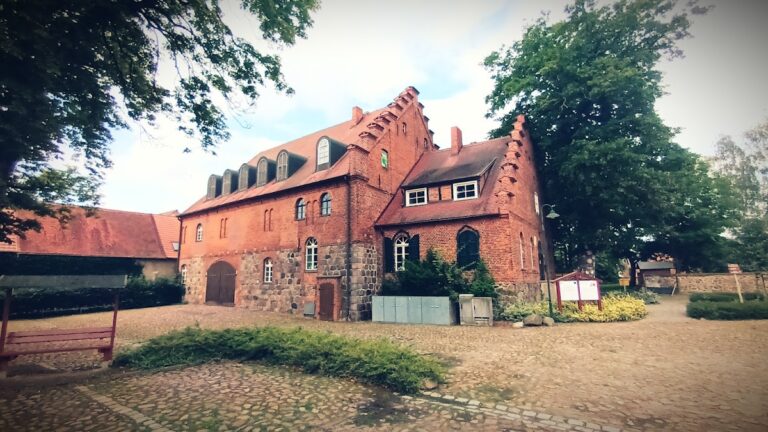
The church is a long, rectangular hall built from fieldstone, using naturally occurring, roughly shaped stones rather than regularly cut masonry. A half-timbered tower rises above the western part of the building. Its structural timber frame has brick infill. Two north entrances belong to different phases and designs, while the interior preserves a wooden vaulted ceiling, extensive painted decoration, and furnishings from the late sixteenth through the nineteenth centuries.
Building and painted interior
North entrances and tower
One north portal has a pointed arch and reflects the church’s late-medieval phase. A second north portal is an elaborate main entrance framed with strapwork, a flat ornament resembling interlaced bands. Above it is an alliance coat of arms combining the heraldic arms of the von Alvensleben and von Klinken families, dated 1609. The western tower is built in half-timbering with brick-filled panels.
Vault and wall paintings
The interior was probably originally covered by a flat ceiling. It is now closed by a wooden barrel vault with applied moulded ribs, whose intersections carry hanging pinecones. Numerous angel putti playing musical instruments fill the painted vault. At its crown, angels carry the Instruments of the Passion, objects associated with Christ’s suffering and Crucifixion. The transition between the vault and the north and south walls contains the Evangelists, Matthew, Mark, Luke, and John, together with Apostles, Christ’s principal early disciples. Painted scrollwork frames the windows, and the eastern round window has additional grotesque ornament.
Liturgical furnishings
Altarpiece
The principal altar furnishing is an altarpiece set within a richly ornamented architectural framework. Its central panel contains a relief of the Last Supper before a painted interior, while the upper section shows the Crucifixion. Figures of the Evangelists flank the composition, and lower figures stand in niches between pilasters. Grotesques form the side elements, while some of the elaborate scrollwork and strapwork is painted instead of carved.
Pulpit
Moses, a major biblical prophet and lawgiver, supports the pulpit. Its hexagonal basket and stairway retain seven Apostles from an original eight, along with the Judge of the World. Four reliefs on the basket represent the Annunciation, the Adoration of the Shepherds, the Crucifixion, and Christ’s Resurrection. Heraldic reliefs on the stairway are associated with Sophia von Münchhausen, Hans von Alvensleben, Sophia von Klinken, and Sophia von Saldern. On the soundboard, putti carrying the Instruments of the Passion appear between mascarons.
Baptismal font
The hexagonal baptismal font combines sandstone and marble. Strapwork decorates its shaft, while the basin shows the Baptism and Circumcision of Jesus and the Evangelists set between grotesques. Some of the representations are damaged. Angels’ heads form the frieze around the rim, and the lantern-shaped cover is crowned by a dove representing the Holy Spirit. The cover bears the date 1610.
Seating and memorials
Gallery and seigneurial pew
A seigneurial pew, a designated seating area for a church lord or other high-ranking patron, stands on the north side. Three partly turned columns support it, and its balustrade panels contain scenes from the life of Christ within painted scrollwork frames dating from the late seventeenth century. Simple pastor’s and confessional seats stand beneath the pew, with back walls divided by pilasters. The western gallery dates from the beginning of the seventeenth century.
Tombstones
Two children’s tombstones carry low-relief representations of the deceased. One commemorates Ludolph von Alvensleben, who died in 1597, and includes an ancestral proof. The other commemorates Hans Clamer Moller, who died in 1609. Several seventeenth-century tombstones of pastors are mounted on the exterior north wall.
Organ
Robert Voigt’s 1885 organ has twelve stops distributed across two manuals, keyboards played by the hands, and a pedal, the keyboard operated by the feet. Its mechanical cone chest uses cone-shaped valves operated mechanically to control the air supplied to the pipes. The instrument is largely preserved in its original condition and was restored in 2020.