Beopjusa: A Historic Buddhist Temple on Songnisan
Site at a Glance
- Rating
- 4.5
- Popularity
- Medium
- Country
- South Korea
- Primary era
- Early Modern
- External website
- Open
- Eras represented
- Medieval, Early Modern, Modern
- Civilizations
- Goryeo, Joseon, Silla
- Site type
- Religious
- Remains
- Monastery
On this page20 sections
History
Beopjusa is a Buddhist temple on Songnisan in Boeun County, South Korea, traditionally founded in 553 during the Silla period by the monk Uisin. Affiliated with the Jogye Order, the dominant Seon, or Korean Zen Buddhist, tradition, it serves as the order’s fifth district head temple. The temple has also been associated with Beopsang, a Buddhist tradition concerned with consciousness and perception, and with devotion to Maitreya, the Buddha expected to appear in a future age.
Foundation and Silla development
According to tradition, Uisin returned from India carrying Buddhist scriptures on a white mule. The animal stopped at the place where the temple was established, and the name Beopjusa, meaning “Residence of Dharma,” refers to the scriptures housed there. An ICOMOS evaluation instead connected the temple’s establishment with the eighth-century monk Jinpyo and his disciple Yeongshim. These accounts preserve different explanations for the temple’s beginnings.
Beopjusa was rebuilt in 720 during the reign of Silla King Seongdeok and again in 776 under King Hyegong. These rebuilding phases established a long pattern of renewal that continued through later dynasties.
Goryeo expansion and royal patronage
During the Goryeo dynasty, which followed Silla and gave Korea its modern name, Beopjusa expanded as prominent monks successively resided there and undertook repeated reconstructions. The temple was one of the 31 head temples of the period, and descriptions associate it with a monastic population of as many as 3,000 monks.
In 1363, King Gongmin ordered a Buddha relic from Tongdosa to be enshrined at Beopjusa. A reliquary stupa connected with this event remains behind Neunginjeon. The temple also hosted a gathering of the Humane Kings Sutra sponsored by King Sukjong for his brother Uicheon, when as many as 30,000 monks reportedly assembled there.
Joseon change and wartime destruction
The Joseon dynasty, which ruled Korea from the late fourteenth to the early twentieth century, continued to provide royal support to Beopjusa. King Sejo supported the monk Sinmi, who lived at Bokcheonam, and helped promote a major rebuilding. By the middle of the Joseon period, the complex reportedly contained more than 60 buildings and about 70 hermitages.
Beopjusa’s state support later declined, and the institution contracted from its earlier scale. A local tradition also associates the surrounding area with King Taejo, who is said to have retired nearby after conflicts among his sons.
During the Japanese invasions of Korea in the 1590s, Beopjusa became a base for monk soldiers in Chungcheong Province. The ensuing warfare destroyed most of the temple’s wooden buildings, although stone works including the Twin-Lion Stone Lantern and Stone Lotus Basin survived. Reconstruction proceeded from 1605 to 1626 under the leadership of the monks Samyeong and Byeogam Gakseong, creating the major early seventeenth-century rebuilding phase represented at the site.
Modern additions and heritage recognition
In 1939, the resident monk Jang Seoksang commissioned the sculptor Kim Bokjin to develop a Maitreya image. Work was suspended for a time and completed in 1964. A separate bronze Maitreya statue, 33 metres high, was constructed in 1990 and covered with a gold-coloured finish in 2002.
Beopjusa became Historic Site No. 503 in 2009. The temple and its surrounding cultural landscape are also associated with Scenic Site No. 61 and two natural monuments. In 2018, Beopjusa joined the UNESCO World Heritage property Sansa, Buddhist Mountain Monasteries in Korea, inscribed under criterion (iii) for its evidence of a living or vanished cultural tradition. The site contains three Korean National Treasures and at least twelve Treasures, along with regional cultural properties and cultural-heritage materials that represent Silla, Goryeo, Joseon, and later Buddhist phases.
Remains
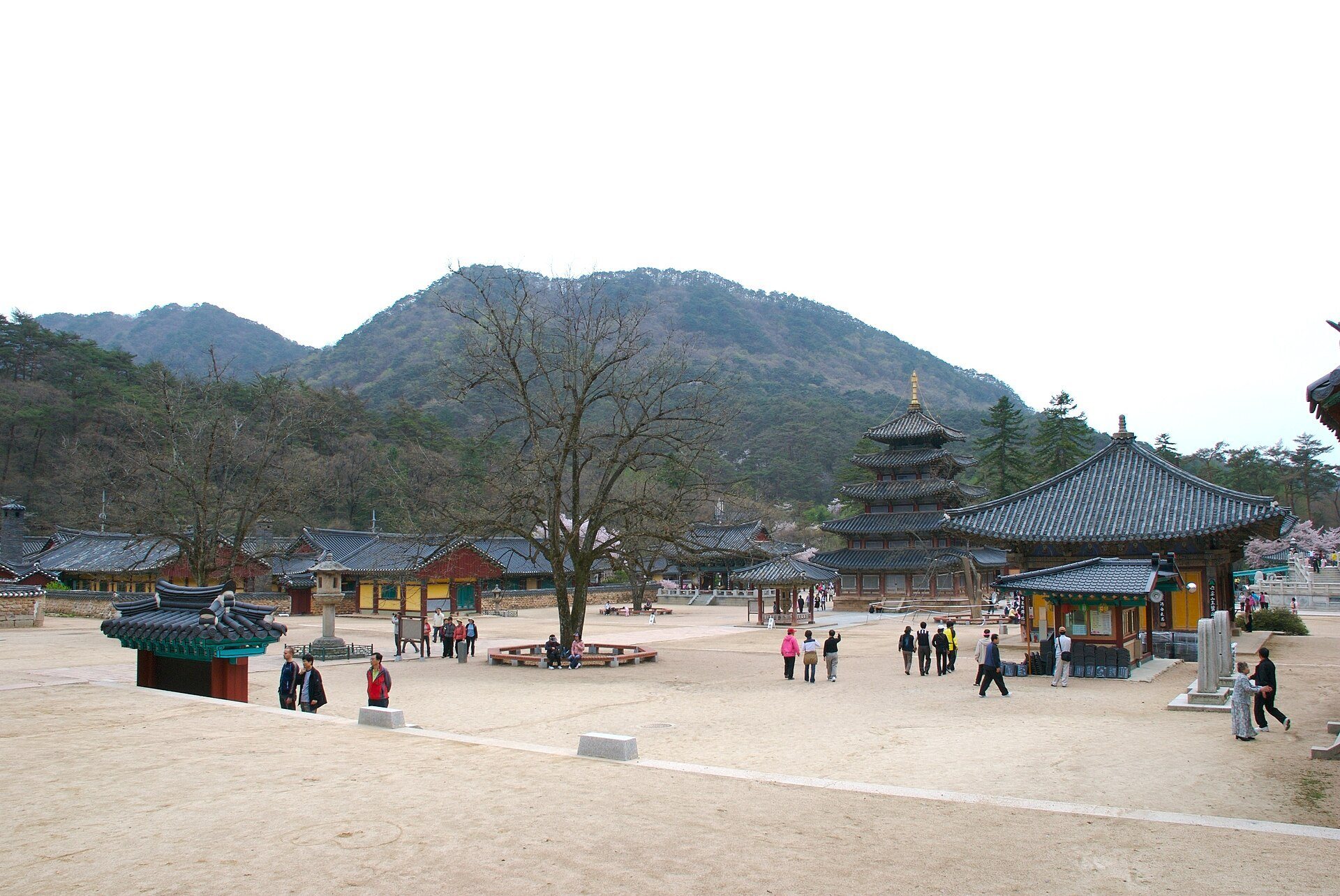
Beopjusa occupies a temple precinct on the slopes of Songnisan. Its recorded historic complex included more than 60 buildings and approximately 70 hermitages. The surviving landscape combines halls, hermitages, stupas, memorial monuments, inscriptions, natural rock surfaces, and stone installations from successive Silla, Goryeo, Joseon, and modern phases.
Wooden and principal temple buildings
Palsangjeon
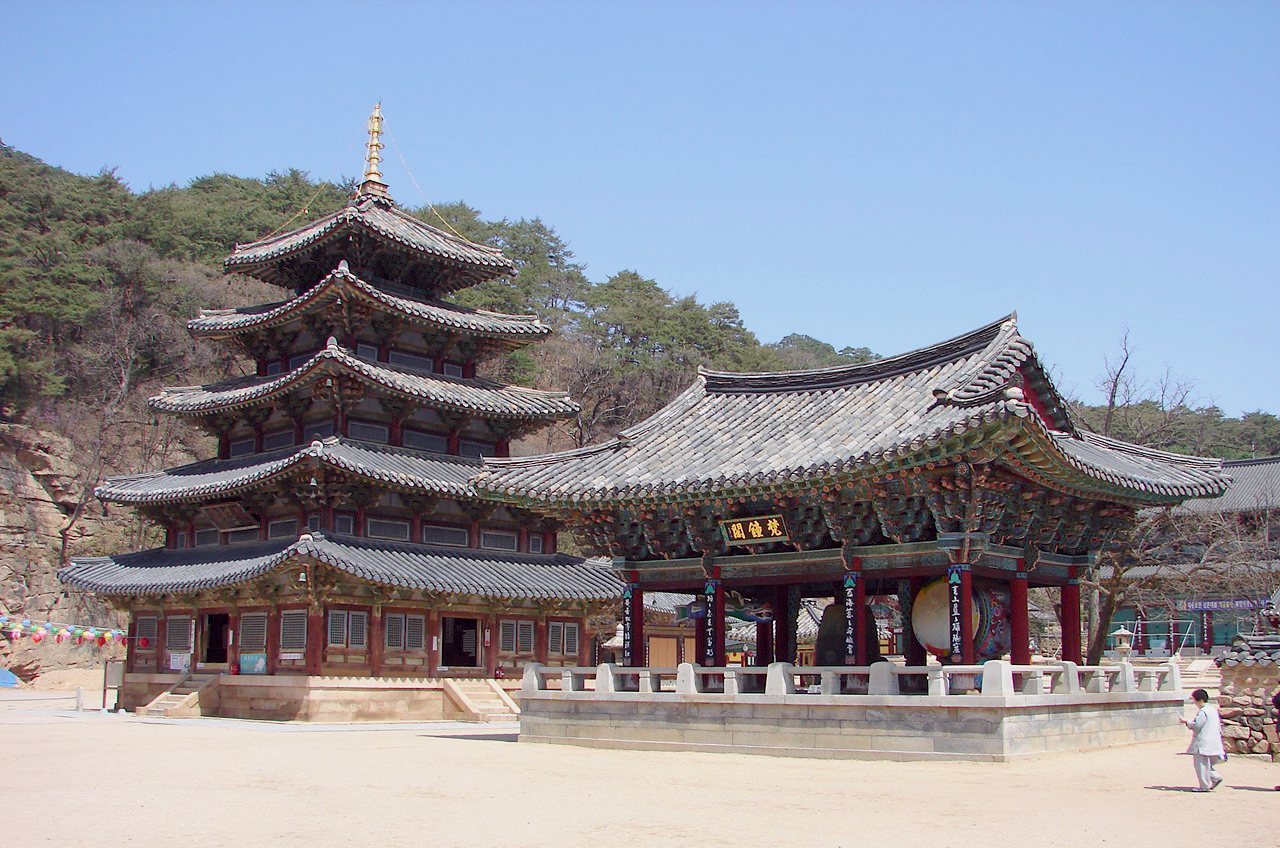
Palsangjeon is a five-story wooden pagoda and the only surviving Korean wooden pagoda of its type. Tradition places its foundation in 553, while its present form belongs to the reconstruction of the 1620s after repeated wartime damage. It was repaired in 1968. The name refers to the Eight Scenes painted inside, which present episodes from the life of Shakyamuni Buddha.
The scenes show the Buddha’s descent from Tushita Heaven, birth at Lumbini, excursions through the four gates, renunciation, ascetic practice in the Himalayas, defeat of Mara beneath the tree, first teaching at Deer Park, and final nirvana beneath the twin sala trees. The building also contains four gilt seated images of Shakyamuni Buddha and small white figures representing the Five Hundred Arhats, liberated Buddhist practitioners.
Main temple halls and hermitages
Daeungbojeon, the Main Buddha Hall, stands behind Seonhuigung Wondang. Other named components of the complex include Wontongbojeon, Sacheonwangmun, Neunginjeon, and Gung Hyeondang. Hermitage buildings at Bokcheonam and Sujeongam extend the surviving complex into the surrounding mountain setting.
Neunginjeon and relic monuments
Neunginjeon is associated with the Buddha relic placed at Beopjusa in 1363. The reliquary stupa connected with that enshrinement remains behind the hall. The precinct also contains the Sejon Sarira Stupa, Buddhist stupas, and numerous memorial steles. A sarira is a relic associated with the Buddha or an eminent Buddhist practitioner, while a stupa or pagoda can serve as its reliquary monument.
Silla stone works
Twin-Lion Stone Lantern
The Twin-Lion Stone Lantern is a Silla work probably made around 720. Two upright stone lions stand on their hind legs and support the octagonal roof with their forelegs, replacing the more usual central shaft of an octagonal lantern. The arrangement was traditionally understood to express the Buddha’s compassion and protection from the eight dangers.
Stone Lotus Basin
The Stone Lotus Basin is a stone lotus-pool installation probably created around 720. Three tiers of supports rise from an octagonal base to a lotus platform, making the basin appear suspended above the ground. The lotus imagery represents liberation from worldly impurity and escape from the cycle of rebirth.
Other carved and structural remains
A Buddha image is carved into the eastern rock face, and flagpole supports survive near the temple entrance. Other stone works attributed to the Silla period include the Four Heavenly Kings Stone Lantern and the rock-carved seated Buddha. The grounds also contain the Stone Pot, an earthenware-pot-shaped stone installation partially buried about 40 metres from Chongji Seon Center. Its original function is unknown, while local tradition identifies it as a stone kimchi jar.
Images, shrines, and inscriptions
Huigyeon Bodhisattva
The Huigyeon Bodhisattva image stands in an open-sided hall beside Palsangjeon. It rests on a foundation stone and carries a hot incense burner on its head. The form represents the bodhisattva’s vow to offer incense to the Buddha for eternity. A bodhisattva is a figure who seeks enlightenment while postponing final liberation in order to aid other beings.
Seonhuigung Wondang
Seonhuigung Wondang is a prayer shrine for Yeongbin of the Yi clan, a royal concubine of King Yeongjo and the mother of Crown Prince Sado. A wondang is a Korean Buddhist shrine established for the spiritual welfare of a deceased person, especially a member of a royal or aristocratic household. Its position behind Daeungbojeon represents the incorporation of a royal concubine’s shrine within a Buddhist temple.
Jajeong Gukjon Stele
The Jajeong Gukjon Stele is an upright inscribed monument cut into a natural rock cliff by royal order of King Chunghye. It commemorates the monk Jajeong Gukjon, who had attained the rank of National Preceptor.
Celestial chart screen
The Folding Screen of Celestial Charts contains 300 constellations and 3,083 stars. Kim Tae-seo and An Guk-bin produced it from charts made by I. Koegler during his stay in China in 1723. It is described as the largest and most accurate surviving copy of Koegler’s celestial charts and is thought to have been presented to Beopjusa when Seonhuigung Wondang was established.
Monastic infrastructure and wider precinct
The temple preserves a cistern and a large iron pot associated with the needs of its former monastic population. These installations relate to the period when Beopjusa reportedly served thousands of monks. The complex also includes the hanging Buddha banner, the modeled Vairocana triad, the wooden seated Avalokiteshvara, the stone standing Huigyeon Bodhisattva, and the memorial stupas of the monks Suam and Hakjo.
Further cultural properties are located at Bokcheonam, Munsuam, Sanggoam, and Sujeongam, including halls, paintings, stone pagodas, and seated Buddha images. Together with the main halls, rock carvings, inscriptions, relic monuments, and surviving stone installations, these features preserve the physical record of Beopjusa’s long development on Songnisan.