Nothgottes: A Gothic Pilgrimage Church and Monastic Site in Germany


Site at a Glance
- Rating
- 4.4
- Popularity
- Very Low
- Country
- Germany
- Primary era
- Medieval
- External website
- Open
- Eras represented
- Medieval
- Civilizations
- Holy Roman Empire
- Site type
- Religious
- Remains
- Church
On this page8 sections
History
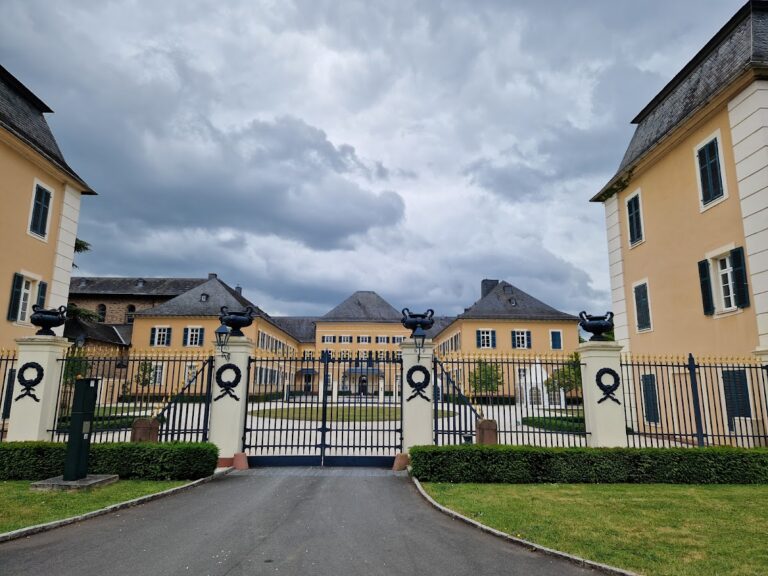
Nothgottes is a Catholic pilgrimage site and monastery in Germany, centered on a late-fourteenth-century Gothic pilgrimage church in the Eibingen district of Rüdesheim am Rhein. Its name means “Need of God,” and pilgrimage activity there dates from the fourteenth century. The site lies within the Diocese of Limburg and has formed part of the UNESCO World Heritage property Upper Middle Rhine Valley since 2002.
Medieval shrine and pilgrimage church
A chapel was built and consecrated at Nothgottes in 1390. Tradition attributes its foundation to the knight Johann Brömser von Rüdesheim, after one of his peasants found an image of Christ sweating blood while plowing and heard the words “Need of God.” Another tradition connects the chapel with a vow Brömser made during the Crusades to build three churches if he returned safely, with Nothgottes said to be the final one.
During the fifteenth century, the chapel was enlarged into a pilgrimage church. An indulgence granted in 1449, meaning a remission of certain temporal consequences of sin under conditions set by the Catholic Church, helped attract pilgrims to the shrine.
Monastery and early modern pilgrimage
Between 1620 and 1622, the Bishop of Mainz established a Capuchin monastery at Nothgottes. The Capuchins were a reform branch of the Franciscan Order that followed a stricter form of Franciscan religious life. The monastery remained in operation until 1813, when secularization led to its dissolution.
An annual foot pilgrimage from Kruft began in 1674, probably in fulfillment of a vow made during a plague epidemic. Oral tradition holds that the journey has continued without interruption. Members of the Nothgottes Brotherhood leave Kruft two days before reaching Nothgottes on the first Sunday of September, and the group numbers approximately 60 to 80 people.
Farm, estate, and religious care
Following the monastery’s dissolution in 1813, its buildings were sold and converted into a farm. Emma Frohn acquired the property in 1903, when it was in poor condition. With her husband, Anton Rust, she transformed the site into an estate. The former church became a concert hall, although pilgrims continued to be admitted.
After Frohn and Rust died, the Diocese of Limburg purchased the property. The Poor Handmaids of Jesus Christ, a Catholic women’s congregation devoted to charitable and pastoral work, used Nothgottes from 1932 until 1938 and cared there for children with disabilities. The Nazi regime expelled the sisters in 1937 and expropriated the buildings.
After the Second World War, the church returned to ecclesiastical ownership, and the sisters came back as an outpost of Marienhausen Monastery near Aulhausen. They left Nothgottes at the end of 1951. The Diocese of Limburg later used the site for education and spiritual retreats, operating it specifically as an education and retreat house from 1976 to 2006.
Recent monastic communities
The Community of the Beatitudes occupied Nothgottes from 2006 to 2012. This Catholic community combines contemplative and apostolic life. In September 2013, Vietnamese Cistercian monks from Chau Son Don Duong Abbey re-established a monastic community at the site, with additional personnel arriving in 2014. The Cistercians are a Catholic order originating in the reform movement at Cîteaux, traditionally emphasizing communal discipline, contemplation, and simplicity. The monks follow a contemplative way of life, and their services are open to the public. Father Anselm Cong Luan Tran has served as prior since September 2021.
The return of the Cistercians restored that order’s presence in the Rheingau 210 years after the former Cistercian Abbey of Eberbach ended in 1803.
Remains
Nothgottes stands at approximately 214 metres above sea level in a wooded valley of the Rheingau Hills. The valley opens southward toward Geisenheim, and the site lies north of the junction of the Kühtränker Graben with the Blaubach, whose valley extends southeast toward Geisenheim. The wooded summit of Nothgotteskopf rises to the northwest at 298.7 metres. A woodland clearing to the north ends at the ruins of Plixholz, while forested slopes rise southwest toward the unforested Ebental plateau. Nothgottesstraße runs southward and uphill along the valley slope toward Windeck, near Eibingen Abbey above the vineyards of Eibingen.
Gothic pilgrimage church
The pilgrimage church is Gothic, with a core dating from the late fourteenth century and enlargement during the fifteenth century. It forms a symmetrical, three-nave stepped hall, meaning that the central nave and side aisles rise in successive stages. Cross-ribbed vaults, supported by intersecting stone ribs, cover the interior, while the choir ends in a five-eighths polygon formed from five sides of an implied octagon. The gabled roof is less steep above the side aisles than above the central nave.
Roof turret and venerated image
Two bronze bells hang in the church’s roof turret, a small tower rising from the roof. The Otto bell foundry of Hemelingen in Bremen cast them in 1934, and they survived the Nazi-era destruction of church bells. Their stated disposition is G-sharp5 plus 2 and B5 plus 3. The venerated image associated with the foundation tradition was moved from Nothgottes to the museum in Rüdesheim.
Nearby sites