Rocca Estense: The Medieval Castle of San Felice sul Panaro
Site at a Glance
- Popularity
- Low
- Country
- Italy
- Primary era
- Medieval
- Eras represented
- Medieval, Early Modern
- Civilizations
- Holy Roman Empire, Italian
- Site type
- Military
- Remains
- Castle
On this page9 sections
History
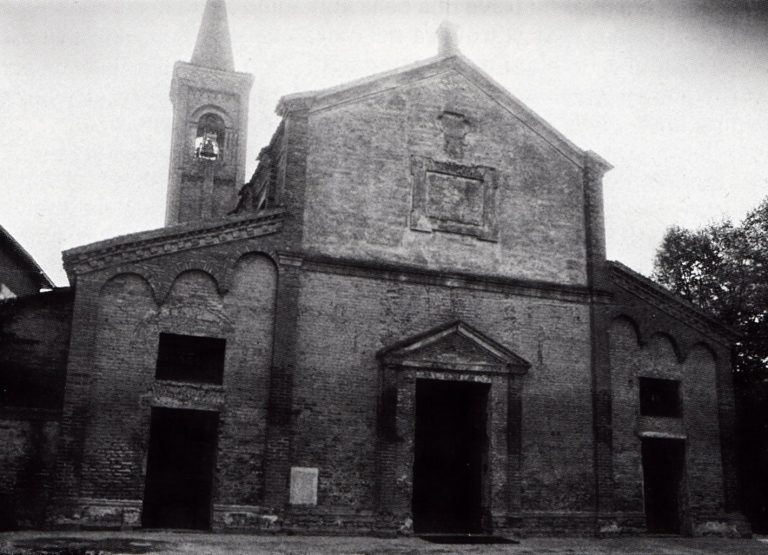
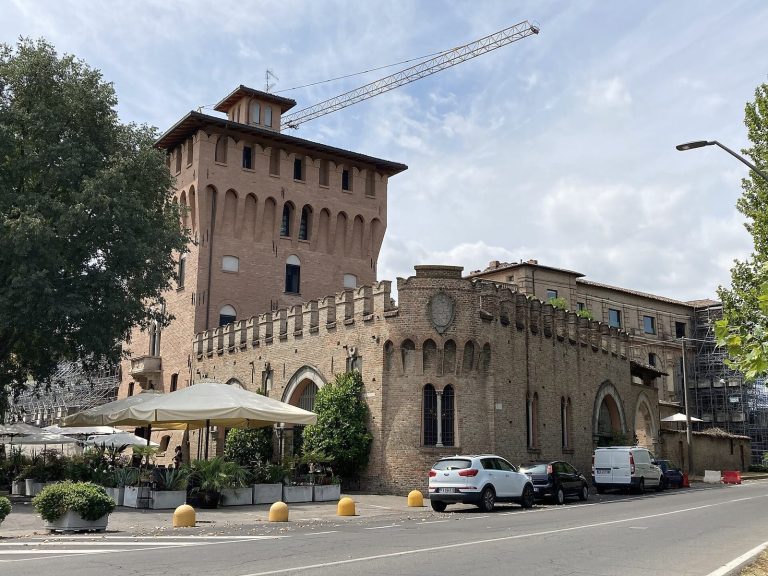
Rocca Estense is a castle in the historic center of San Felice sul Panaro, Italy, and the town’s principal historic monument. A castle stood here by the beginning of the tenth century, before the Este dynasty, a ruling house in northern Italy, began construction of the Rocca in 1340.
Early castle and changing control
The castle’s earliest documentary mention dates to 927. A charter signed in 929 by Hugh of Provence, a tenth-century king of Italy, also refers to it. From 1001 to 1227, the bishop of Modena ruled both the town and castle. They then passed to Modena’s Commune, its medieval civic government, and in 1228 became an Este possession.
Mantuan lord Rinaldo Bonacolsi, commonly known as Duke Passerino, captured the castle in 1312. After his defeat and death in 1328, the Pico family, associated with Mirandola, controlled it until 1338. Paolo Pico briefly regained control in 1346.
On 25 November 1332, Charles IV of Luxembourg, later Holy Roman Emperor, defeated the League of Castelbaldo at the Battle of San Felice. The league brought together the Este, Scaliger, and Gonzaga ruling houses.
Este fortress and civic role
Obizzo III d’Este began building the Rocca in 1340. The fortress took about twenty years to complete, with work ending around 1360–61. Its strong enclosing walls had already been damaged during a siege. In 1380, a castle officer called a castellan, responsible for command or administration, was appointed with the rank of captain.
In 1412, Niccolò III d’Este ordered repairs and additional defenses, assigning the work to military architect Bartolino da Novara. Further strengthening followed in 1421. The Este also granted the community a seal showing two eagles on towers; the design remains the municipal coat of arms.
Pope Julius II, who held office from 1503 to 1513, stayed at the Rocca on 2 January 1511 while travelling to the siege of Mirandola. The castle is also called Girone. The name’s origin is uncertain, but it may refer to the fortress rising above the town wall.
Residence, prison, and modern history
The Rocca became a residence in the seventeenth century and was converted into a prison in 1800. At the municipality’s initiative, it received recognition as a national monument in the early twentieth century. It later housed the municipal council chamber, the Quinto Tosatti cultural room, and the municipal library.
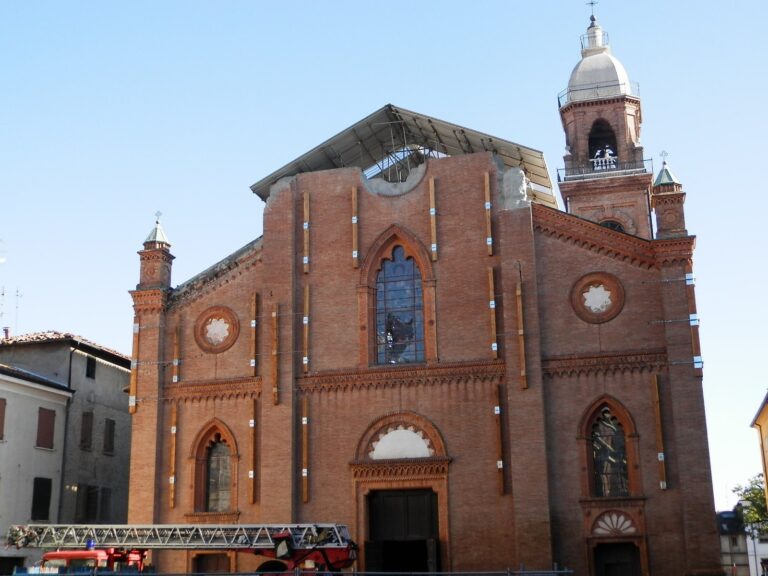
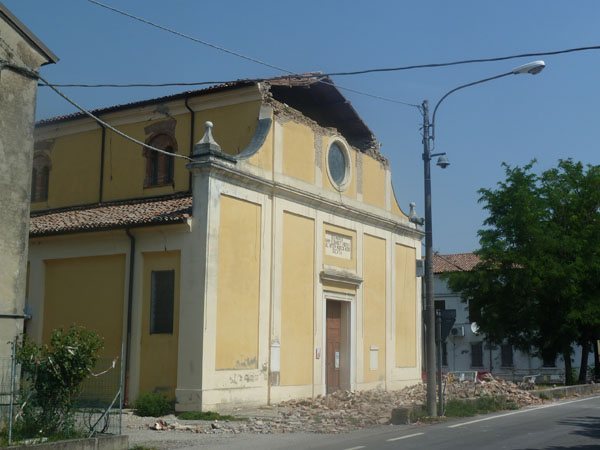
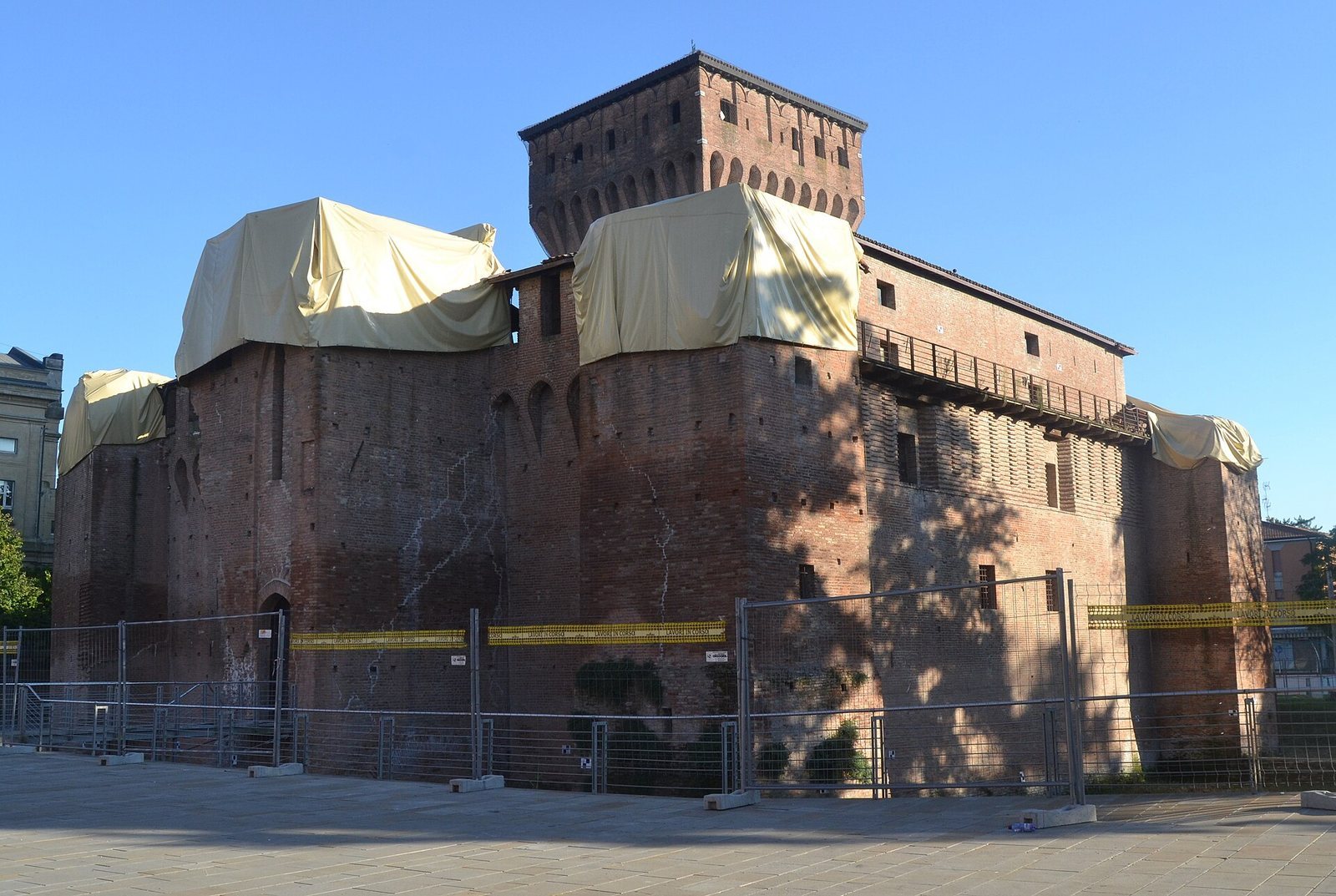
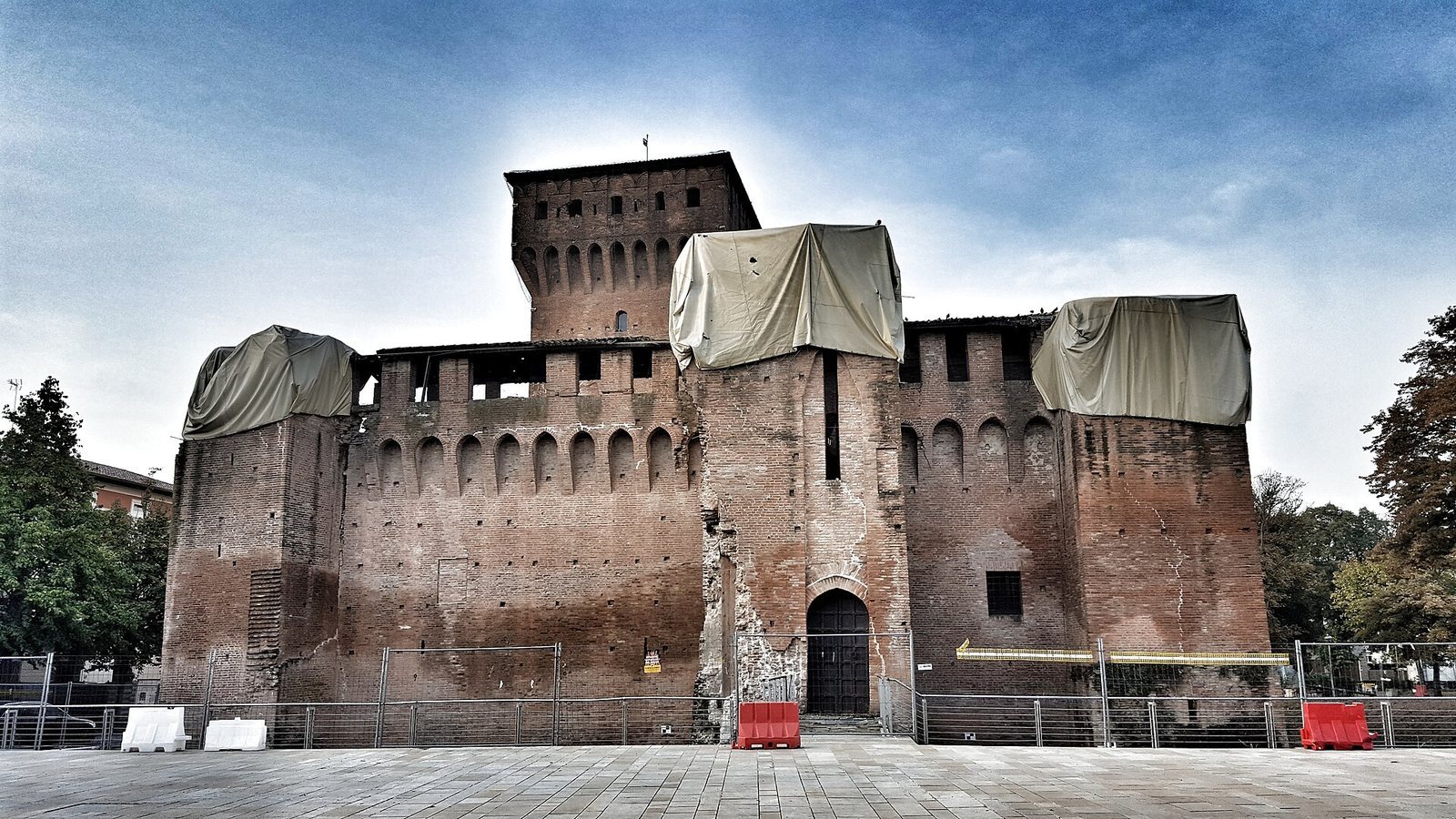
Earthquakes on 20 and 29 May 2012 damaged the castle. The first had a magnitude of 6.0, and the second worsened the damage caused by the first.
Remains
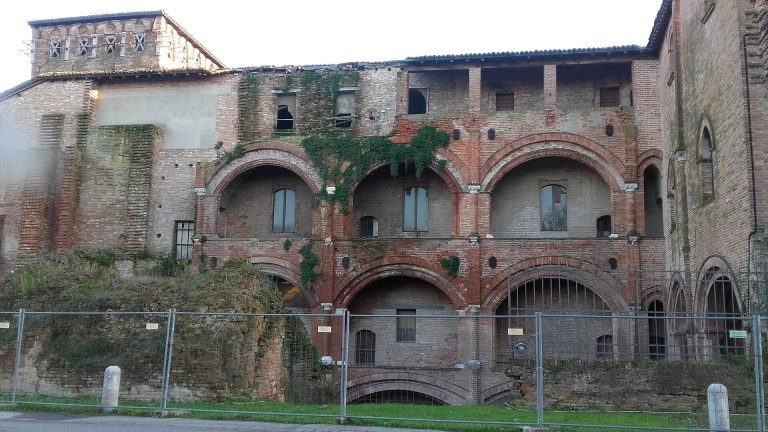
The brick castle has a four-sided plan, fortified outer structures, and a tower at each corner. The tall tower at the southeast corner is the keep, the castle’s principal fortified tower. Within the walls, the courtyard is centered on a well. Covered stairways connect it to the upper rooms and to paths along the wall tops.
Interior spaces
Ground-floor prisons
The ground floor contains the former prisons. Graffiti and drawings scratched into their walls remain as traces of the people held there.
Room of Pope Julius II
On the upper floor, the room known as the Room of Pope Julius II contains a fresco, a painting made on plaster, depicting Saint Anthony of Padua, a Franciscan friar and Christian saint, adoring the Child. An eighteenth-century fireplace is decorated with stucco, a plaster-based material.
Keep and archaeological exhibition
The keep contains numerous rooms. Frescoed coats of arms survive in its final hall, including the Este emblem of a white eagle against a blue background. A permanent archaeological exhibition dedicated to Giuseppe Venturini (1877–1965) was also housed in the tower. Its finds ranged from the Bronze Age to the modern period and included Bronze Age vases, ceramics imported from Gaul, an ancient region of western Europe, Attica, the region around Athens, and North Africa, and part of a Greek-marble Roman sarcophagus from the imperial period, when Rome was ruled by emperors.
The 2012 earthquakes collapsed the towers’ roofs and left severe cracks in the keep. The earthquake on 29 May aggravated the damage from 20 May.