Bedd Arthur: A Possible Neolithic Hengiform Monument in Wales
Site at a Glance
- Rating
- 4.6
- Popularity
- Very Low
- Country
- United Kingdom
- Primary era
- Stone Age
- Eras represented
- Stone Age
- Civilizations
- Unclassified
- Site type
- Civic
- Remains
- Megalithic Monument
History
Bedd Arthur is a possible Neolithic monument on the Preseli ridge in Pembrokeshire, Wales, United Kingdom. The Neolithic was the later Stone Age, when farming communities used stone tools. Bedd Arthur is described as a hengiform monument, a prehistoric enclosure with a bank and ditch, usually circular or oval. Its archaeological identity remains unconfirmed, and the site has not been excavated.
The name means “Arthur’s Grave.” Local folklore identifies the site as the burial place of King Arthur, a legendary British ruler whose historical existence is uncertain. Bedd Arthur is a scheduled monument, meaning it is legally protected from damage or disturbance.
The stone arrangement has been compared with the earliest form of Stonehenge, a prehistoric monument in Wiltshire, England. It has also been proposed, speculatively, as a possible model for or influence on Stonehenge’s bluestone horseshoe, but no connection is confirmed. Carn Menyn, which Bedd Arthur overlooks, has been suggested as a source of some of Stonehenge’s bluestones.
A 2011 study matched a group of rhyolite bluestones at Stonehenge, made from volcanic rock, with an outcrop at Rhosyfelin, about three kilometres north of Bedd Arthur. Investigation there in 2015 found no evidence of quarrying. This supports the possibility that the stones were carried east by ice as glacial erratics, rocks transported by a glacier or ice sheet, rather than indicating a Neolithic cultural link between the places.
Remains
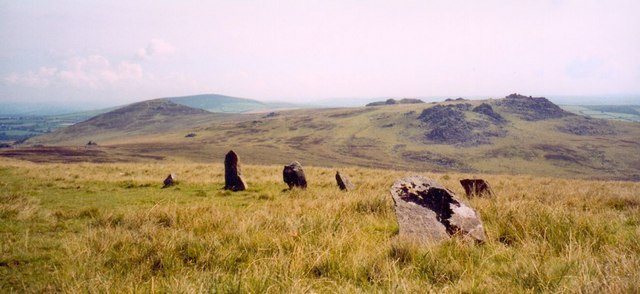
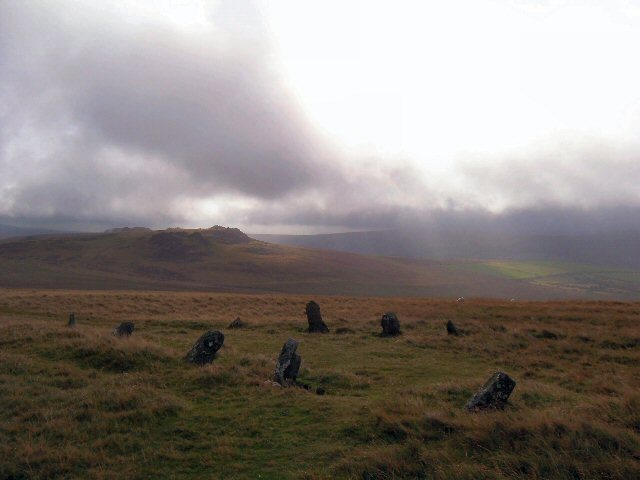
The site lies along the Preseli ridge and overlooks Carn Menyn, a rocky outcrop. Its low bank and ditch are barely visible. Inside them, thirteen upright stones, each no more than about 60 centimetres high, and at least two fallen stones form a setting approximately 20 by 10 metres. The enclosure’s indistinct outline has been interpreted in several ways, including as rectangular, sub-rectangular, oval, horseshoe-shaped, or pointed-elliptical. The standing stones themselves form an oval or horseshoe pattern.
The stones appear to lean inward, perhaps because they once stood along the sides of a mound. A burial chamber may have occupied the centre of the setting. Erosion or grave hunters could have removed the mound, as has also been proposed for Bedd yr Afanc, a passage grave, or burial chamber reached by a passage, on the north side of Mynydd Preseli. One end of Bedd Arthur’s setting is truncated, a feature compared with entrance-like forms at some elongated Neolithic burial mounds.