Batterie de Sermenaz: An Artillery Fortification in France


Site at a Glance
- Rating
- 4.6
- Popularity
- Very Low
- Country
- France
- Primary era
- Modern
- External website
- Open
- Eras represented
- Modern
- Civilizations
- French
- Site type
- Military
- Remains
- Fort
On this page6 sections
History
Batterie de Sermenaz is a former artillery fortification in France, built in 1878–1879 on the Sermenaz Plateau in Neyron. Also known as Fort de Sermenaz or Batterie de Gribeauval, it formed part of Lyon’s second fortified belt, a network of defensive works surrounding the city. Associated with Fort de Vancia, it helped protect a gap in Vancia’s defensive coverage.
Construction and military role
The fortification was established on the plateau, also called Mont Goitron, as an artillery position. Its arrangement included seven gun ports and supporting defensive structures, allowing the battery to contribute to the wider protection of Lyon alongside Fort de Vancia.
Wartime use and later stewardship
In 1943, the Camp Didier maquis, a clandestine armed resistance group active in France during the Second World War, used the battery to store weapons and ammunition. The fort is now owned by the Municipality of Neyron and has been decommissioned.
Between 2013 and 2019, the French National Forestry Office carried out rehabilitation work in the surrounding forested area, including the planting of 500 trees. Since September 2020, the Forts pour demain initiative has involved planting fruit trees around the fort.
Remains
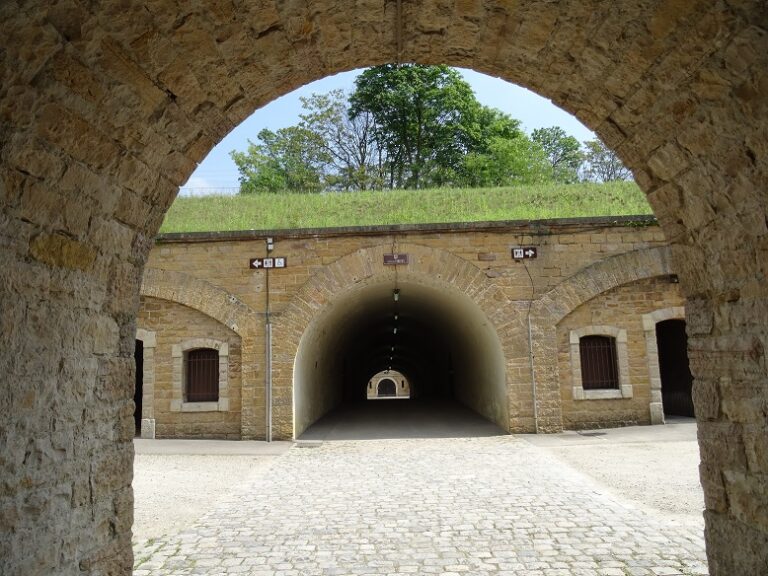
Batterie de Sermenaz retains the basic arrangement of a compact artillery fortification enclosed by a ditch. Its defensive perimeter contained seven gun ports, while the central area held accommodation and ammunition facilities protected by earthworks.
Ditch and artillery defenses
The ditch was crossed by a rolling bridge. Two caponiers, fortified structures projecting into or alongside a ditch so defenders could fire along it, covered the bridge and helped protect the ditch from assault. The artillery position was not modernized with special concrete and was excluded from the 1900 modernization program.
Barracks and powder magazine
A central earth mound protected the barracks, which housed a garrison of 75 men. The artillery was supplied by a powder magazine with a capacity of 26 tons, forming the principal ammunition facility within the fortification.