Basilica of Santa Margherita: A Gothic Revival Sanctuary in Cortona


Site at a Glance
- Rating
- 4.7
- Popularity
- Medium
- Country
- Italy
- Primary era
- Modern
- External website
- Open
- Eras represented
- Medieval, Early Modern, Modern
- Civilizations
- Grand Duchy of Tuscany, Italian
- Site type
- Religious
- Remains
- Basilica
On this page10 sections
History
The Basilica of Santa Margherita is a Roman Catholic sanctuary in Cortona, Italy, dedicated to Margaret of Cortona, the thirteenth-century saint associated with the town. The present church is a Gothic Revival building whose history reaches back to an eleventh-century religious foundation, and it belongs to the Diocese of Arezzo-Cortona-Sansepolcro.
Medieval Foundation
The site began with a small oratory dedicated to Saint Basil, built by Camaldolese monks beside a smaller chapel dedicated to the same saint. The Camaldolese were members of a Benedictine reform tradition founded at Camaldoli in Italy. In 1258, the church and its adjoining convent suffered damage during the siege of Cortona by Arezzo. The complex was rebuilt in 1288 through the efforts of Margaret of Cortona, a Franciscan tertiary, meaning a lay person affiliated with the Franciscan order without necessarily living in a religious community. After the rebuilding, it was dedicated to Saints Basil, Giles the Hermit, and Catherine of Alexandria.
Margaret died in 1297 in a room behind the old church, where she had lived during the final years of her life. She was buried in the wall of the Chapel of Saint Basil, at approximately the location now occupied by the third altar on the left side of the nave. The basilica’s foundation is dated to 1304. By 1330, the people of Cortona had constructed a larger church designed by Giovanni Pisano, partly to provide a setting for Margaret’s relics. Her relics were exhumed in 1456 and became objects of veneration. Margaret was canonized in 1728.
Rebuilding and Basilica Status
The church underwent major enlargements and reconstructions in 1738 and again between 1874 and 1878. The nineteenth-century work by Enrico Presenti and Mariano Falcini produced the building’s present Gothic Revival form, using medieval Gothic forms such as pointed arches, vertical emphasis, and ribbed vaulting in a later period. Domenico Mirri designed the façade, which was completed by Giuseppe Castellucci in 1896.
The church was raised to the status of a minor basilica in 1927. This is a special honorific designation granted by the Catholic Church to churches recognized for religious, historical, or pastoral importance. The basilica remains an active Roman Catholic church, with a Franciscan monastery standing behind it.
Remains
Setting and Surviving Medieval Fabric
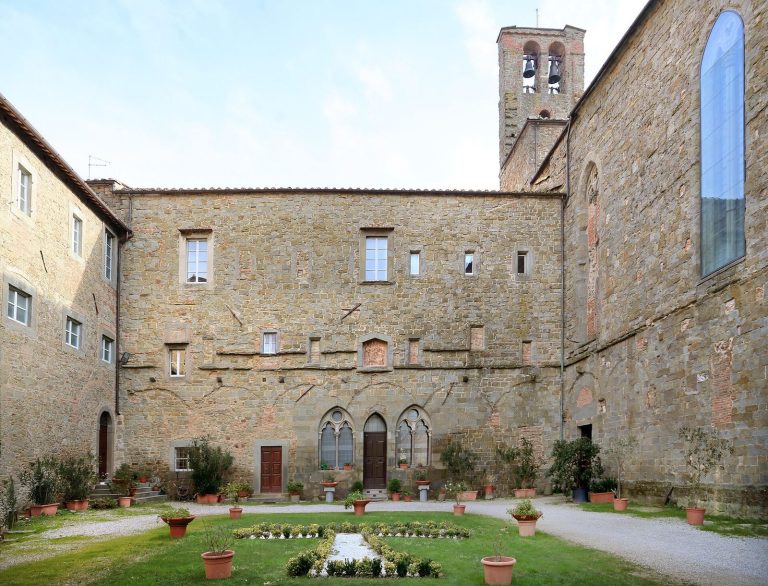
The basilica stands on Cortona’s hillside, just below the Fortezza Medicea, a Medici-era fortress. It occupies the intersection of Via delle Santucce and Via Sant Margherita. The earlier church was an oratory approximately 15 metres long beside the Chapel of Saint Basil. The later church, approximately 30 metres long, incorporated the old building into its nave. The choir and the second and third vaults of the central nave survive from the original church, while a bell tower dated to 1650 stands behind the basilica beside the Franciscan monastery.
Chapels, Altars, and Memorials
Margaret’s Mausoleum and Reliquary
On the left side of the transept is a richly worked marble mausoleum produced by Sienese workshops and designed by Pietro Berrettini. Near the main altar stands a silver reliquary casket dated 1774, also designed by Berrettini. A reliquary casket is a container made to preserve and present a saint’s remains or relics; this one displays Margaret’s incorrupt body.
Altars and Religious Images
A marble statue of Margaret, sculpted by Vincenzo Pacetti and dated 1781, stands in a niche on the right side of the church. The second altar on the right holds an altarpiece showing the Virgin and Saint Elizabeth of Hungary by Jacopo da Empoli. Another altar on the right contains a thirteenth-century wooden crucifix that originally came from the Church of San Francesco in Cortona. Margaret is traditionally said to have prayed before it.
The right-hand walls display relics and captured standards donated by the Knights of Malta stationed in Cortona. The first altar on the left formerly held Francesco Vanni’s altarpiece of Saints Louis of Toulouse, Francis, Dominic, and Margaret. The second altar formerly held Pietro Giannotti’s painting of the Massacre of the Innocents. The main altarpiece formerly contained Luca Signorelli’s large Deposition, which is now preserved in the Diocesan Museum.
War Memorial Chapel
The left side of the nave contains a large chapel commemorating people from Cortona who died in war. Osvaldo Bignami decorated the chapel with frescoes, adding a modern memorial space to the basilica’s sequence of medieval and later religious features.
Preserved Artistic Remains
Fragments of a fresco from the church attributed to Pietro Lorenzetti are preserved in the Diocesan Museum. The basilica’s artistic history also includes fourteenth-century frescoes, including one attributed to Barna da Siena, and numerous canvases that were formerly kept inside the church and later moved or dispersed.