Castello di Reschio: A Medieval Fortified Castle in Umbria


Site at a Glance
- Rating
- 4.7
- Popularity
- Low
- Country
- Italy
- Primary era
- Medieval
- External website
- Open
- Eras represented
- Medieval
- Civilizations
- Holy Roman Empire, Papal States
- Site type
- Military
- Remains
- Castle
On this page9 sections
History
Castello di Reschio is a medieval fortified castle in Italy, situated in the municipality of Lisciano Niccone in the province of Perugia. It formed part of a chain of walled settlements in Umbria, near the boundary between the Papal States, territories governed by the pope, and the Grand Duchy of Tuscany. The fortification probably took shape between the ninth and eleventh centuries, possibly around 1050, during incastellamento, the medieval concentration of rural settlement within fortified sites for defence and local administration.
Origins and early lordship
The name Reschio is associated with the Roman place-name Resculum. In the medieval period, the castle belonged to the county of Porta Sant’Angelo under the commune of Perugia, although its territorial connections also involved the Bourbon del Monte family, known as the Marchesi del Monte Santa Maria. Their earlier base was associated with Colle.
Seventeenth- and eighteenth-century historians referred to land grants allegedly issued by Charlemagne and other emperors to the Bourbon del Monte family. Charlemagne was the Frankish ruler crowned emperor in 800. These grants were once considered possible early records of Reschio, but the documents no longer survive, and some were treated as forgeries. A later imperial connection is associated with Frederick Barbarossa, the twelfth-century Holy Roman Emperor.
On 3 May 1202, Uguccione di Ranieri of the Vagliana branch of the Marchesi del Monte Santa Maria submitted Reschio, its courts and territories, and several nearby holdings to Perugia. The arrangement included Monte Gualandro, Castel Nuovo, Santa Maria di Pierle, Lisciano, and Tisciano. Uguccione formalized it through a treaty of protection and vassalage, an accomandigia in which a lord placed land or a settlement under the protection of a more powerful authority. The treaty may have preserved holdings originally connected with an imperial grant associated with Frederick Barbarossa.
Imperial feud and family conflict
On 14 May 1355, Emperor Charles IV invested Ugolino and his nephews Angelo, Guiduccio, and Pietro, members of the Marchesi del Monte Santa Maria, with Reschio and the castles of Marzana and Lippiano. The act confirmed their privileges, released the holdings from their previous protection obligations, and placed the family directly under the Holy Roman Empire, a political order that included territories in parts of Italy. Reschio consequently became an imperial feud, meaning a fief held directly from the emperor rather than from a local intermediary.
Reschio remained in the possession of the Marchesi del Monte Santa Maria in 1364. In 1365, Antonia, the granddaughter of Ranieri, inherited part of the marquisate, including the castle. Through her marriage to Ranieri di Tiberio Montemelini, the inheritance passed into the Montemelini family of Perugia. Antonia then had to defend the fortress against relatives, especially her cousin Cerbone, who killed numerous members of the family in an attempt to become the sole ruler of the marquisate.
From Tuscan protection to the Bichi family
In 1593, Fulvio Montemelini placed the fief under the protection of the Grand Duke of Tuscany, the neighboring state ruled by the Medici and later dynasties. The pope condemned him for displaying the Medici coat of arms above the castle gateway. In 1601, Count Niccolò Montemelini, the son of Napoleone, sold the fief through the Congregation of the Barons, a papal body responsible for baronial fiefs, to Angelo Cesi, bishop of Todi. Cesi later gave it to his nephew Venanzio Chiappino. The sale deed was drawn up in Perugia by the notary Francesco Torelli.
On 5 December 1678, Count Prospero Cimarra purchased the County of Reschio from the Duke of Acquasparta for 25,000 scudi. Cimarra held contracts for the grain-milling tax in towns, lands, and castles of the Roman district, but he owed approximately 30,000 scudi to the Apostolic Chamber, the central financial and administrative institution of the Papal States. He was therefore forced to sell the Reschio property.
On 27 May 1692, Cardinal Carlo Bichi offered 23,000 scudi to purchase the county for his nephew, Marquis Galgano Bichi of the Bichi family of Siena. Pope Innocent XII confirmed the transaction on 11 October, and the deed was drawn up by the notary Francesco Antamoro on 20 October. The Bichi Ruspoli Forteguerri Pannilini family subsequently contributed to the development of the Reschio community. In the 1920s, the village’s first and only elementary school opened through the determination of the teacher Nazareno Carnevali.
Estate ownership and restoration
In 1932, after approximately 240 years of Bichi ownership, Marquis Ridolfo Bichi Ruspoli Forteguerri Pannilini sold the Reschio estate to Professor Angiolo Maria Cenciarini. The transaction covered the estate’s farmhouses and the contents of the castle, buildings, and farms as an entire property, for a total price of 800,000 lire. Under Cenciarini’s administration, the cultivation and processing of tobacco received major impetus.
During the 1970s, the Counts Bosca di Roveto owned the property and undertook restoration work on the castle. The Bolza family acquired the Reschio estate during the late twentieth century, with Count Benedikt Bolza identified as the purchaser. The present owners began a broader program to rehabilitate the estate’s buildings, including the castle. Castello di Reschio is designated Italian national heritage and is described as restored.
Remains
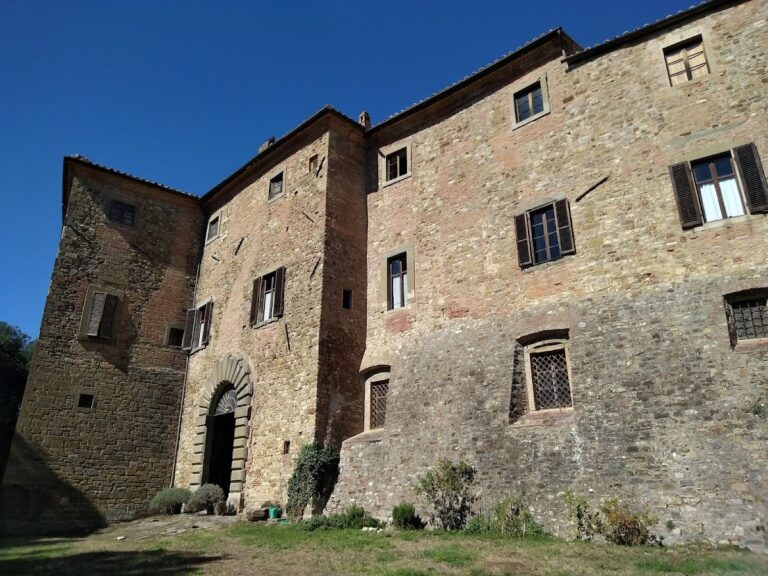
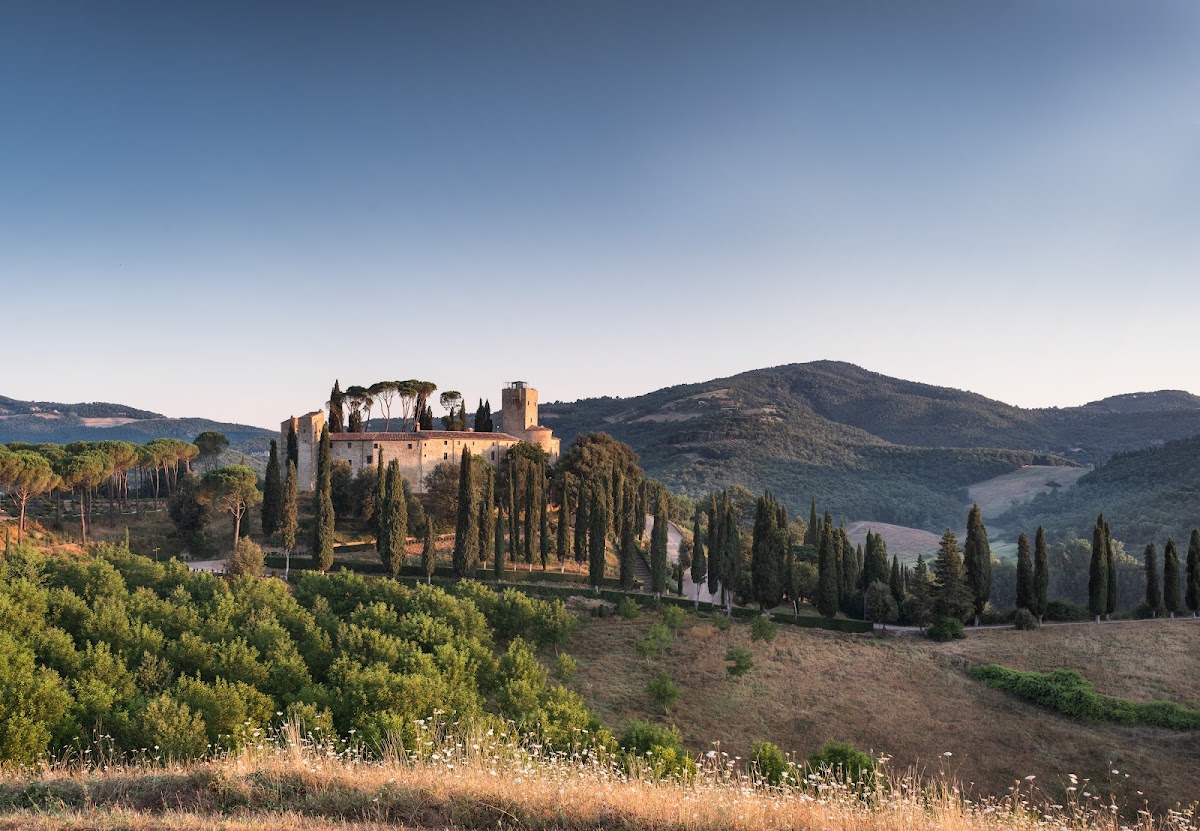
Castello di Reschio occupies a hillock above the Val di Pierle, along the right bank of the Niccone stream. Its fortified complex is arranged around a single entrance gate, a continuous curtain wall enclosing the site, defensive towers, and a manor residence within the enclosure. Restoration has preserved the castle as a coherent fortified group, while work in the internal courtyard exposed stone remains that reveal episodes in the building’s development.
Fortified enclosure
Entrance and defensive walls
The single entrance gate provides access through the surrounding curtain wall, the continuous defensive barrier enclosing the castle. An inscription above the gateway records the transfer of the property by Bishop Angelo Cesi to his nephew Venanzio Chiappino, linking the principal entrance with the ownership change of 1601. Towers form part of the fortified enclosure, whose surviving fabric expresses the castle’s defensive organization.
Internal courtyard and stone fabric
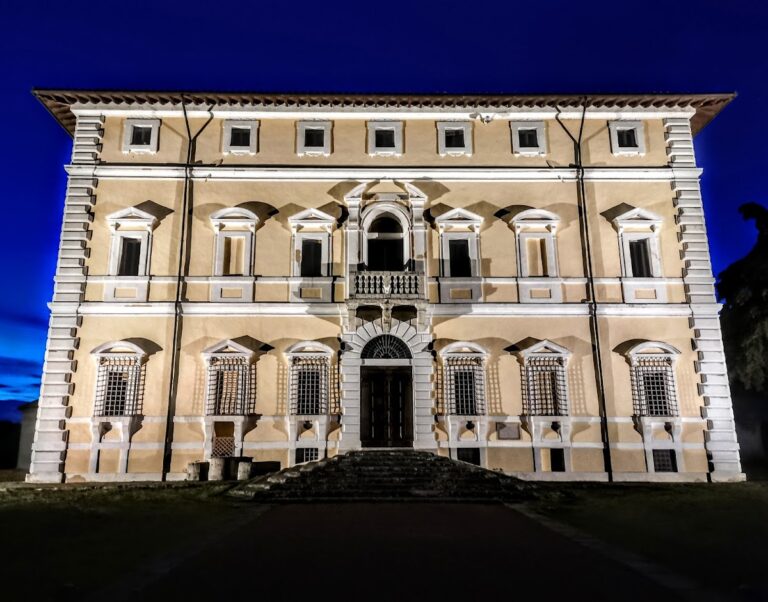
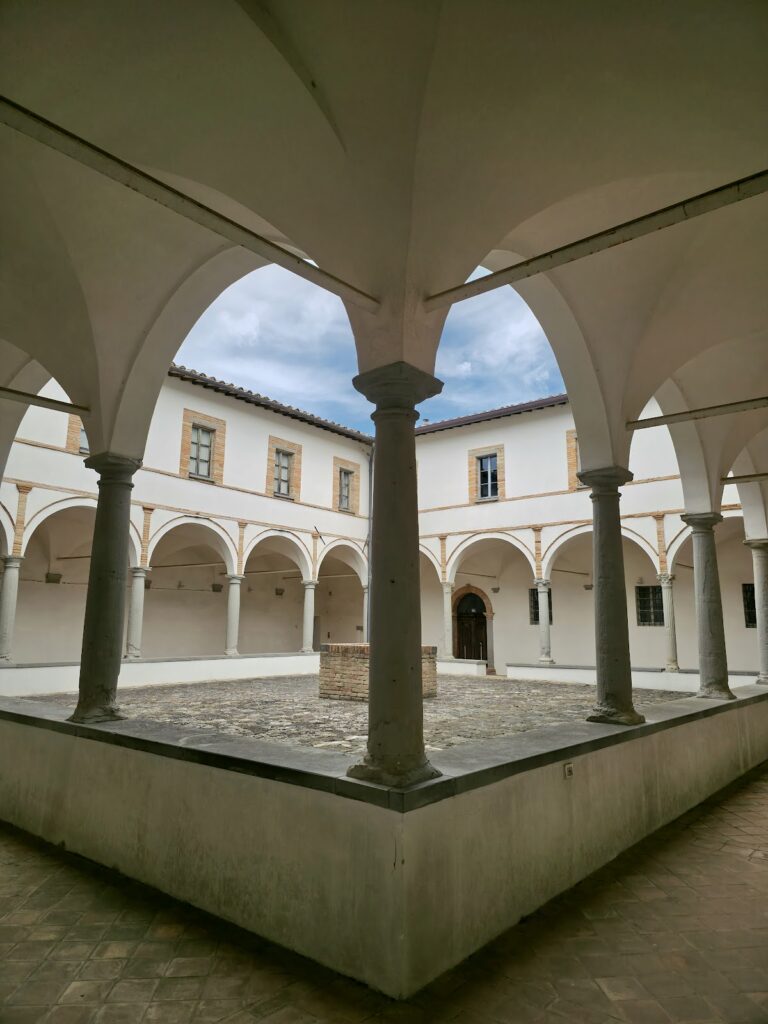
Inside the enclosure stands the manor residence, forming the principal domestic building of the fortified complex. Restoration work in the 1970s removed plaster from the internal courtyard and exposed stone remains. These revealed physical evidence of different episodes in the building’s history. The castle is currently described as restored, and the surviving courtyard fabric remains part of the recovered architectural complex.
Nearby sites