Basilica of San Lorenzo: Mortara’s Roman Catholic Church and Minor Basilica


Site at a Glance
- Rating
- 4.6
- Popularity
- Low
- Country
- Italy
- Primary era
- Medieval
- Eras represented
- Medieval, Early Modern, Modern
- Civilizations
- Duchy of Milan, Habsburg, Kingdom of Sardinia, Spanish
- Site type
- Religious
- Remains
- Basilica
On this page27 sections
History
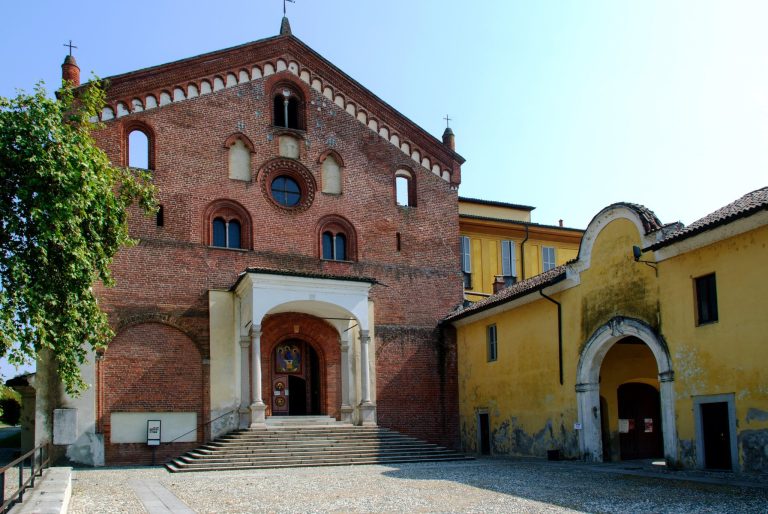
The Basilica of San Lorenzo is Mortara’s principal Roman Catholic church in Italy, dedicated to Saint Lawrence and built in the Lombard Gothic style between 1375 and 1380. Traditionally attributed to Bartolino da Novara, it belongs to the Diocese of Vigevano, serves as the seat of the cathedral chapter, and has been a minor basilica since 1939.
Medieval foundation and later alterations
Construction took place in the late fourteenth century, when Lombard Gothic architecture in northern Italy commonly used brick, pointed openings, buttresses, and restrained decoration. Work on the minor portal followed in 1443. The church’s earlier collegiate status linked it to the parish church of Sant’Albino, a relationship later recalled by the facade paintings of Saints Amicus, Amelius, and Albinus Alcuin.
Further structural alterations were carried out by Martino Bassi in 1573. The building also changed internally as chapels and liturgical spaces were adapted. The second chapel on the right had originally been the apse of the nave. Alterations made to create an organ chamber and a new sacristy had given it its present form by 1614.
Confraternities and devotional life
San Lorenzo has long been associated with lay religious associations whose members organized particular devotions, charitable activities, and liturgical responsibilities. The Confraternity of the Rosary was established in 1571. The Confraternity of the Blessed Sacrament, the oldest confraternity based in the church, was followed in the building’s devotional history by the Confraternity of Saint Joseph and the Confraternity of the Holy Spirit.
The Rosary confraternity commissioned Bernardo Lanino’s altarpiece in 1578, a work celebrating the Virgin’s intervention during the Battle of Lepanto on 7 October 1571. Lepanto was a major naval battle between the Ottoman fleet and a Christian coalition promoted by Pope Saint Pius V and commanded by Don John of Austria. The Rosary altar originally stood on the left side of the presbytery, where the confraternity had its seat.
The church’s Passion devotion also has ancient roots in Mortara. Until the nineteenth century, the city observed an Entierro rite on Good Friday, introduced in 1712. This ceremony was not connected with the former Spanish rule of the city. Its original processional images were later destroyed and replaced by sculptures that continue to be carried during Holy Week.
The chapel of the Pietà once occupied the area of the present side entrance. A later Chapel of the Dead Christ was built partly with material recovered from the demolished chapel, preserving a physical connection with the earlier devotional setting. The Passion tradition remains associated with the Dead Christ sculptures and the statue of Our Lady of Sorrows.
Nineteenth- and twentieth-century restoration
Restoration and alteration campaigns between 1829 and 1840 were directed by Epifanio Fagnani. In 1916, Giulio d’Andrade and Cesare Bertea restored the facade and one side of the church. These interventions formed part of the building’s continuing adjustment after centuries of structural and liturgical change.
A major renewal followed in 1929 at the initiative of Monsignor Luigi Dughera, parish priest from 1919 to 1960. Giuseppe Piatti substantially revised the interior, removing the original altar and installing a new altar table beneath a large ciborium. Unsafe chapels were demolished, ancient windows were reopened, and the interior was given a more restrained appearance. Dughera, who is buried inside the church, commissioned several statues in 1940, including those of Saint Joseph, the Dead Christ, Our Lady of the Rosary, and Saint Anthony.
Pope Pius XII raised San Lorenzo to the rank of minor basilica in 1939. The same period brought a new organ. A sixteenth-century instrument was transferred to the Church of San Pietro in Asti, while a temporary Mascioni organ was installed in 1937. The present Mascioni instrument followed in 1939 and 1940 and was restored by its maker in 2014.
Remains
The basilica is an unfinished brick building with a Latin-cross plan measuring 49 by 19.5 metres. Its three naves are crossed by a shorter transept, and the interior is organized around a wider central nave, side aisles, chapels, and a presbytery ending in a five-sided apse. A square bell tower rises on the left side of the choir.
Exterior and facade
Brick facade and portals
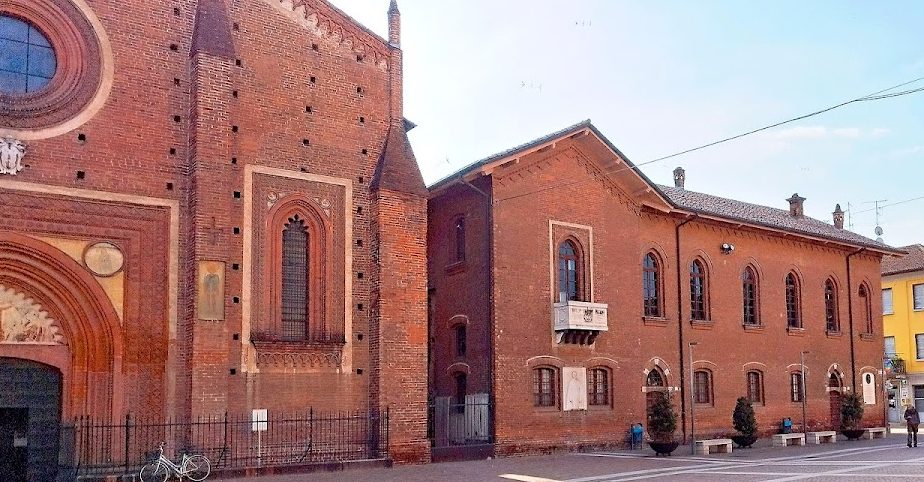
The brick facade has a central rose window and lateral pointed-arch windows. Buttresses frame the front and taper upward into pinnacles at the roofline. Two fifteenth-century exterior bas-reliefs are set above the entrance portal, while fifteenth-century roundels by Boniforte da Mortara add further decoration. The facade also contains polychrome stained glass by Francesco Mossmeyer.
Nando Bialetti painted the frescoes in the portal lunettes. The former main-portal fresco showed the Virgin enthroned with four kneeling saints, but it has been lost. The lunette above the minor portal depicts the Deposition and commemorates the demolished Chapel of the Pietà.
Facade frescoes and earlier polyptych
Bialetti also painted the facade pilasters with Saints Amicus, Amelius, and Albinus Alcuin. He copied the figures from a fifteenth-century polyptych by Paolo da Brescia, an altarpiece made of several panels or compartments. That work had formerly stood in the collegiate church’s earlier location at Sant’Albino and is now preserved in the Sabauda Gallery in Turin.
Plan and principal interior spaces
Naves, transept, and presbytery
The nave is divided into five bays, or sections, with the central nave wider than the two side aisles. Two chapels open from each side aisle at the transept. The presbytery begins in the final nave bay and continues through a shortened bay to the five-sided apse. Its main focus is a basilical altar beneath a large ciborium, a permanent architectural canopy over an altar. The ciborium has a copper-clad dome whose interior mosaic depicts Jerusalem and Bethlehem.
Early Virgin and Child fresco
The first bay on the right contains an anonymous fresco of the Virgin and Child, the oldest artwork in the church. Painted a few years after the building was constructed, it was moved twice before reaching its current position. The Virgin is shown with outstretched arms, while the naked Child stands on her knees.
Saints Roch and Sebastian painting
The second bay on the right contains a painting of the Virgin between Saints Roch and Sebastian. Dated 1524 and attributed to Gaudenzio Ferrari, it belongs to the group of early works preserved along the nave.
Chapels on the right
Rosary Chapel
The first chapel on the right contains Bernardo Lanino’s Madonna of the Rosary with Saints and Devotees, painted in 1578 for the Confraternity of the Rosary. The devotees are arranged in two rows that diverge toward the background. Richly dressed women of the confraternity appear on the right. On the left are Saint Pius V, Don John of Austria, Marcantonio Colonna, Sebastiano Venier, Doria, Barbarigo, and Spinola. Saint Peter Martyr appears in the foreground, invoking the Virgin, who is surrounded by putti holding rosary crowns.
The predella, the lower horizontal section of the altarpiece, contains a roundel showing the two fleets drawn up before the Battle of Lepanto. Fifteen small panels around the main image represent the Mysteries of the Rosary. The ensemble is completed by five canvases depicting the Archangel Gabriel and the Annunciation, the Flight into Egypt, the Rest of the Holy Family, and the Glory of Paradise. They are attributed to Giulio Cesare Procaccini, with the Paradise scene attributed to Camillo Procaccini. Wooden statues of Saint Thomas Aquinas and Saint Dominic stand above the altarpiece.
Blessed Sacrament altarpiece
Another wooden altarpiece in the first right chapel was commissioned between the fourteenth and fifteenth centuries by the Confraternity of the Blessed Sacrament. Its small shrine is divided into three niches by pilasters with capitals. The carved inscription reads “Societas Corporis Christi.” Painted wooden statues of the Virgin Mary, the Risen Christ, and Saint John the Evangelist occupy the niches. The anonymous work formerly stood at the right apse altar.
Chapel of Saint Ambrose
The second right chapel was commissioned by the Tignosi family. Its large altarpiece of Saint Ambrose, painted by Giovanni Battista Crespi, known as Il Cerano, is dated 1610. The Crucifixion includes Saints Ambrose, Lawrence, and Mary Magdalene. Saint Ambrose was the fourth-century bishop of Milan.
The painting is set within a monumental marble altar built in 1734 by the Pellegatta family, marble workers from Viggiù. Beside it stands an 1838 marble stele by Abbondio Sangiorgio, supporting a bust of Canon Luigi Travelli. Its inscription praises Travelli as an educator, poet, and patriot.
Saint Joseph altar and reliquary
The altar of Saint Joseph stands at the rear of the former Corpus Domini altar and originally belonged to the Confraternity of Saint Joseph. Beneath it is the principal reliquary, a container for preserving or displaying religious relics, holding numerous saints’ relics.
Chapel of the Dead Christ
The Chapel of the Dead Christ contains material reused from the demolished Chapel of the Pietà. It also houses Our Lady of Sorrows, carved by Giuseppe Antignati in 1753, together with processional sculptures associated with the Good Friday rites. These works relate directly to Mortara’s long-standing Passion devotion.
Choir, organ, and baptismal area
Apse and Dughera tomb
The apse contains a wooden Crucifix made by the Pavese workshop of the da Surso family and restored in 1999. The tomb of Monsignor Luigi Dughera lies on the left side of the presbytery, close to the area he helped renew during his long tenure as parish priest.
Mascioni organ
The present Mascioni organ, opus 523, was built in 1939 and 1940. It has electric transmission, two manuals of 61 notes each, a 32-note concave-radial pedalboard, 30 stops, and approximately 1,700 pipes. The first manual, the Grand Organ, is on the right side of the presbytery. Pipes on the left are silent and were installed for symmetry. The second manual, the Swell, is in the apse behind the main organ, while the pedal division is housed in the main case. The console is in the apse.
Baptismal font
The baptismal font stands at the rear of the left nave and was renewed during the second half of the twentieth century. Above it hangs a copy of Paris Bordon’s Baptism of Christ, donated by the Brera Gallery in 1937 in recognition of the completed restoration work.
Chapels on the left
Nativity ensemble
The first chapel on the left, formerly dedicated to Saint Vincent Ferrer, contains a fifteenth-century wooden Nativity ensemble attributed to a fifteenth-century artist. The altarpiece measures 4.70 metres high and 3.60 metres wide and originally contained more than eighty figures. Many were stolen over the centuries.
Its carved lower section represents a loggia with columns and arches divided into twelve compartments. Six patriarchs and six biblical women once emerged from them. Each side jamb contains three niches, originally occupied by six prophets, whose figures were stolen. The lintel depicts the Marriage of the Virgin.
The central Nativity scene includes the Virgin, Saint Joseph, and two kneeling shepherds. The original Child was stolen and replaced by a carving made by artists from Val Gardena. Of the four winged putti, two remain, and one shepherd is distinguished by a double goitre.
The ensemble formerly had decorated shutters, which were removed at the direction of Saint Charles Borromeo, a sixteenth-century archbishop of Milan and Catholic reformer. Behind the figures is a wooden panel carved with the Adoration of the Magi. Six surrounding reliefs depict the Visitation, the Adoration, the Circumcision, the Preaching in the Temple, the Flight into Egypt, and Joseph’s Dream. God the Father and three cherubim appear above.
Chapel of the Holy Spirit
The second chapel on the left is known as the Chapel of the Holy Spirit. It contains a fifteenth-century polyptych in six compartments, attributed to A. De Murini. The Confraternity of the Holy Spirit commissioned the work and had its seat in the chapel shrine.
Chapel of the Blessed Sacrament
The final chapel on the left, dedicated to the Blessed Sacrament, contains an altarpiece of the Immaculate Conception with Saint Bernardino, attributed to Giovan Antonio Cucchi. The painting originally stood in the church of San Bernardino. The chapel also contains Ludovico Pogliaghi’s Sacred Heart, a commissioned copy of his work made for the University of the Sacred Heart in Milan.
Former organ and Saint Lawrence statue
A wooden statue of Saint Lawrence by Virgilio Del Conte, dated 1592, was formerly placed on top of the sixteenth-century organ case. When that organ was sold and transferred to San Pietro in Asti in the 1930s, the statue was moved there as well. The relocation preserves the history of an earlier church installation beyond its original setting.