Saint Mary Chapel in Garbagna Novarese: A Romanesque Oratory
Site at a Glance
- Popularity
- Low
- Country
- Italy
- Primary era
- Medieval
- Eras represented
- Medieval, Modern
- Civilizations
- Duchy of Milan, Holy Roman Empire, Italian
- Site type
- Religious
- Remains
- Chapel
On this page12 sections
History
The Saint Mary Chapel in Garbagna Novarese, Italy, is a Roman Catholic oratory, a small place of worship, dedicated to Mary and also known as Madonna di Campagna. Its Romanesque core, built in a medieval architectural style, includes a rounded apse thought to date to 1050–1075; further building work followed in the twelfth century. The chapel belongs to the Diocese of Novara, a church district overseen by a bishop, and is owned by the municipality.
Medieval origins and development
The earliest known written reference to the church dates to 1077, and it appears again in a record from 1181. A document from 1347 describes its chaplain as a priest from Cantù who did not live in the house adjoining the church. The oratory’s lands covered 65 pertiche, a historical measure of area amounting to more than four hectares; most of the land was arable.
A renovation in the Gothic period, a later phase of medieval architecture, added decorative arches with small tooth-like projections. The building’s appearance changed further over the centuries, while its original structure and interior wall paintings, or frescoes, were preserved.
Religious use and nineteenth-century events
In the eighteenth century, a hermit lived in the house on the church’s south side. Under arrangements with the Novara diocese’s administration, he supported himself by begging in Garbagna and nearby places. In 1848, the same role was assigned to Carlo Maria Zorzoli, whose identity is otherwise unknown.
During the cholera pandemic of 1854–1855, the chapel served as a lazaretto, a place for isolating people during an epidemic.
Twentieth-century changes and conservation
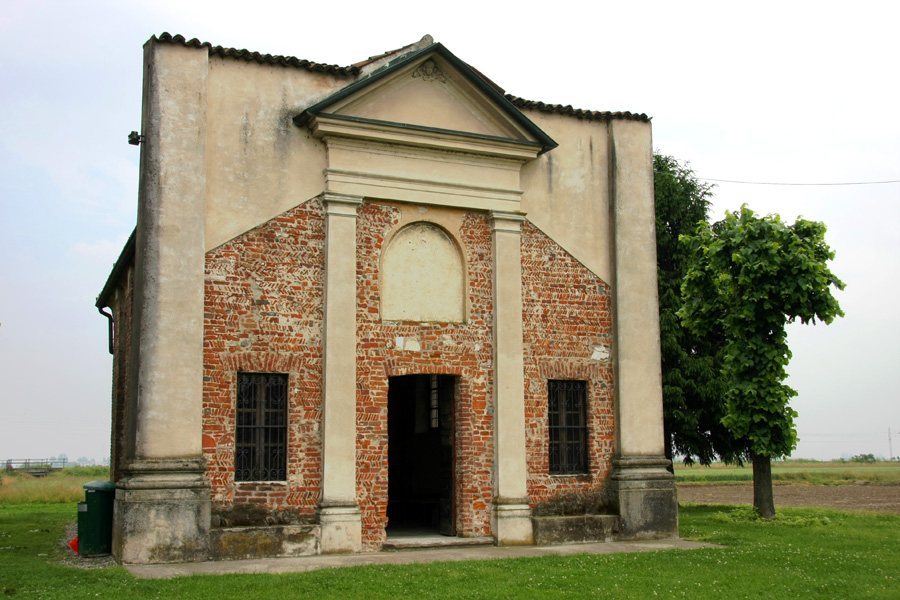
Architect Giovanni Lazanio remodeled the façade in 1908 in the Neoclassical style, which revived forms associated with classical antiquity, and raised it well above the nave roof. During a pastoral visit on 7 August 1932, Bishop Giuseppe Castelli called for urgent repairs and asked that the local municipal head under Fascist rule be notified, particularly to protect the frescoes. In 1936, architectural historian Paolo Verzone criticized the façade’s unusually tall, wall-like form. It was later lowered for structural reasons.
Intruders entered through a window in the adjoining house during the 1960s or 1970s and stole the ancient altar and a small marble column. Between 1994 and 2000, the municipality commissioned conservation and restoration work on the crawl space, walls, roofs, interior plaster, and frescoes. The work, supervised by the regional heritage authority, made the paintings clearer and more legible.
Remains
The chapel is arranged as a single main body, or nave, ending in a semicircular apse, beneath a wooden gabled roof. Its west-facing front combines the building’s Romanesque fabric with a later Neoclassical façade. It stands northeast of Garbagna Novarese, near the Novara–Alessandria railway line.
Exterior fabric
Apse and masonry
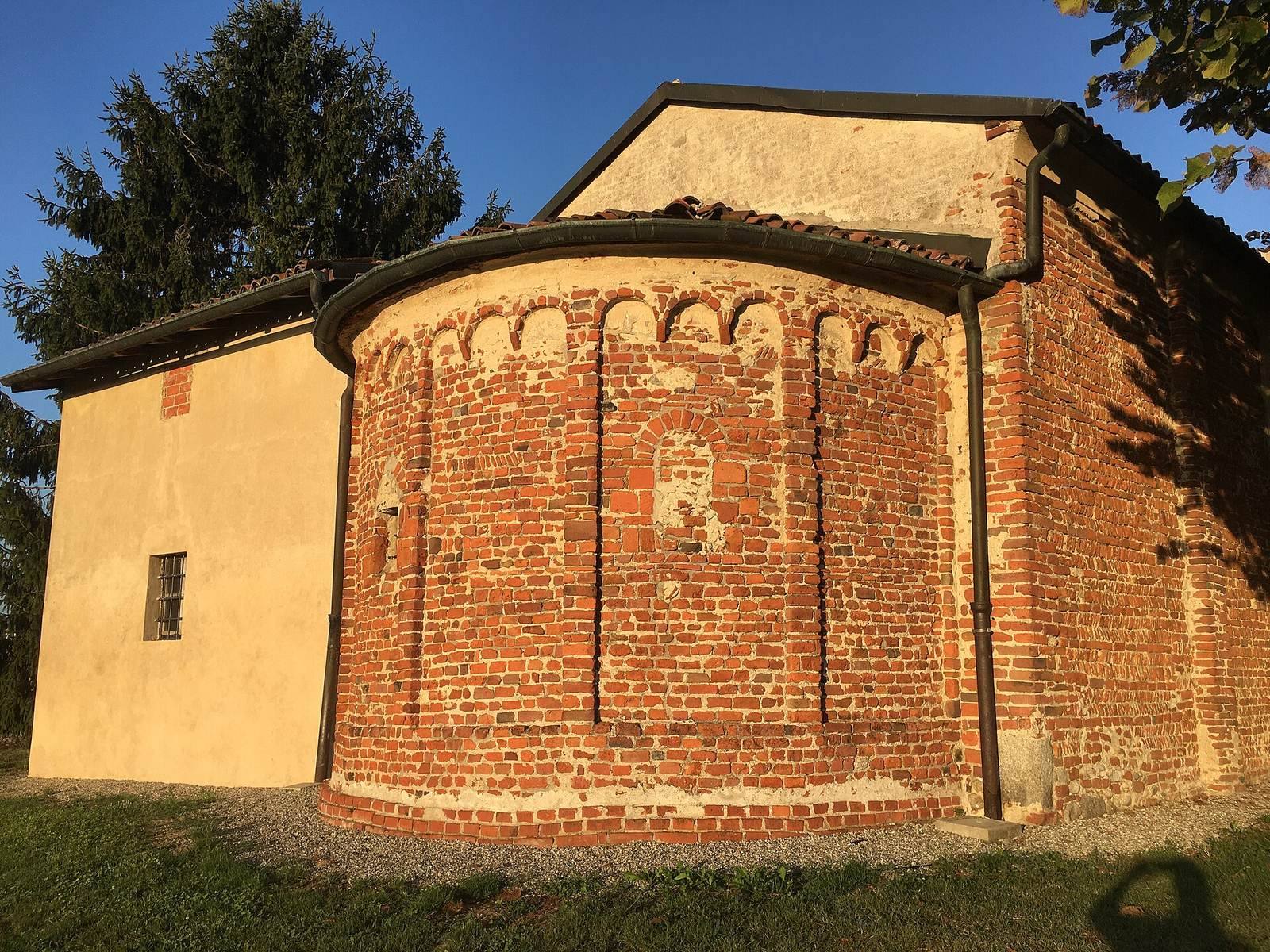
The walls are built mainly of horizontal brick courses set in mortar, while irregular reused materials appear in the side walls and façade. Shallow, column-like pilasters divide the apse exterior into five sections. Each section is topped by decorative blind arches, arches without openings, arranged in groups of three. Four tall, narrow windows originally admitted light, two in the apse and two on the south wall. Their openings widened toward the interior, but they were blocked in the fifteenth century when the interior was painted.
Façade and adjoining house
The original façade had a simple gabled outline and a broad, double-pitched eave that sheltered a fifteenth-century painting of Mary nursing the infant Jesus above the entrance. Gian Antonio Merli painted it in 1490. It remained visible in 1980 and was lost by 2009. The house adjoining the chapel to the south preserves inside it tooth-edged arches that once also decorated the church’s north side.
Interior frescoes
Paintings in the apse
Thirteen fifteenth-century frescoes cover the semicircular apse wall and the left nave wall. The apse sequence includes Saint Bernardino of Siena with Saint Bovo; Mary enthroned with the infant Jesus, crowned by two musician angels, while Saint Francis presents a kneeling patron; a central Pietà; a small Saint Helena above a narrow window; a separate image of Mary and the infant Jesus; and Blessed Peter Lombard with Saint Nicholas of Tolentino.
The painting of Saint Francis presenting the patron is signed by Tommaso Cagnola and dated 27 April 1481. It is regarded as a key work for understanding his art. The central Pietà, which retains Romanesque echoes, and the small Saint Helena and separate image of Mary and the infant Jesus are dated to the early fifteenth century. Another fresco depicts a mitred figure with a pearl-decorated ceremonial headdress, an orange cloak over a finely folded tunic, white gloves and rings, and a staff in one hand. The other hand holds three books and a pen; golden rays surround the figure’s head. Late Gothic clothing and throne forms, together with the finely drawn faces, have informed a proposed link to the Master of Garbagna, an art-historical label rather than a known individual. Giovan Battista Ferro and Filippo Maria Ferro also noted strong Romanesque features.
Saint Bovo appears as a young, blond knight carrying a white banner with a red cross. Art historian Dominique Rigaux interpreted the image within the tradition of military saints and the Christian ideal of the soldier of Christ, a defender of the poor and oppressed. She also connected this imagery with the peasant cultures of the Po Valley and pre-Alpine valleys.
Paintings on the left nave wall
Seven paintings run along the left wall within a long framed panel. From left to right, they show Saint Gratus of Aosta; Mary enthroned with the naked infant Jesus; the Vision of Saint Eustace; Saint Bernard of Aosta; an enthroned Mary and child known as the shoe Madonna; Saint Catherine of Alexandria; and Mary enthroned with the infant Jesus and a little friar.
In the Vision of Saint Eustace, a hunting scene becomes a religious image when a crucifix appears between a deer’s antlers. The painting is valued for its historical, religious, and artistic qualities, and it, like some other works on the wall, has been attributed to the Cagnola workshop. A critic interpreted an inscription accompanying the image of Mary and the infant Jesus with the little friar as an ex-voto, an offering or appeal connected with a vow. The inscription was understood to show Alaxina, identified as Baltramini’s wife, asking Mary for a favor for her young son. Antonio Massara attributed that painting to Tommaso Cagnola and dated it to around 1481.
Inscriptions and interpretations
An inscription identified by art historian Antonio Massara names Stefanina de Prolis and her son Iacobinus as the commissioners of a fresco. Its date and authorship remain matters of interpretation. Fabio Bisogni and Chiara Calciolari associated its style with the Master of Garbagna, while Giovan Battista Ferro and Filippo Maria Ferro considered it a rare work of the early fifteenth century and allowed that it might be older.
Historian Lino Cassani noted the painting’s longstanding popular devotion. Writer Dante Graziosi discussed the chapel’s frescoes in La terra degli aironi, describing religious art in the old buildings of the lower Novara plain as sustaining the faith of poor people while also affirming the authority of wealthy patron families.