Basilica of Our Lady of the Martyrs, Lisbon: A Post-Earthquake Baroque Church


Site at a Glance
- Rating
- 4.7
- Popularity
- Low
- Country
- Portugal
- Primary era
- Early Modern
- External website
- Open
- Eras represented
- Medieval, Early Modern
- Civilizations
- Portuguese
- Site type
- Religious
- Remains
- Basilica
On this page12 sections
History
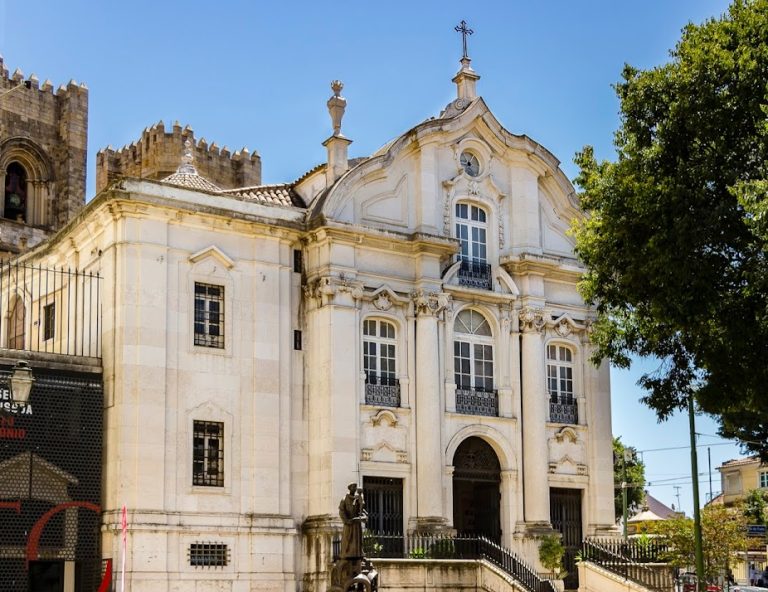
The Basilica of Our Lady of the Martyrs is a Roman Catholic church in Lisbon, Portugal, whose origins lie in the Christian reconquest of the city in 1147. The parish established around it is described as Lisbon’s oldest, and the present building combines Late Baroque and late Neoclassical design shaped by the city’s post-earthquake reconstruction.
Origins after the Reconquest
The parish of Our Lady of the Martyrs was created immediately after Christian forces recovered Lisbon from Muslim rule in 1147. It began with a small chapel built to house an image of the Virgin Mary brought by English crusaders. The chapel took the name Our Lady of the Martyrs in memory of the soldiers who died defending the Christian faith.
Tradition associates the chapel with Afonso Henriques, the first king of Portugal, who is said to have sought the Virgin’s help and protection there. The first baptism in Lisbon after the Reconquista, the Christian recovery of the city, is also traditionally placed at the chapel in 1147. An enlargement around 1600 and the addition of chapels around 1700 gradually transformed the modest foundation into a large Baroque church.
Earthquake and Reconstruction
The church was completely destroyed by the Lisbon earthquake of 1755. Its replacement formed part of the Pombaline rebuilding, the large-scale reconstruction of Lisbon directed after the disaster by the Marquis of Pombal. Work began in 1768 under Reinaldo Manuel dos Santos, an eighteenth-century Portuguese architect and engineer.
Religious authorities dedicated the rebuilt church in March 1784, while further work led to another consecration in 1866. The basilica is a minor basilica attached to the Patriarchate of Lisbon. It is protected as a property of public interest, and its rebuilding is regarded as an example of high-quality religious architecture within Lisbon’s post-earthquake reconstruction. The church also gave its name to the former parish of the Martyrs and now stands within the parish of Santa Maria Maior, in the Chiado district.
Remains
The present basilica has a single nave flanked by eight lateral chapels. Marble surfaces, painted decoration, sculpture, carved furnishings, and a rear bell tower form the principal surviving elements of the rebuilt church. Together they reflect its combination of Late Baroque and late Neoclassical design.
Interior and Decorative Arts
Nave and Chapels
The single nave is lined with eight lateral chapels, and the interior is faced with marble. Numerous statues and paintings enrich the church, while the altarpieces, ornamental structures placed behind the altars, contribute to its elaborate religious interior.
Façade and Painted Decoration
A central bas-relief, a sculpted image projecting slightly from the façade, shows Afonso Henriques giving thanks to the Virgin for the recovery of Lisbon. It also commemorates the martyrs who died in the battle. The ceiling paintings and altarpieces were produced by Pedro Alexandrino de Carvalho and his pupil José António Narciso.
Bell Tower
The bell tower stands at the rear of the building, forming a distinct part of the basilica’s exterior arrangement.
Furnishings and Religious Objects
Organ
The organ and its case were made by António Xavier Machado e Cerveira, a Portuguese organ builder and maker of keyboard instruments. The case is decorated with gilded carving.
Nativity Scene
The basilica preserves an eighteenth-century nativity scene containing 126 figures sculpted by the Machado de Castro school, the workshop tradition associated with the Portuguese sculptor Joaquim Machado de Castro.
Baptismal Font
The baptismal font survived from the pre-earthquake basilica. It was used for the baptisms of Bartolomeu Fernandes, later known as Bartholomew of the Martyrs, in 1514; Cardinal Luís de Sousa in 1630; and the poet Fernando Pessoa in 1888. A painting of the Baptism of Jesus by Pedro Alexandrino de Carvalho is associated with the font.