Basilica of Santa Croce: A Franciscan Church and National Pantheon in Florence


Site at a Glance
- Rating
- 4.8
- Popularity
- Very High
- Country
- Italy
- Primary era
- Medieval
- External website
- Open
- Eras represented
- Medieval, Early Modern, Modern
- Civilizations
- Grand Duchy of Tuscany, Italian, Republic of Florence
- Site type
- Religious
- Remains
- Basilica
On this page26 sections
History
The Basilica of Santa Croce is a Roman Catholic Franciscan church in Florence, Italy, dedicated to the True Cross and administered by the Archdiocese of Florence. Built mainly between 1294 and about 1385 in the Gothic period, it became one of the major achievements of Italian Gothic architecture and later served as a religious, civic, artistic, and national monument.
Franciscan foundation
According to tradition, Saint Francis of Assisi founded Santa Croce. Francis, the founder of the Franciscan movement, visited Florence in 1211. His followers established themselves outside the city walls in 1226–1228, on an inhospitable island formed by branches of the Arno. There they founded an oratory, which was enlarged and then substantially rebuilt from 1252.
The friars soon disagreed over the scale and character of the church. Some wished to preserve a simple, poor building in accordance with the Franciscan Rule, whose ideals emphasized poverty, preaching, and communal religious life. Others considered the existing church inadequate. In 1294, the community decided to build a completely new basilica.
Building the Gothic basilica
Construction of the present basilica began in 1294, probably under the direction of Arnolfo di Cambio, a leading Florentine architect and sculptor of the late thirteenth and early fourteenth centuries. His attribution is traditional and based on stylistic comparison rather than surviving documentary proof. Florentine civic and religious authorities attended the foundation ceremony, together with a large public gathering.
The work began at the apse while the older church remained in use by the friars. The population and wealthy families of the Florentine Republic financed the construction. By Arnolfo’s death in 1302, the choir and transept with their chapels were probably complete. The basilica became usable around 1320, although political and economic crises, flooding, and plague delayed the remaining work. The building was probably finished around 1385.
The convent developed alongside the church. It soon contained a sacristy, dormitory, infirmary, guesthouse, refectory, and library, and later became one of Florence’s largest convent complexes. Santa Croce also hosted numerous confraternities, including companies dedicated to Santa Maria delle Laudi, the Discipline of Santa Croce, Saint Francis of the Hammer, Saint Bernardino, Saint Francis and Saint Mary Magdalene, the Nativity of the Virgin Mary, Saint Anthony Abbot, Saint Bonaventure, Our Lady of Loreto, Saint Philip Benizi, and Blessed Peter the Comb-maker.
The basilica was consecrated during Epiphany in 1443 by Cardinal Bessarion in the presence of Pope Eugene IV. Over time, its identity expanded beyond that of a Franciscan church. It became a religious civic centre for Florentine families and guilds, an artistic workshop, a theological centre, and a place of burial and commemoration.
Vasari’s remodelling
From 1566, Cosimo I de’ Medici, the sixteenth-century ruler of Florence, directed Giorgio Vasari to remodel the church according to Counter-Reformation principles. The Counter-Reformation was the Catholic reform movement that followed the Protestant Reformation, and it placed new emphasis on orderly worship and carefully controlled religious imagery.
Vasari removed the choir screen and the friars’ choir, dismantled chapels and funerary monuments attached to the nave walls, whitewashed many medieval frescoes, and installed large stone altars. The alterations changed both the appearance and the use of the interior. They also concealed or damaged much of Andrea Orcagna’s fresco decoration. Fragments of those paintings were later found beneath the sixteenth-century plaster and placed in the museum.
The fourteen large stone altars along the nave were designed by Vasari and made from 1566 by Francesco da Sangallo. Their paintings form a cycle on the Passion of Christ and were produced by several artists associated with the Academy of the Art of Drawing. Vasari also designed the tomb of Michelangelo after the artist’s remains were brought from Rome in 1564.
Napoleonic occupation and national commemoration
During the French occupation, Vivant Denon directed the removal of artworks from the convent. Denon was a French diplomat, writer, and arts administrator who organized systematic artistic confiscations during the Napoleonic period. Works taken from Santa Croce included a Saint Francis and the Miracle of the Dying Man by Pesello Peselli, which were shipped to France.
The former convent buildings were gradually secularized from the late eighteenth century and adapted to other uses. In 1866, the complex became public property during the suppression of religious houses that followed the wars of Italian unification. Parts of the former convent later accommodated the National Central Library of Florence, an elementary school, and the Leather School.
Santa Croce became increasingly associated with the commemoration of prominent Italians. In the nineteenth century, it developed into a national pantheon connected with art, music, literature, science, and politics. Ugo Foscolo called it a “Temple of Italian Glories” in his poem Dei sepolcri. He was buried in the basilica in 1871, beside figures including Michelangelo, Machiavelli, and Galileo, in accordance with his wishes. Gioachino Rossini was transferred there in 1887.
Dante received a monumental cenotaph because Ravenna refused to surrender his remains. A cenotaph is a commemorative monument for a person buried elsewhere. Requests for burial eventually came from throughout Italy. Approximately 15,000 burials were housed at Santa Croce, with each request examined by a special commission and approved by the Grand Duke, who also determined the associated donation.
Museum formation and conservation
The former refectory opened as a museum on 2 November 1900 under Guido Carocci. The institution expanded in 1959 as the Museum of the Works of Santa Croce, incorporating the two cloisters, the principal refectory, and other rooms. Its collections came to preserve paintings, sculpture, stained glass, glazed terracotta, architectural models, detached frescoes, and objects associated with the church and convent.
In 1940, Ugo Procacci noticed the Badia Polyptych being removed from the church and concluded that it had probably been taken from Badia Fiorentina during the Napoleonic occupation and mistakenly reinstalled at Santa Croce. Between 1958 and 1961, Leonetto Tintori removed whitewash and overpaint from Giotto’s frescoes in the Peruzzi Chapel, revealing parts of the original decoration. Later nineteenth-century restorations in the Bardi Chapel were also removed to expose surviving portions of Giotto’s paintings.
The flood of Florence on 4 November 1966 severely damaged the basilica, convent, artworks, and furnishings. Floodwater reached approximately 4.88 metres in the refectory. The disaster made Santa Croce a symbol of Florence’s artistic losses and of the city’s subsequent restoration and conservation efforts. The museum reopened in 1975. Cimabue’s damaged Crucifix returned the following year, although much of its painted surface had been lost.
In 2006, nineteen major paintings damaged by the flood were returned after extensive restoration. Giorgio Vasari’s segmented Last Supper, which had remained in storage for about forty years, was reassembled and returned after restoration by the Opificio delle Pietre Dure. Other campaigns restored the high-altar frescoes in 1947 and 2005–2011, the high-altar windows in 2008, and the painted Crucifix in 2012. The work on the high-altar frescoes revealed two small portraits of the 1947 restorers among the ornamental details.
Modern structural surveys and restoration campaigns have continued to address the fabric of the basilica. In October 2017, falling masonry caused the death of a visitor and led to the temporary closure of the church, as well as an investigation into its maintenance and stability. The basilica has the status of a minor basilica, a conventual church, and an Italian national monument.
Remains
Plan and exterior
Santa Croce has an Egyptian or Tau-cross plan, shaped like a T rather than a Latin cross. A Tau, or commissa, cross has a shortened upper arm and resembles the letter T; in Franciscan contexts it is associated with the symbolism of Saint Francis. The church has three aisles divided by two rows of large octagonal piers, an exceptionally extended transept measuring approximately 73.74 metres, and a central nave approximately 115.43 metres long and 38.23 metres wide.
Pointed arches carried on octagonal piers support the thin walls. Above the arcades, a gallery runs around the central nave, creating a strong horizontal line while also bracing the slender structural members and extensive wall surfaces. The nave has a timber-trussed roof rather than a vault. Its apparently simple Franciscan appearance therefore conceals a complex structure designed to span an exceptionally wide interior without overwhelming the thin walls.
Medieval and nineteenth-century façades
The original façade remained unfinished. It stood on eight steps, with exposed pietraforte masonry and a simple central portal. A statue of Saint Louis of Toulouse by Donatello occupied a niche, while a figure of Christ was placed above the rose window in 1437 during a severe plague.
The present façade was designed by Niccolò Matas from 1837 and built between 1853 and 1863. Its forms draw on the cathedrals of Siena and Orvieto, as well as Romanesque and Gothic Florentine architecture. Three gables, alternating white and green marble, and polychrome marble inlay give it its present appearance. The English Protestant Francis Joseph Sloane partly financed the work, initially wishing to remain anonymous.
Building the new façade required the demolition of the Palace of the Inquisition and the destruction of its courtyard. The remaining space was combined with part of the first cloister in front of the Pazzi Chapel, producing the present irregular plan. A Star of David appears in the façade’s tympanum. Its interpretation as a reference to Matas’s Jewish faith remains unproven, since the symbol also occurs in Christian decorative traditions.
The three portal lunettes represent episodes associated with the True Cross. Tito Sarrocchi sculpted the Finding of the Cross, Giovanni Duprè the Triumph of the Cross, and Emilio Zocchi the Vision of Constantine. The central portal doors formerly belonged to Florence Cathedral and were moved to Santa Croce in 1903. Matas was buried beneath the entrance threshold by decision of the Parliament of Italy in 1886.
Side elevations and bell tower
The side elevations are articulated by the bare triangular gables of the false nave bays. Each bay contains a tall bifora, or two-opening window, while the exposed pietraforte masonry is decorated mainly with waterspouts shaped as human or leonine heads.
The fourteenth-century portico of the Pinzochere is attached to the left side of the basilica. Restored and enlarged in the mid-nineteenth century, it contains embedded heraldic shields and the funerary monuments of Alamanno Caviccioli, dating to about 1337, and Francesco de’ Pazzi, whose sarcophagus rests on caryatids.
A similar portico occupies the right side of the church beside the Great Cloister. The rear triangular gables are visible mainly from the private internal garden or from distant viewpoints. The present slender bell tower was built by Gaetano Baccani between 1842 and 1845 and rises 78.45 metres. It contains six large bells cast in 1843 by the Pistoia founder Terzo Rafanelli, with some later recasting.
An earlier bell tower collapsed onto the church in 1521. Later projects, including one entrusted to Francesco da Sangallo in the late sixteenth century, remained incomplete. The surviving base became known as the “mass of Santa Croce” and was demolished during construction of the nineteenth-century façade.
Nave and funerary monuments
The interior originally emphasized broad wall surfaces for large fresco cycles. These image sequences communicated biblical narratives to people who could not read, a function often called the “Bible of the Poor.” Instead of the usual three chapels at the east end, Santa Croce has eleven there, with five more at the ends of the transept.
The floor contains 276 marble burial slabs decorated with reliefs and inlaid coats of arms. Numerous wall monuments remain between the Vasarian altars. Many nineteenth-century aristocratic tombs removed in the early 1960s were reassembled beneath the loggia of the Great Cloister.
Right aisle
The right aisle contains Michelangelo’s tomb, designed by Vasari after the artist’s remains were brought from Rome in 1564. The monument includes sculptures personifying Painting, Sculpture, and Architecture by Battista Lorenzi, Valerio Cioli, and an artist whose attribution remains uncertain, together with frescoes by Giovan Battista Naldini.
In front of Michelangelo’s tomb stands Antonio Rossellino’s Madonna del Latte of 1478, part of the tomb of Francesco Nori. Nori died while saving Lorenzo de’ Medici during the Pazzi conspiracy. The aisle also contains Vasari’s Way to Calvary, dated 1572 and restored in 2017–2018; Jacopo Coppi’s Ecce Homo of 1576; Alessandro Fei’s Flagellation of 1575; and Andrea del Minga’s Prayer in the Garden of Gethsemane, dated about 1574–1578.
Donatello’s Cavalcanti Annunciation, made about 1435, is displayed in the same aisle. The funerary monuments include those of Leonardo Bruni, Gioachino Rossini, and Ugo Foscolo, as well as the cenotaph of Dante, made by Stefano Ricci in 1829.
Bernardo Rossellino made Leonardo Bruni’s tomb in 1444–1445. It is an early Renaissance arcosolium, a tomb set within a recessed wall niche closed by an arch. Carlo Marsuppini, who dictated Bruni’s inscription, was later buried opposite him in the left aisle.
Benedetto da Maiano’s pulpit, dated about 1481–1485 and restored in 1998–1999, has a heptagonal base and a suspended projecting balcony. Its stair is built into the thickness of the pier. Red marble inlay, five partly preserved gilded relief panels depicting the life of Saint Francis, and niches containing figures of the Virtues decorate the structure. Beneath it is the polychrome marble tomb slab of Piero Mellini, whose geometric design was conceived as a counterpart to the pulpit and attributed to Benedetto and Giuliano da Maiano.
Other right-aisle monuments include Niccolò Machiavelli’s tomb by Innocenzo Spinazzi, made in 1787, and Luigi Lanzi’s monument by Giuseppe Belli, made in 1810. Machiavelli’s monument consists of a sarcophagus surmounted by an allegorical figure of Politics holding the writer’s portrait, beneath the inscription “TANTO NOMINI NULLUM PAR ELOGIUM.”
The final right-aisle altar contains the Entry into Jerusalem. Luigi Serristori commissioned the painting from Cigoli in 1604, but Cigoli’s departure for Rome interrupted the work. Giovanni Bilivert completed it between 1615 and 1620 after Cigoli’s death.
Left aisle
The left aisle contains Vasari’s Pentecost, painted in 1567–1568; Desiderio da Settignano’s tomb of Carlo Marsuppini from 1453; Giovanni Stradano’s Ascension of 1569; Agnolo Bronzino’s Pietà of 1569; Vasari’s Incredulity of Saint Thomas; Santi di Tito’s Supper at Emmaus and Resurrection of 1574; and Giovan Battista Naldini’s Deposition of 1583.
Other memorials include Lorenzo Ghiberti’s tomb slab, the tombs of Giovanni Lami and Eugenio Barsanti, a commemorative plaque for Antonio Meucci, and Lorenzo Bartolini’s monument to Vittorio Fossombroni. The latter is surmounted by an Assumption of Mary attributed to Agnolo Gaddi.
Galileo Galilei’s tomb lies at the beginning of the left aisle. It contains Galileo, his disciple Vincenzo Viviani, and probably Galileo’s daughter, Sister Maria Celeste. The monument has a bust by Giovan Battista Foggini and personifications of Astronomy and Geometry by Vincenzo Foggini and Girolamo Ticciati.
Chapels and medieval frescoes
Principal chapel
The principal chapel has a strongly vertical Gothic interior, umbrella-like vault ribs, and very tall narrow biforas. Agnolo Gaddi painted its fresco cycle on the Legend of the True Cross around 1380 and also supplied designs for its stained-glass windows.
The cycle follows the history of the Cross through episodes including the presentation of the branch of the Tree of Life to Seth, the planting of the tree over Adam’s grave, the Queen of Sheba’s veneration of the wood, its concealment and recovery, the making of the Cross, Saint Helena’s discovery of it, its transport to Jerusalem, its seizure by the Persian king Khosrow, and the emperor Heraclius’s recovery of it.
The high altar contains a composite polyptych, an altarpiece made of several painted or sculpted panels. Its central Madonna is by Niccolò Gerini, while the Doctors of the Church are by Giovanni del Biondo and an unidentified painter. The polyptych replaced an earlier work by Ugolino di Nerio. It was itself temporarily replaced by a ciborium designed by Vasari and carved by Battista Botticelli and Dionigi Nigetti, inaugurated in 1569.
A painted Crucifix hanging in the chapel is attributed to the Master of Figline and dated to about 1320. The high-altar frescoes, windows, and Crucifix have all undergone modern restoration campaigns.
Peruzzi and Bardi chapels
Giotto painted the fresco cycles in the Peruzzi Chapel and the Bardi Chapel between about 1320 and 1325. Giotto’s treatment of solid figures, spatial settings, and dramatic narrative strongly influenced later European painting. The Peruzzi cycle depicts the lives of Saint John the Baptist and Saint John the Evangelist, while the Bardi cycle presents the life of Saint Francis.
The Peruzzi Chapel’s stained-glass window was designed by Jacopo del Casentino and transferred from the Giugni Chapel. The Giugni Chapel contains the tombs of Julie Clary and her daughter Charlotte Napoléone Bonaparte. Whitewash and overpaint were removed from the Peruzzi frescoes between 1958 and 1961, exposing parts of the original decoration. Later nineteenth-century restorations in the Bardi Chapel were removed to reveal surviving sections of Giotto’s paintings.
Baroncelli and Castellani chapels
The Baroncelli Chapel has two bays and contains Taddeo Gaddi’s frescoes of the Life of the Virgin, dated 1332–1338. Taddeo Gaddi, Giotto’s leading pupil and successor, included an early Western depiction of a night scene in the cycle and designed its stained-glass windows. The chapel also contains Sebastiano Mainardi’s Madonna of the Girdle, a tomb by Giovanni di Balduccio dated 1327, statues of the archangel Gabriel and the Annunciate Virgin on the entrance piers, and Vincenzo Danti’s Madonna and Child of 1568.
The Castellani Chapel has two bays with frescoes by Agnolo Gaddi and assistants depicting the lives of Saints Anthony Abbot, John the Baptist, John the Evangelist, and Nicholas of Bari. Its tabernacle is by Mino da Fiesole, its painted Cross by Niccolò Gerini, and its statues of Saint Francis and Saint Dominic belong to the della Robbia school.
Other medieval and Renaissance chapels
The Velluti Chapel has fourteenth-century frescoes by an unknown artist and a polyptych by Giovanni del Biondo with a predella by Neri di Bicci. The Pulci-Berardi Chapel contains Bernardo Daddi’s frescoes of the martyrdoms of Saints Lawrence and Stephen, dated about 1330, together with a glazed polychrome terracotta by Giovanni della Robbia.
The Bardi di Vernio Chapel contains Maso di Banco’s frescoes of the life of Saint Sylvester, stained-glass designs by the same artist, and Giovanni del Biondo’s altarpiece depicting Saint John Gualbert and scenes from his life. Two tombs stand in frescoed niches. Donatello’s wooden Crucifix is also kept there, alongside the chapel’s original 1335 screen, ciborium, two gilded wooden angels formerly made for the high altar, and a fourteenth-century Pisan-school sarcophagus.
The Niccolini Chapel was erected by Giovanni Antonio Dosio in 1584. Its dome was frescoed by Volterrano, its statues were made by Pietro Francavilla, and its two altarpieces are by Alessandro Allori. The Machiavelli-Salviati Chapel contains Jacopo Ligozzi’s Martyrdom of Saint Lawrence and the tomb of Countess Sofia Zamoyska by Lorenzo Bartolini, made between 1837 and 1844. Nearby lies a worn tomb slab of Bartolomeo Valori by Lorenzo Ghiberti, dated about 1427.
The left-side chapels include the Spinelli Chapel, redecorated by Gasparo Martellini in 1837; the Chapel of the Italian Mother, formerly the Capponi Chapel, dedicated in 1926 to the mothers of Italian First World War dead and containing Libero Andreotti’s Pietà; and the Ricasoli Chapel, with early nineteenth-century frescoes of the life of Saint Anthony of Padua by Luigi Sabatelli and his sons.
Medici Chapel
The Medici Chapel, also called the Novitiate Chapel, and its entrance hall were designed by Michelozzo for Cosimo the Elder around 1445. The complex has numerous Medici coats of arms, a barrel-vaulted entrance hall, and a doorway lunette attributed to Fra Bartolomeo.
The chapel has a rectangular plan, vaults, and a recessed altar apse. Its principal altarpiece is Andrea della Robbia’s glazed terracotta Madonna and Child with Angels and Saints, made around 1480. Other works include a stained-glass window designed by Alesso Baldovinetti, a composite tomb monument to Francesco Lombardi, Carlo Portelli’s Dispute over the Immaculate Conception, and an Annunciation attributed to Francesco Traballesi.
Sacristy and Rinuccini Chapel
The large sacristy has a timber-trussed roof, fourteenth- and fifteenth-century furnishings, and painted decoration. Its wooden cupboards contain inlays by Michele di Giovanni da Fiesole and display reliquaries and illuminated choir books. Other furnishings include a fourteenth-century corner bench, a marble lavabo by Pagno Portigiani, and a polychrome terracotta bust of the Redeemer by Giovanni della Robbia.
Scenes from the life of Christ by Niccolò Gerini, Taddeo Gaddi, and Spinello Aretino cover the south wall. The Rinuccini Chapel opens from the east side of the sacristy. Giovanni da Milano painted its frescoes between 1363 and 1366, depicting the lives of Mary and Mary Magdalene, while Matteo di Pacino completed the lower section. The chapel retains its original screen from 1371 and has a polyptych by Giovanni del Biondo.
Cloisters and Pazzi Chapel
Great Cloister and Pazzi Chapel
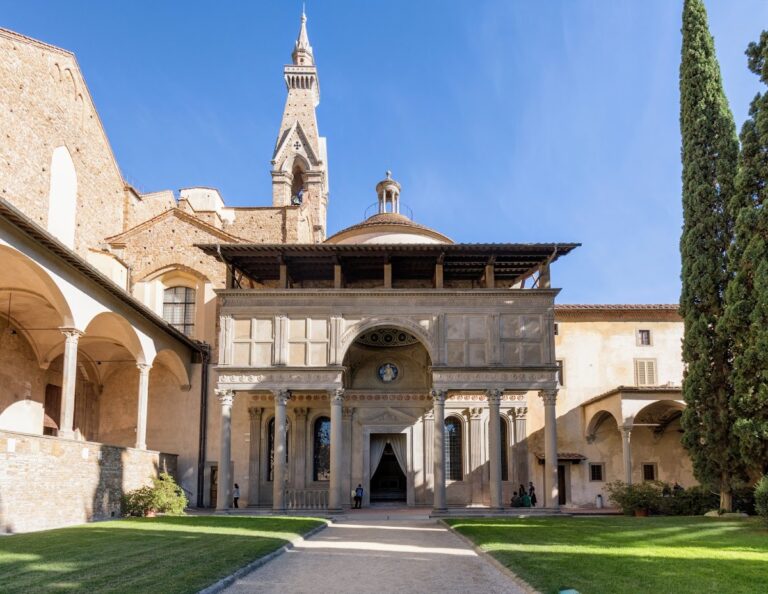
The Great Cloister and the Pazzi Chapel form a major part of the former convent. The fourteenth-century cloister was originally divided into a rectangular cloister in front of the Pazzi Chapel and a square cloister. The square section was demolished together with the Palace of the Inquisition, and the two spaces were combined into the present irregular P-shaped plan.
Filippo Brunelleschi, a principal architect of the early Italian Renaissance, designed the Pazzi Chapel, which was completed as the chapter house in the 1470s. Its portico is attributed either to Giuliano da Sangallo or to Brunelleschi’s designs. The chapel has a simple, harmonious Renaissance interior, a barrel vault, and a restrained architectural arrangement.
Its decoration includes a frieze by Desiderio da Settignano, glazed terracotta medallions and rosettes by Luca della Robbia, a lunette by Luca della Robbia, and wooden doors carved by Giuliano da Maiano in 1472. The interior contains twelve large Apostles’ medallions, a frieze of cherubs and the Lamb, four polychrome Evangelist medallions attributed either to Andrea della Robbia or to Brunelleschi’s designs, and a stained-glass window designed by Alesso Baldovinetti.
Second cloister
The second cloister has a square plan and a central well. Built in 1453, it is made entirely of pietra serena, a grey sandstone, with round arches supporting an architraved loggia. Its spandrels contain graffiti decoration, relief medallions, coats of arms, and emblems. The National Central Library of Florence occupies rooms on its southern and eastern sides.
The north side contains a gallery of funerary monuments, mainly from the nineteenth century, moved and reassembled between 1964 and 1986. Notable monuments include those to Virginia de Blasis, Giuseppe Sabatelli, Giovanni Pacini, and Louise de Favreau. Other memorials commemorate Girolamo Segato, Florence Nightingale, and the patriot Giuseppe La Farina.
A group of ten cypresses surrounds statues of God the Father by Baccio Bandinelli and a bronze Warrior by Henry Moore. The adjacent Remembrance Park commemorates ten Florentine soldiers who died in the First World War and received gold medals for military valour. It was inaugurated in Piazza Santa Croce in 1923 and moved to its present position in the early 1950s.
Refectory museum
The former fourteenth-century refectory contains the museum’s major works. Taddeo Gaddi’s frescoes from 1333 cover its west wall, including the Tree of Life, a Crucifixion, and the Last Supper. The decoration also includes scenes of Saint Benedict, Christ dining with the Pharisee, Saint Francis receiving the stigmata, and the life of Saint Louis of Toulouse.
Six fragments of Andrea Orcagna’s frescoes are displayed in the refectory after being recovered from beneath sixteenth-century plaster in the right aisle. They include parts of a Triumph of Death, a Last Judgment, and Hell. Other frescoes include a damaged Lamentation lunette by Taddeo Gaddi and Giovanni del Biondo’s Arrival of the Franciscans in Florence, which includes a view of Florence Cathedral Square around 1380.
Donatello’s gilded bronze statue of Saint Louis of Toulouse was made in 1423–1424 for Orsanmichele. After its removal from there in 1487, it stood for more than three and a half centuries at the centre of Santa Croce’s unfinished façade. It is now displayed in the refectory.
The museum also contains a detached fresco of Saints John the Baptist and Francis. It originally stood in the choir and was later moved to the right aisle. The work is associated with the luminous style of Domenico Veneziano and was once attributed to Andrea del Castagno.
Restored paintings in the refectory include works by Nardo di Cione, Lorenzo di Niccolò, Giovanni del Biondo, Lorenzo Monaco, Rossello di Jacopo Franchi, Domenico di Michelino, Francesco Salviati, Agnolo Bronzino, and Cigoli. Salviati’s Deposition, made in 1548, was recovered in severely fragmented condition. Bronzino’s Descent of Christ into Limbo, painted in 1552, was censored during the Counter-Reformation, and previously concealed details were rediscovered after restoration.
Additional museum rooms contain detached frescoes, stained glass, glazed terracottas, paintings, architectural models of the façade and bell tower, fragments attributed to Giotto and Alesso Baldovinetti, sculptures by Tino da Camaino and Giambologna, and plaster models for the nineteenth-century façade statues.
Organ, gardens, and dispersed works
The organ originally occupied one of two symmetrical marble cantorie created during Vasari’s sixteenth-century works. Onofrio Zefferini built the first organ between 1575 and 1579, using a case designed by Vasari. The instrument was replaced in 1929 by a larger organ built by the Giovanni Tamburini firm.
The flood of 1966 irreparably damaged the organ console and electronic controls. The instrument was restored and later underwent another major restoration by Mascioni in 2009–2010. In 2011, it had four 61-note keyboards, a 32-note concave-radial pedalboard, and three separate sound bodies distributed between the two cantorie and a case behind the high altarpiece.
The former convent gardens behind the church contain mature trees, including hackberries and Atlas and Himalayan cedars. Parts of the gardens are associated with the Pestalozzi and Vittorio Veneto schools, the National Central Library, and the Leather School.
Several works formerly at Santa Croce are now elsewhere. They include Giotto’s Peruzzi Polyptych at the North Carolina Museum of Art, The Eternal and Angels at the San Diego Museum of Art, fragments from Taddeo Gaddi’s sacristy cupboard at the Galleria dell’Accademia, the Alte Pinakothek, and the Gemäldegalerie in Berlin, and Filippo Lippi’s Novitiate Altarpiece at the Uffizi.
Burials and memorials
Santa Croce’s surviving and commemorative funerary monuments include those of Michelangelo, Galileo, Machiavelli, Vittorio Alfieri, Ugo Foscolo, Gioachino Rossini, Leonardo Bruni, Carlo Marsuppini, Leon Battista Alberti, Lorenzo Ghiberti, Giovanni Lami, Vittorio Fossombroni, and Giovanni Gentile.
Dante, Enrico Fermi, Guglielmo Marconi, Leonardo da Vinci, and Raffaello Morghen are represented by cenotaphs or memorial plaques because their remains are elsewhere. Together with the church’s paintings, chapels, cloisters, and convent buildings, these monuments preserve Santa Croce’s changing role as a Franciscan foundation, a Florentine religious and civic centre, and a pantheon of Italian memory.
Nearby sites