Banz Abbey: A Benedictine Monastery and Baroque Heritage Complex in Germany


Site at a Glance
- Rating
- 4.5
- Popularity
- Medium
- Country
- Germany
- Primary era
- Early Modern
- External website
- Open
- Eras represented
- Early Modern
- Civilizations
- Holy Roman Empire
- Site type
- Religious
- Remains
- Monastery
On this page15 sections
History
Banz Abbey is a former Benedictine abbey in Germany, founded around 1070 on the site of an earlier castle above the Upper Main valley. Countess Alberada of Schweinfurt and her husband, Count Hermann of Habsburg-Kastl, established the monastery, which was regarded as the oldest monastery on the upper Main until its secularization. The complex was later rebuilt in the Baroque period and became a major center of Catholic scholarship and religious life.
Foundation and medieval development
After the founders died, the abbey entered a period of decline. Bishop Otto I of Bamberg helped restore its position, and in 1127 he granted the neighboring castle of Stachilize to the monastery at the request of Abbot Baldwin. During the Middle Ages, Banz acquired extensive lands, received donations, and granted estates to noblemen as fiefs, meaning property held in return for service or allegiance.
The monastery also held burial rights for members of regional aristocratic families and acted as a lender. These responsibilities and assets made Banz an important economic institution in the surrounding region. Its Benedictine community was governed by an abbot and remained connected ecclesiastically with the Diocese of Würzburg, while the Bishopric of Würzburg recognized Bamberg’s temporal supremacy in 1566.
Destruction, religious conflict, and recovery
A major fire largely destroyed Banz in 1505. Reconstruction was still incomplete when the German Peasants’ War of 1525, a series of uprisings by rural communities against lords and ecclesiastical authorities, brought looting and another fire. The monastery was left in ruins, and the monks were forced to flee temporarily.
From 1565 to 1568, Banz became the focus of a political and religious conflict involving the Duke of Saxony and the bishops of Würzburg and Bamberg. Armed forces occupied the monastery. In 1568, the entire convent and Abbot Georg Truchseß von Henneberg left Banz and converted to Protestantism. Until then, the community had admitted only noblemen as monks.
The monastery was resettled in 1575 at the request of the Bishop of Würzburg under Abbot Johann Burkhard, who remained in office until 1598. The restriction to noble monks was abolished. Burkhard reorganized the abbey’s finances and recovered property that had been lost. This restoration of the community established the basis for its later recovery.
War and Baroque rebuilding
The Thirty Years’ War, the major European conflict of 1618 to 1648 involving religious and political rivalries, again devastated Banz. Swedish and imperial troops passed through the area, food became scarce, and the abbey was left with damaged buildings, ruined lands, and a sharply reduced population after the armies withdrew.
Monastic life revived under Abbot Otto de la Bourde, and rebuilding resumed under Abbots Eucharius Weiner and Kilian Düring. Leonhard Dientzenhofer began the reconstruction in 1698, and his brother Johann continued the work after Leonhard’s death in 1707. The principal building was largely completed between 1698 and 1704, while the abbey church was consecrated in 1719. The rebuilding gave Banz its characteristic early South German-Bohemian Baroque appearance.
Scholarship and secularization
During the second half of the eighteenth century, Banz became known throughout the Holy Roman Empire, the political federation of central European territories that lasted until 1806, as a center of Catholic Enlightenment. This movement sought to connect Catholic theology and institutions with scholarly inquiry, education, and Enlightenment intellectual culture. The learned monks attracted researchers, including Protestant scholars, and gave the abbey a wider intellectual role.
Secularization, the dissolution or transfer of church institutions and property to secular authorities, began at Banz in November 1802 and was officially completed on 24 October 1803. The Electorate of Bavaria assumed control. Some buildings were sold and demolished, valuables were confiscated, and the monastery’s art collection and library were dispersed. The abbey church became a parish church, the monastic estate was converted into the Banz district court, and the crypt, a chamber beneath the church used for burial and worship, was temporarily used as a cowshed.
Castle residence and twentieth-century uses
In 1814, Duke Wilhelm in Bavaria acquired the former monastery. The complex thereafter became known as Banz Castle and served as his summer residence, a use that protected the buildings from complete demolition. The duke received the King of Bavaria and the Empress of Russia there, and the residential rooms were refurnished. The crypt remained the burial place of the ducal family until 1883.
After the First World War, the Wittelsbach family leased the property to Trappists expelled from Oelenberg Abbey in Alsace. The monks stayed at Banz until they moved to Engelszell in 1925. In 1933, the Community of the Holy Angels bought the buildings from Duke Ludwig Wilhelm in Bavaria for one Reichsmark, while the surrounding lands remained with the Wittelsbach family. The community provided pastoral care for German Catholics living abroad.
From 1941, art and cultural property was stored in the vaulted cellars. Between 1942 and 1945, the Wehrmacht, Nazi Germany’s armed forces from 1935 to 1945, used parts of the castle as a reserve military hospital. From the summer of 1944, Kurt von Behr, a member of the Einsatzstab Reichsleiter Rosenberg, lived at Banz and deposited numerous works of art in the lowest cellar of the south wing. The organization was responsible for the seizure and administration of cultural property during the Second World War.
After the war, much of the former monastery was converted into a Caritas retirement home for refugees and expellees. The School Sisters of Our Lady from Bohemia operated the home, which housed 324 residents in 1950 and closed in 1964. In 1978, the Community of the Holy Angels donated the former monastery to the Hanns Seidel Foundation, which is closely associated with the Christian Social Union of Bavaria. The foundation established a conference and educational center there, while the local parish assumed responsibility for the abbey church. A substantial restoration program followed. The former monastic lands later passed to the House of Liechtenstein through the 1993 marriage of Sophie in Bavaria to Hereditary Prince Alois of Liechtenstein. The complex now forms part of the Gottesgarten, or “Garden of God,” landscape ensemble in the Upper Main region.
Remains
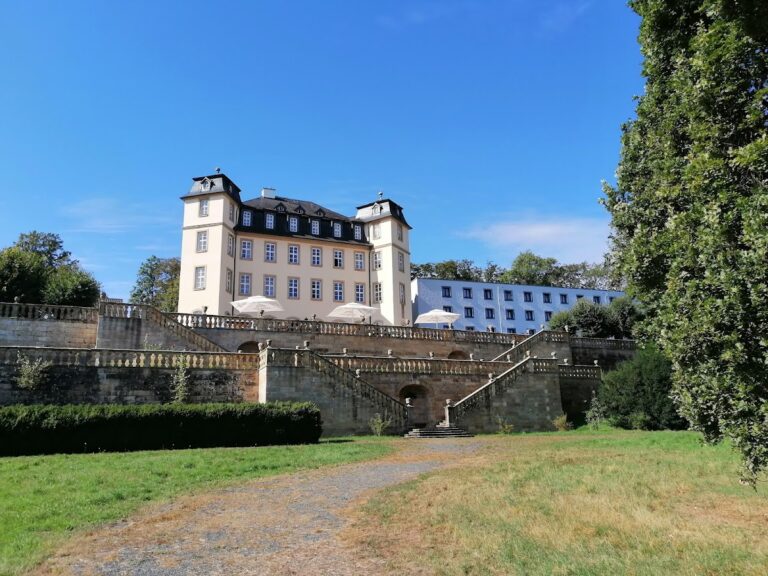
Banz Abbey occupies a hill above the Upper Main valley within the Gottesgarten landscape ensemble. Its surviving complex combines a Baroque monastic layout with later administrative, residential, religious, and museum uses. The elevated site is incorporated into the design of the church and provides broad views across the surrounding region.
Abbey church
Facade and spatial design
The former abbey church is dedicated to Saints Dionysius and Peter. Its foundation stone was laid in 1710, and the church was consecrated in 1719. A prominent two-tower facade presents the building against its elevated setting and forms a major part of the complex’s early South German-Bohemian Baroque character.
Johann Dientzenhofer designed an interior based on interlocking, dynamically arranged ellipses rather than right-angled spaces. Curved walls are interrupted by side chapels, while massive piers, inward-projecting balconies, and an active vaulted ceiling create a unified interior. The arrangement is characteristic of Baroque architecture, whose curved forms and strong movement integrate structure and decoration.
Altars, decoration, and choir stalls
Balthasar Esterbauer created the high altar, pulpit, and statues of saints in the church and on the facade in 1721. Melchior Steidl painted the ceiling frescoes. The high altar has no altarpiece, allowing the choir altar to be seen through it, an arrangement that reflects an idea by Dientzenhofer.
The choir stalls contain richly inlaid panels made by Johann Georg Neßtfell, court cabinetmaker and ebonist to the Schönborn court. Together with the sculpture and frescoes, the stalls form part of the church’s integrated Baroque interior.
Organs and bells
The church originally contained three organs by Johann Philipp Seuffert, the Würzburg court organ builder. The main organ stood on the west gallery, the choir organ was positioned on the left side of the monks’ choir, the part of a monastic church reserved for the community’s choral offices, and a winter-choir organ stood in a small upper-level winter choir north of it.
The present west-gallery organ is a relocated Seuffert organ from the demolished church of Grafschaft Abbey. Gerald Woehl of Marburg installed it and supplemented approximately one quarter of the instrument. The former winter-choir organ is now in the branch church of Saint Catherine in Oberküps, where twentieth-century renovations substantially altered its historical substance. The former summer-choir organ served in the Laurentius Church in Ebersdorf until it was destroyed in a church fire in 1945.
The organ now positioned above the monks’ choir was built by Thomas Eichfelder of Bamberg and is used in winter during services held in the crypt. The church also retains a five-bell bronze peal tuned to d1, e1, g1, a1, and c2.
Courtyard buildings and Consulentenbau
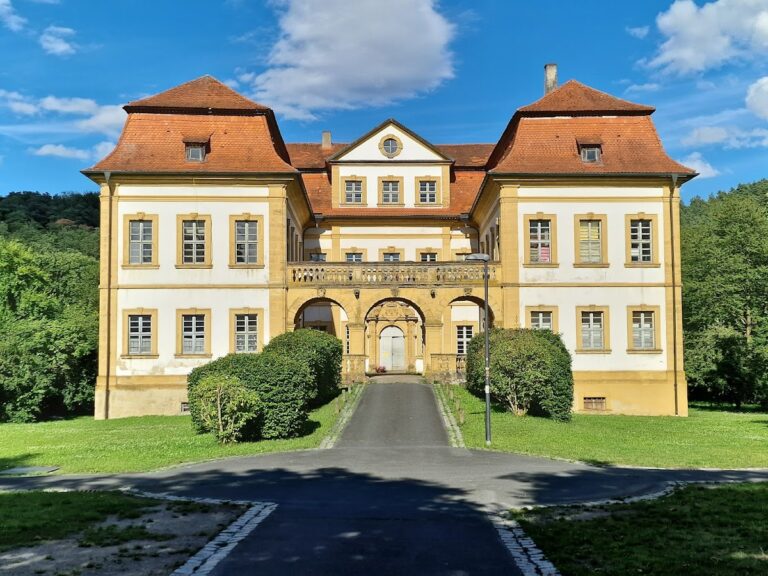
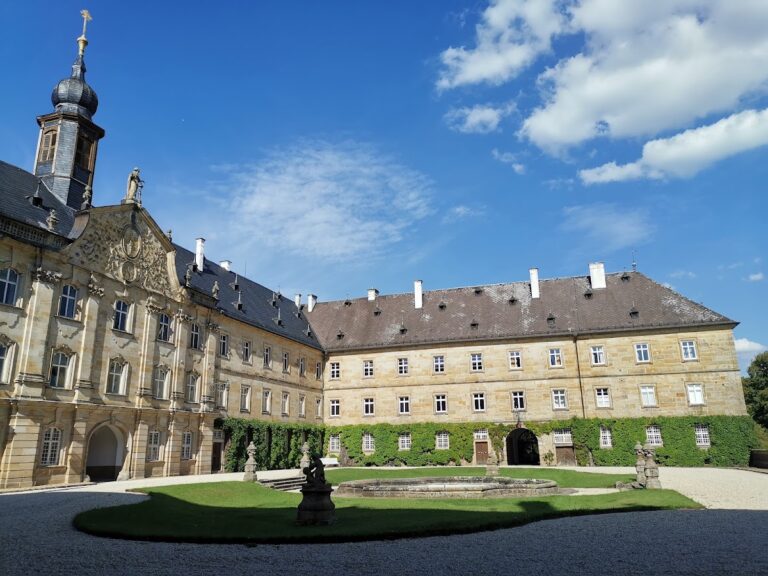
The economic and administrative buildings enclose the castle courtyard. They were executed in 1752 from designs by Balthasar Neumann, and the entrance gate carries Rococo ornament, a lighter decorative style associated with delicate and asymmetrical forms.
West of the gate building stands the Consulentenbau, a three-storey commercial building with two or three basement levels. It formerly served as the office building of the secular administrator. Since 1987, it has housed Museum Kloster Banz, whose historical collection traces the institution’s changing history from the seventeenth century to its present use as a Hanns Seidel Foundation educational center.
Museum collections
Fossil collection
The museum’s fossil collection is among the oldest paleontological exhibitions in Bavaria. Carl Theodori, a jurist, and Augustin Andreas Geyer, a Catholic cleric, organized and scientifically curated it in 1814 and 1857. The collection includes fossils found around Banz, including ammonites, belemnites, ichthyosaurs, flying reptiles, fish, crinoids, and marine crocodiles. Together they illustrate Jurassic marine life in southern Germany about 200 million years ago.
A central exhibit is a 2.10-metre-long ichthyosaur skull found near Unnersdorf on the Main in 1842. Joseph Victor von Scheffel wrote two poems about the specimen in 1859.
Oriental Collection
The museum also contains the Oriental Collection assembled by Duke Max in Bavaria after his several-month journey through the Near East in 1838. It includes archaeological material associated with ancient Egyptian and pharaonic culture, natural-history specimens, and ethnographic objects from the Ottoman Empire, as well as Egyptian mummies.
The collection is associated with limestone relief blocks from the Nubian Temple of Dendur, whose reconstructed temple is now in the Metropolitan Museum of Art in New York. Permanent displays are supplemented by changing exhibitions that connect archaeology, Egyptology, ethnology, and paleontology.
Nearby sites