Leixlip Castle: A Norman Castle and Longstanding Residence in Ireland


Site at a Glance
- Rating
- 4.6
- Popularity
- Very Low
- Country
- Ireland
- Primary era
- Medieval
- Eras represented
- Medieval, Early Modern
- Civilizations
- British, Norman
- Site type
- Military
- Remains
- Castle
On this page13 sections
History
Leixlip Castle is a Norman castle complex in Ireland, standing at Leixlip where the Rivers Liffey and Rye Water meet. Built by the Anglo-Normans between 1172 and 1175, it is one of Ireland’s oldest inhabited stone defensive structures and has remained a residence for more than 900 years.
Earlier settlement and Norman foundation
The site had an earlier Viking settlement. In 917, Sihtric Cáech, the Viking king of Dublin, defeated the army of the king of Leinster in a battle fought at Leixlip. The location also marked a boundary between the ancient kingdoms of Leinster and Brega. During the medieval period, ships could reach the site from the sea, while in later centuries it stood near the boundary of the Pale, the part of Ireland under effective English administration.
Adam de Hereford, a follower of Strongbow, built the castle after the Anglo-Norman conquest of Ireland. Strongbow was the commonly used name of Richard de Clare, whose intervention helped establish English and Anglo-Norman power in the country. The castle’s central section dates from 1172, while the larger complex developed between 1172 and 1175. King John used it as a hunting residence during his visit to Ireland in 1185, when he held the title of Lord of Ireland.
Siege, ownership, and later residents
In 1316, Edward Bruce besieged Leixlip Castle during his campaign against English rule in Ireland. Edward Bruce was a Scottish prince who claimed the title of High King of Ireland, but the castle withstood the attack.
Judge Nicholas White acquired the castle in 1567, and his descendants retained it until 1728. William James Conolly then bought the estate, including 809 acres around the castle, for £12,000. The Conolly family later sold it in 1914. Later residents included Archbishop George Stone, the Anglican Primate of Ireland, during the 1750s; George Townshend, Lord Lieutenant of Ireland, in 1770; Lord Waterpark; and Baron de Robeck, who drowned in the River Salmon Leap.
Arthur Guinness established a brewery near the castle in 1755. Arthur Guinness was an Irish brewer associated with the brewery that later became Guinness. The operation moved to St James’s Gate Brewery in Dublin in 1759. In 1922, Leixlip Castle became the residence of the French ambassador to the Irish Free State. William Cavan acquired it in 1945, followed by Desmond Guinness in 1958.
Literary association
Leixlip Castle is associated with Charles Maturin’s horror story Leixlip Castle, published in 1825. Maturin was an Irish novelist and playwright. The castle remains in good condition.
Remains
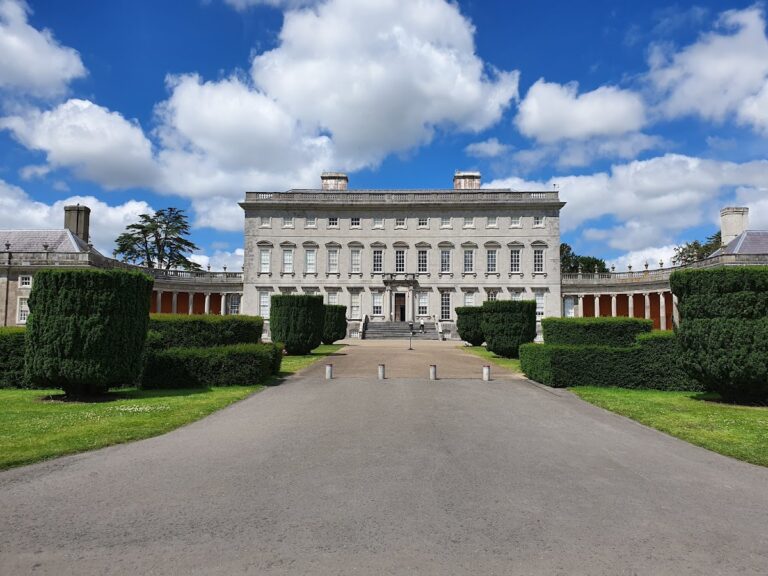
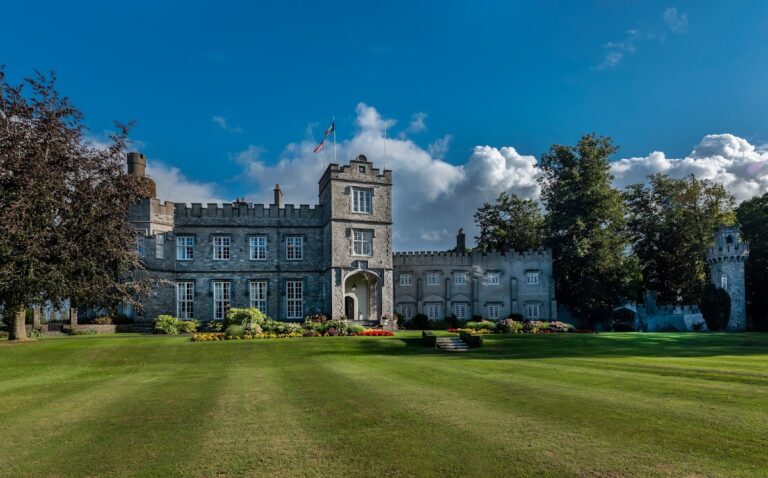
Leixlip Castle occupies a raised cliff above the River Liffey, at the point where the Rye Water joins it. The stone complex combines a twelfth-century central section with later additions and retains historic interiors, garden structures, and collections.
Castle and grounds
Stone castle
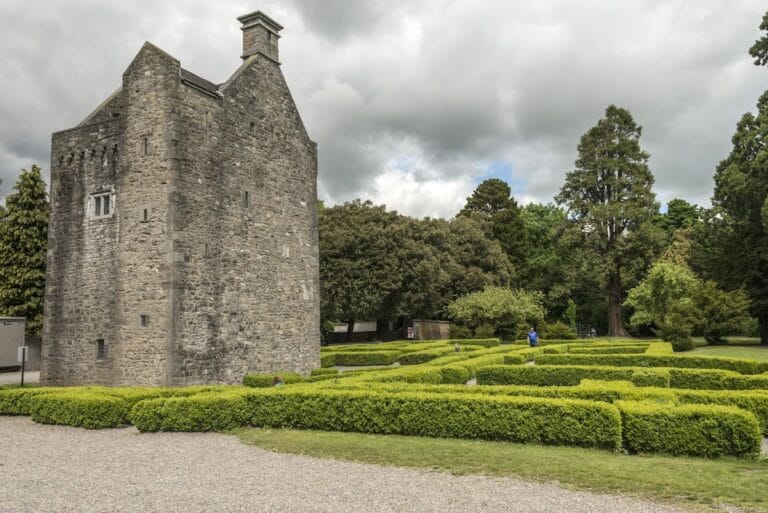
The central part of the castle dates to 1172, within the wider construction campaign of 1172 to 1175. Its defensive stone character reflects its Norman foundation, while its continued residential use has preserved a series of historic rooms and furnishings. The building is in good condition.
Boathouse
A ruined boathouse dating from 1780 remains on the grounds. Its position belongs to the riverside setting below the castle, where the Liffey and Rye Water meet.
Garden structures
At the end of the designed garden stands a temple built as a folly, a deliberately ornamental structure intended mainly for picturesque effect. The grounds also contain a kitchen garden.
Interiors and furnishings
Entrance hall
The entrance hall contains a Brussels tapestry showing Theodotus bringing Julius Caesar the head of Pompey. Brussels tapestry is a finely woven European wall hanging associated with the workshops of Brussels. The scene refers to Theodotus, a Greek rhetorician, presenting the severed head of Pompey, the Roman general and political rival of Caesar, to Julius Caesar.
Principal rooms
The dining room contains numerous pieces of Chippendale furniture, the refined eighteenth-century furniture associated with the English cabinetmaker Thomas Chippendale and carved, rococo-influenced design. The library has elaborate mid-eighteenth-century stucco decoration and a French carpet.
Historic collections
The castle retains historic tapestries, a library, carpets, paintings, sketches, engravings, and architectural drawings. An eighteenth-century large-scale dollhouse is also among its notable furnishings.