Balıklıgöl: Sacred Pools and Religious Heritage in Türkiye




Site at a Glance
- Rating
- 4.7
- Popularity
- Very High
- Country
- Turkey
- Primary era
- Classical
- External website
- Open
- Eras represented
- Iron Age, Classical, Medieval, Modern
- Civilizations
- Byzantine, Roman
- Site type
- Religious
- Remains
- Sanctuary
On this page15 sections
History
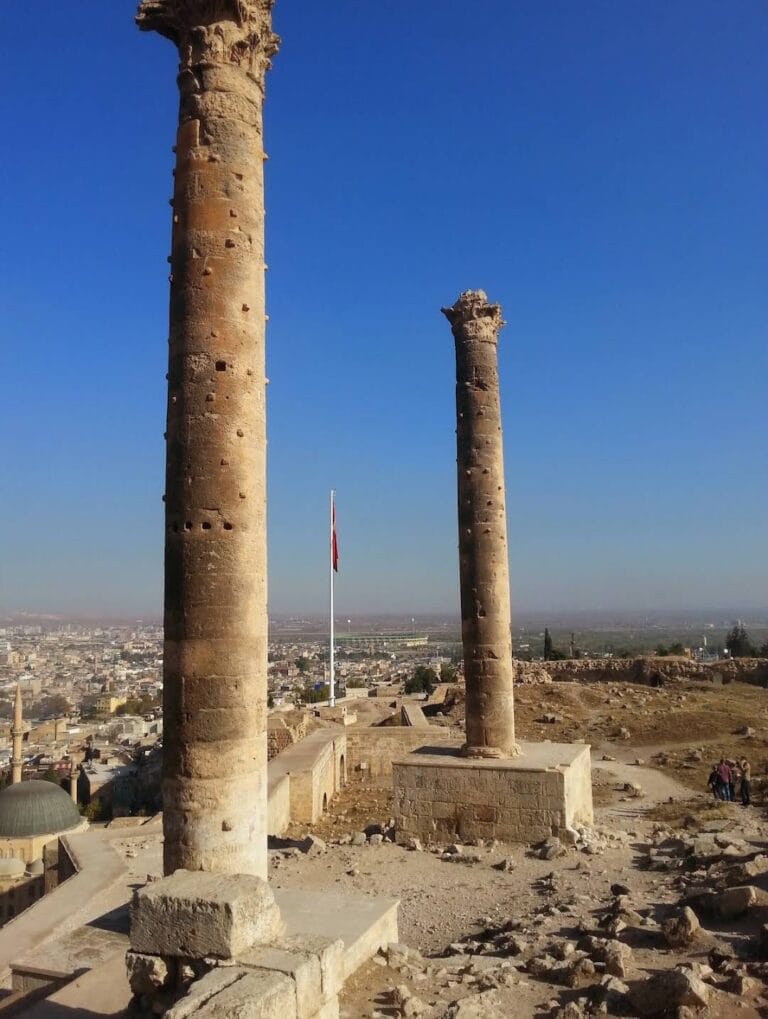
Balıklıgöl is a sacred pool complex in Şanlıurfa, Türkiye, comprising the Halil-ür-Rahman and Ayn-i Zeliha pools. Its fish and waters are revered in Islamic tradition, while the surrounding plateau preserves Jewish and Christian associations alongside historic religious buildings. The precise date and builders of the pools remain uncertain, but they have been interpreted as ancient pagan sacred pools dedicated to Atargatis, probably constructed between 1000 and 300 BCE.
Prehistoric and Hellenistic foundations
The plateau has a history extending back approximately 12,000 years. Excavations near Balıklıgöl produced a prehistoric statue associated with the Pre-Pottery Neolithic period and dated to approximately 8000 BCE. This early evidence places the landscape within a long sequence of human occupation before the emergence of the later urban and religious complex.
In the Hellenistic period, which followed Alexander the Great’s conquests and spread Greek political and cultural institutions across the eastern Mediterranean and Near East, the region was associated with the cult of Atargatis. She was a major goddess of northern Syria linked with water, fertility, love, fish, and pigeons. Her worship included sacred fish pools in other parts of Syria and the Levant.
Macedonian forces under Alexander conquered the Urfa region from the Persians in 331 BCE. Alexander’s commander Seleucus I subsequently renamed the city Edessa. The pools may belong to this wider Hellenistic religious environment, although their exact date, political authority, and original purpose remain uncertain because archaeological investigation on the plateau is restricted.
Osroene, Rome, and the flood of 525
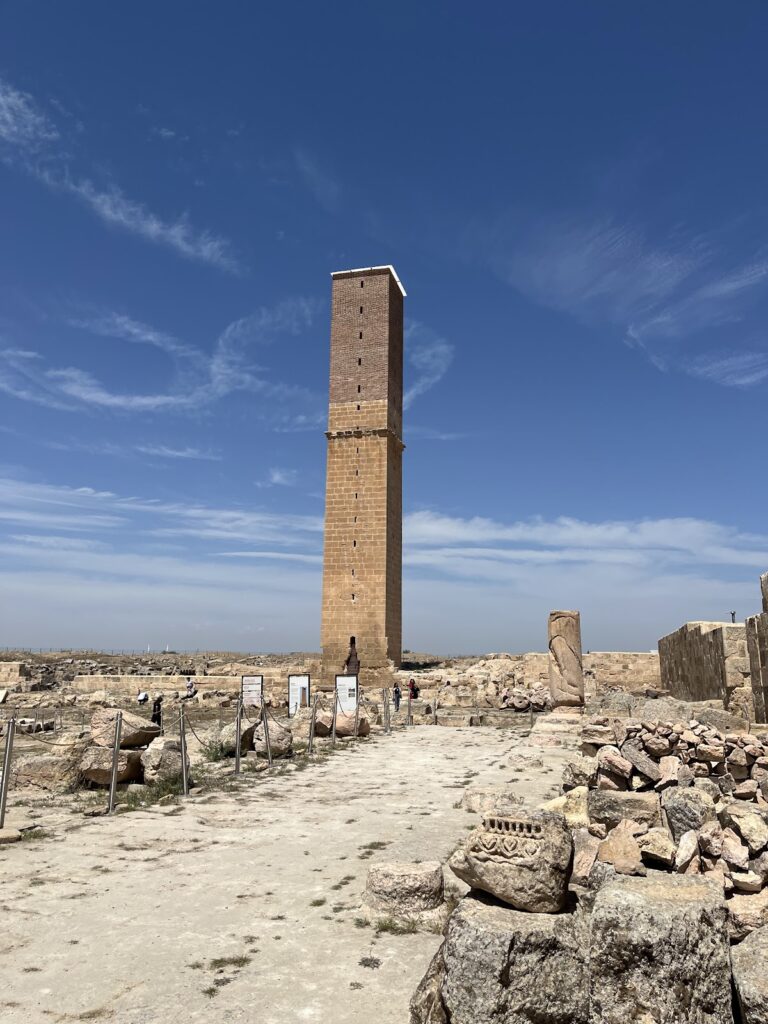
The earliest substantial construction on the plateau is attributed to the Kingdom of Osroene, a kingdom centered on Edessa that ruled the region from approximately 132 BCE to 242 CE. Temples, palaces, and other important buildings stood there. The area then remained under Roman and Byzantine rule for approximately six centuries, during which major works were undertaken to manage its watercourses.
A major flood in 525 filled the Balıklıgöl basin with water, destroyed palaces and other structures on the plateau, and caused the deaths of thousands of people. After Justinian I became Byzantine emperor in 527, engineers were sent to Edessa to control the floodwaters and redirect the streams feeding the basin. The city later became known locally as Justinianopolis in recognition of Justinian’s assistance.
Jewish and Christian traditions
Late antique Jewish tradition connected the area with Abraham and his conflict with Nimrod. The association developed through interpretations linking Abraham’s escape from the city of Ur with escape from fire, followed by the identification of Urfa rather than the ancient city of Ur in southern Mesopotamia as the setting. A first-century CE Jewish haggadic account attributed to Pseudo-Philo and later rabbinic literature helped shape this tradition.
Christian tradition preserves a different interpretation. Egeria, a fourth-century Christian pilgrim from the western Roman world, recorded an account transmitted by the bishop of Edessa that linked the pools and springs with Abgar V of Osroene and a Persian siege. Abgar V was a king traditionally associated with one of the earliest royal conversions to Christianity. In this account, the Persians diverted the city’s water supply, after which springs emerged miraculously on the plateau. The tradition also connects Abgar with the apostle Thomas and says that Abgar built a palace for his son Magnus over channels that continued to carry water.
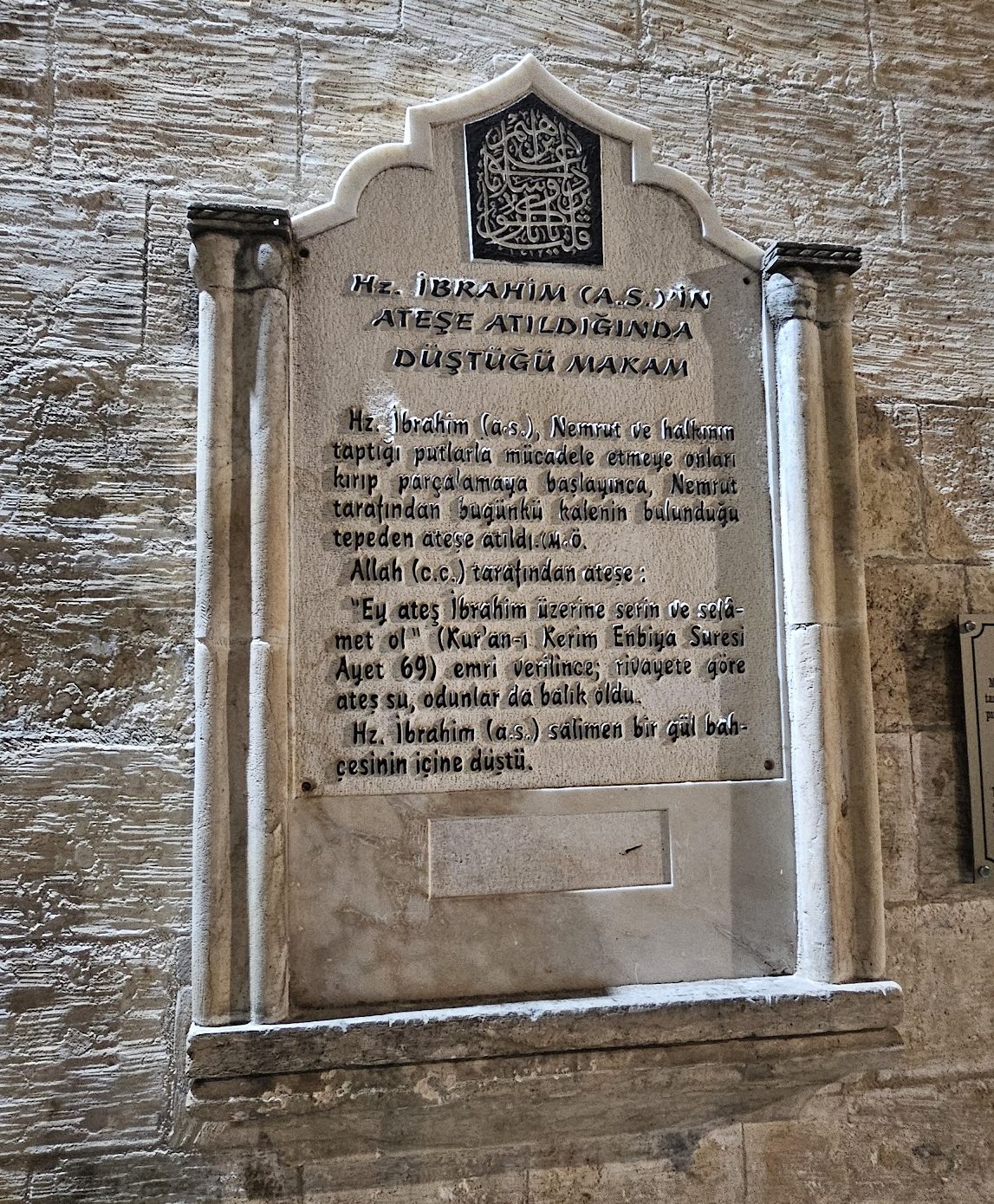
The Islamic tradition holds that Nimrod cast Abraham into a fire from the hill now occupied by Urfa Castle after Abraham rejected idolatry. Divine intervention transformed the fire into water and the wood into sacred carp. Abraham landed in the Halil-ür-Rahman Pool, while Nimrod’s daughter Zeliha created the Ayn-i Zeliha Pool when she followed him. Abraham’s Cave is traditionally identified as his birthplace. The connection between this narrative and Balıklıgöl is not stated in the Quran or hadith collections, and some Islamic researchers regard the story as a later popular belief or legend rather than an ancient account. The form of the popular narrative is described as developing or spreading between 1900 and 1960, partly through the adaptation of Jewish traditions.
The Persian-siege explanation differs from the historical interpretation that Roman engineers altered the plateau’s water channels after the flood of 525. Together, the Islamic, Jewish, and Christian associations represent successive or overlapping interpretations of a much older landscape.
Modern transformation and religious use
Until the 1970s, people swam in the pools and swimming competitions took place there. From the 1970s onward, the pools acquired a more explicitly sacred status, and swimming and eating the fish were prohibited.
Between 1924 and 1928, provincial governor Fuat Baturay caused extensive destruction of historic buildings in Urfa, including religious structures. He reorganized the area around Ayn-i Zeliha as Urfa Republic Park, and the fountain now situated in the center of that pool was added during his administration. The Hz. Ibrahim Halilullah Culture and Education Foundation was established in the 1960s, when conservation and improvement projects for the plateau were first developed. In 1970 and 1971, Tourism and Promotion Minister Necmettin Cevheri removed garages built during the Republican period, planted trees, and converted additional parts of the plateau into a park.
The Dergâh and Balıklıgöl Environmental Improvement Project began in 1992. After disputes over competing designs and several years of revisions, a project by Merih Karaaslan, revised with advice from architect Behruz Çinici, was approved in 1995 on the orders of Prime Minister Tansu Çiller and President Süleyman Demirel. Most of the work was completed in 2000, and partial restoration continues under the same project name. The intervention renewed the mosques, replaced historic wooden minbars with new stone ones, repaired minarets with new cut stone, restored the castle area, reopened a 96-meter-long tunnel, replaced its original stairs, added walking paths, widened the pools, and built restaurants around Ayn-i Zeliha.
Balıklıgöl remains an important pilgrimage and religious destination, particularly during Islamic religious holidays. Its continuing identity combines Abrahamic traditions with interpretations of the pools as ancient pagan sacred installations.
Remains
The surviving site is organized around two adjacent pools and their springs, with historic religious and urban structures distributed across the surrounding plateau. Limestone watercourses formed during the Eocene period feed the pools, and diversion structures reflect the long modification of the water system. The present paths and parts of the pool edges largely derive from the environmental improvement project, which altered the original dimensions to create wider walking areas.
The sacred pools and water system
Halil-ür-Rahman Pool
Halil-ür-Rahman Pool measures approximately 150 by 30 meters and is between 3 and 5 meters deep. Streams and springs supply its water through limestone channels and flood-control works. The pool contains carp, including a moustached variety whose roe is described as poisonous and unsafe for human consumption. The fish are treated as sacred, may not be caught or eaten, and are fed because the pool contains little natural prey.
Ayn-i Zeliha Pool
Ayn-i Zeliha measures approximately 20 by 50 meters and has the same general depth range as Halil-ür-Rahman. A fountain stands at its center, added during Fuat Baturay’s administration when the surrounding area was reorganized as Urfa Republic Park. The environmental improvement project widened the pool’s setting and built restaurants around it. The pool’s fish share the sacred status of those in Halil-ür-Rahman, while local belief associates eating them with illness and a separate legend says it causes blindness.
Religious and urban complex
Mosques and prayer buildings
The plateau includes eight historic mosques and prayer buildings: Rızvaniye Mosque, Hasan Paşa Mosque, Narıncı Mosque, Toktemur Prayer Hall, Sakıbiye Mosque, Mevlid-i Halil Prayer Hall, Yeni Dergah Mosque, and Halil-ür-Rahman Mosque. Halil-ür-Rahman Mosque and Rızvaniye Mosque are associated with the commemoration of Abraham’s deliverance. They are also described as replacing an earlier synagogue and church, a tradition belonging to the later religious history of the site.
Schools and Sufi institutions
Other structures include six religious schools, the Sakıbiye, Tahtamor, Hasan Paşa, Rahimiye, Halil-ür-Rahman, and Rızvaniye schools; two Sufi lodges, Sakıbiye and Ibrahim Halil; and the Halil-ür-Rahman Mevlevi zawiya. A zawiya is a small Islamic religious lodge often connected with Sufi teaching and devotion, while a medrese is an institution of Islamic religious education. These buildings form part of the plateau’s former urban and religious complex.
Cave and castle area
Abraham’s Cave and Maqam Ibrahim Mosque
Abraham’s Cave and the Maqam Ibrahim Mosque lie southeast of the pools and are traditionally associated with Abraham’s life. Water occupies part of the cave’s interior, while worship takes place in the section without water. The cave’s identification with Abraham’s birthplace belongs to the religious traditions that give the wider plateau its continuing sacred character.
Castle tunnel
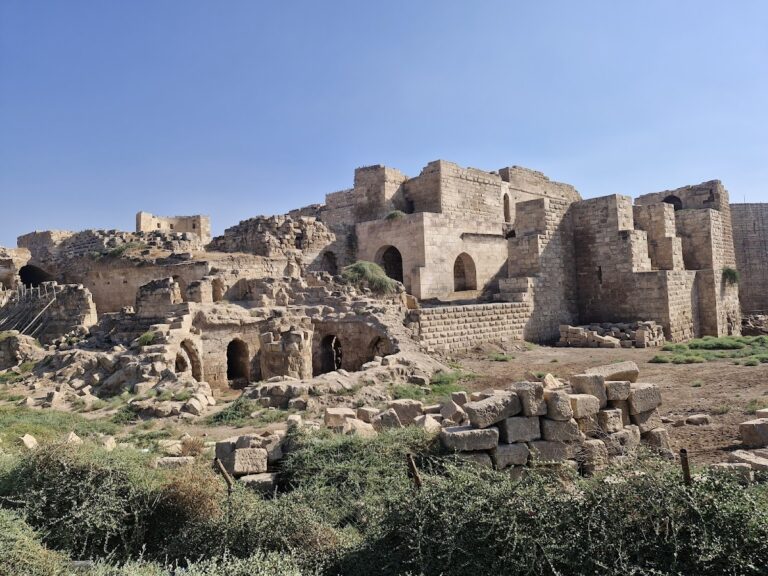
The castle area contains a 96-meter-long tunnel that functioned as a concealed passage. Soil had blocked it before restoration reopened it, and the original stairs were replaced because they were considered unsuitable for walking. The tunnel forms part of the fortified and water-related landscape associated with the plateau.