Sultantepe: An Assyrian Walled City and Tablet Archive
Site at a Glance
- Popularity
- Medium
- Country
- Turkey
- Primary era
- Iron Age
- Eras represented
- Iron Age, Classical
- Civilizations
- Assyrian, Roman
- Site type
- City
On this page13 sections
History
Sultantepe was a walled Assyrian city on a steep mound near modern Şanlıurfa, Türkiye, occupied in the eighth and seventh centuries BCE. It stood near the edge of the Neo-Assyrian Empire, the final phase of Assyrian rule.
Assyrian city and possible identification
The city was rebuilt after about 648 BCE. Sultantepe is sometimes identified as Huzirina, a place name associated with tablets from the mound and the annals of Tukulti-Ninurta II, an Assyrian king. The identification is uncertain. O. R. Gurney objected that the Huzirina named in the royal annals lay no more than a day’s march west of Nisibis, while Sultantepe is about 130 miles farther west.
Abandonment and later settlement
Sultantepe’s written records end abruptly in 610 BCE, when nearby Harran fell to Babylonian and Scythian forces, two years after Nineveh fell. Archaeological evidence points to a violent abandonment, and the city may have shared Harran’s fate. Later activity on the mound is represented by burials, including one identified as Scythian.
The mound remained unoccupied during the Neo-Babylonian period, which followed the Assyrian Empire, and under the Achaemenids, rulers of the Persian Empire. Settlement returned in the Hellenistic period, after Alexander the Great’s conquests. In Roman times, a military settlement occupied the mound while a more luxurious town lay at its base.
Excavation and study
A preliminary archaeological campaign took place in May and June 1951, followed by soundings in 1952 as a joint Anglo-Turkish project. The work involved British archaeologist Seton Lloyd of the British Institute of Archaeology at Ankara and Nuri Gökçe of the Ankara Archaeological Museum. Later deposits covering much of the site made further excavation difficult.
The tablet collection was discovered on 5 June 1951 and transferred to the Museum of Anatolian Civilizations in Ankara. There, the tablets were baked to help preserve them, a process that resulted in the loss of their original field numbers and their recataloguing. O. R. Gurney, Jacob J. Finkelstein, Peter Hulin, and other specialists cleaned and studied the texts over 13 years. Editions began appearing in Anatolian Studies in 1953, followed by a supplement in Archiv für Orientforschung. The work contributed to reconstructing ancient text series and preparing dictionaries of the Assyrian language.
Remains
Settlement and buildings
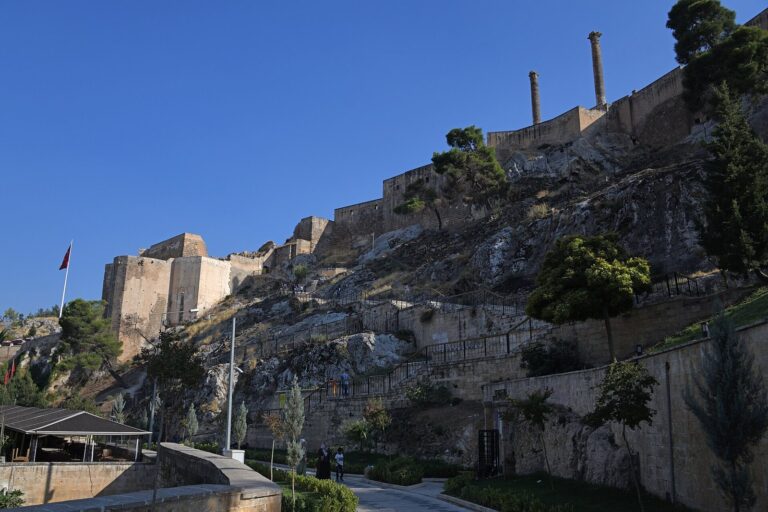
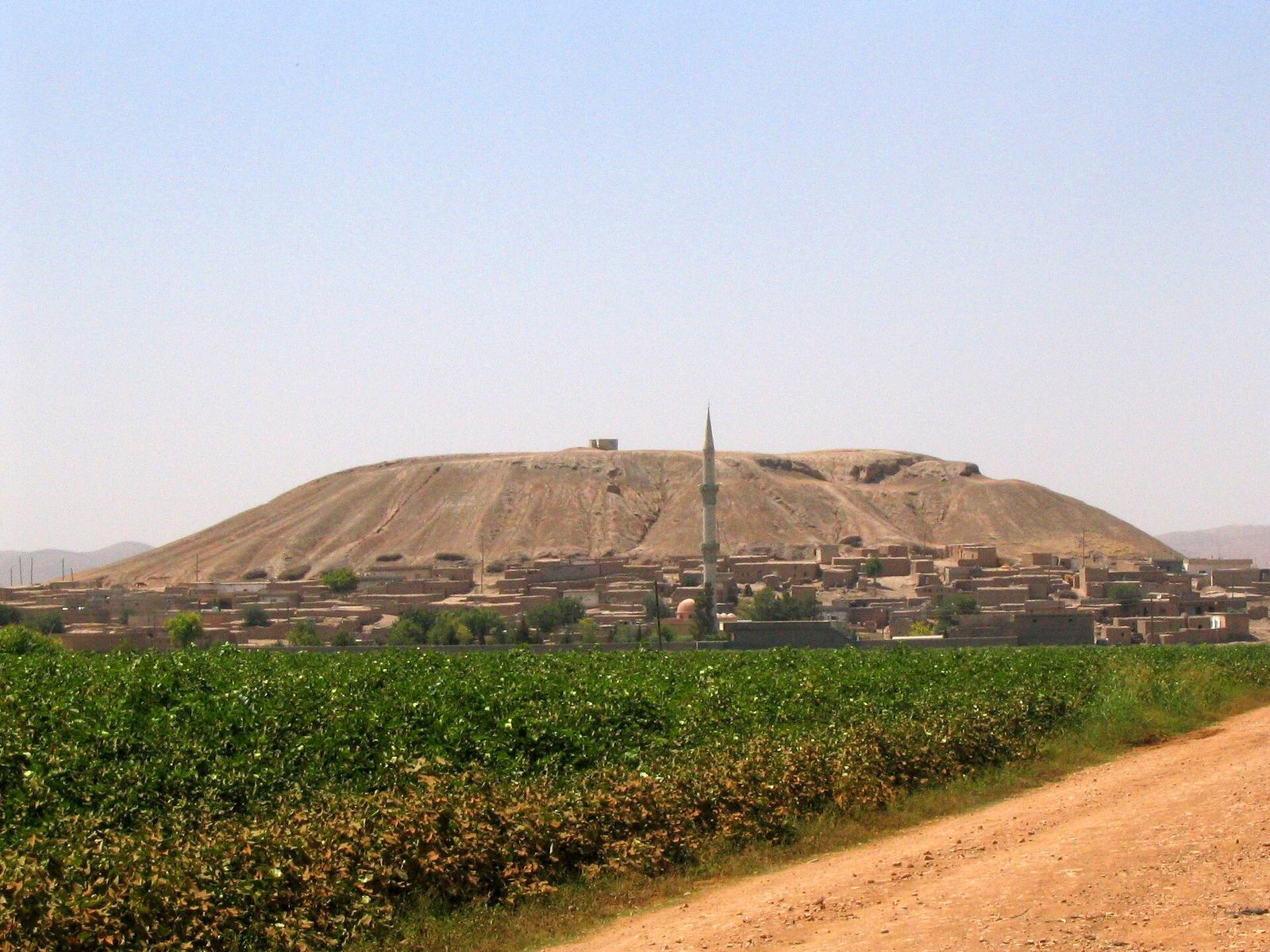
The remains occupy a steep-sided mound rising more than 50 metres, with a flat summit about 100 by 50 metres and a recorded area of approximately half a hectare. The mound lies about 15 kilometres south of Urfa, modern Şanlıurfa, near the Balikh River and the ancient city of Harran. Sultantepe village occupies the base and the north and east slopes in an arc around the mound; the lower town lies beneath the modern settlement.
Gateway and walls
Erosion exposed three basalt column bases at the Assyrian level. They were interpreted as part of a monumental gateway or portico, probably one of four bases and columns. The columns may have reached about a metre in diameter and considerable height. On another face of the mound, massive wall ends from the same level project from a point about seven metres below the summit.
Temple of Sin
A carved stone monument helped identify the principal building as a temple dedicated to Sin, the Mesopotamian moon god. The monument, an upright slab with a relief, is broken in half and shows a crescent with its horns pointing upward on a pedestal. The building had initially been interpreted as either a palace or a temple.
Later settlement layers
About seven metres of Hellenistic and Roman-period debris covers much of the mound, while the Assyrian layers are most accessible at its edges. Circular pits dug for grain storage in classical times cut into older Assyrian deposits. Roman-period remains at the mound’s base include a bath.
Tablet archive
The collection comprises about 600 clay tablets and fragments, most unfired, with a few fired examples. They are written in cuneiform, a script made by impressing wedge-shaped signs into clay. The tablets were not recovered in their original context. A group had been concealed in the northeast part of the elevated center of the settlement, stacked against a mud-brick wall in a residential building known as the House of Qurdi-Nergal. The name comes from a person mentioned frequently in tablet colophons, notes appended to manuscripts. In Area F1, a substantial group lay beneath a carved object thought to be an offering table or pedestal; other fragments came from among a bread oven and grain silos. The concentration of school exercises and misspellings supports the view that some tablets were scribal-school work. The collection has also been interpreted as a household library belonging to a priestly family.
Epic and wisdom texts
The tablets include religious, literary, medical, lexical, administrative, and contractual works, along with rituals, hymns, prayers, incantations, and readings of omens. They preserve forty lines of the creation epic Enuma Elish that were missing from copies found elsewhere in Assyria. A long, error-filled copy of the Epic of Gilgamesh appears to have been written by a novice, perhaps from dictation. Another fragment, worn, bent, and unfired, concerns Enkidu’s feverish dream. Sections of The Righteous Sufferer, a Mesopotamian wisdom composition often compared with the biblical Book of Job, include the earliest known copy of its first tablet, which describes the sufferer’s troubles at the hands of other people.
Other literary compositions
A 175-line work called the Legend of Naram-Sin is written in the form of a narû, a literary composition styled as a royal inscription. Its surviving fragment does not name Naram-Sin, a king of the Akkadian Empire, but presents royal titles, a first-person account of a reign, curses against defacing the text, and blessings for its preservation. The work helped scholars reinterpret related fragments from Nineveh and Hattusa, the Hittite capital, and includes material once identified as the Legend of the King of Cuthah.
The complete 160-line Poor Man of Nippur is a comic Akkadian tale. It probably originated at Nippur, an ancient Mesopotamian city, in the mid-second millennium BCE; the version preserved at Sultantepe dates to the seventh century BCE. Other literary fragments include a fictional Letter of Gilgamesh, a parody in royal style that demands animals and other goods, and parts of the myth of Anzû, a bird-like being in Mesopotamian tradition.
Chronology and practical texts
A series of tablets names limmu officials, whose names designated Assyrian years. This sequence supports the standard chronology for 911–648 BCE. Two contracts are dated to 684 and 674 BCE. The collection also contains medical treatments, vocabulary lists, and the lexical work known as HAR-ra = hubullu. Taken together, these materials make Sultantepe’s tablets a major known Assyrian collection, compared with the library of King Ashurbanipal at Nineveh.