Kvikne Church: A 17th-Century Timber Church in Norway
Site at a Glance
- Country
- Norway
- Primary era
- Early Modern
- Eras represented
- Early Modern, Modern
- Civilizations
- Denmark–Norway, Norwegian
- Site type
- Religious
- Remains
- Church
On this page11 sections
History
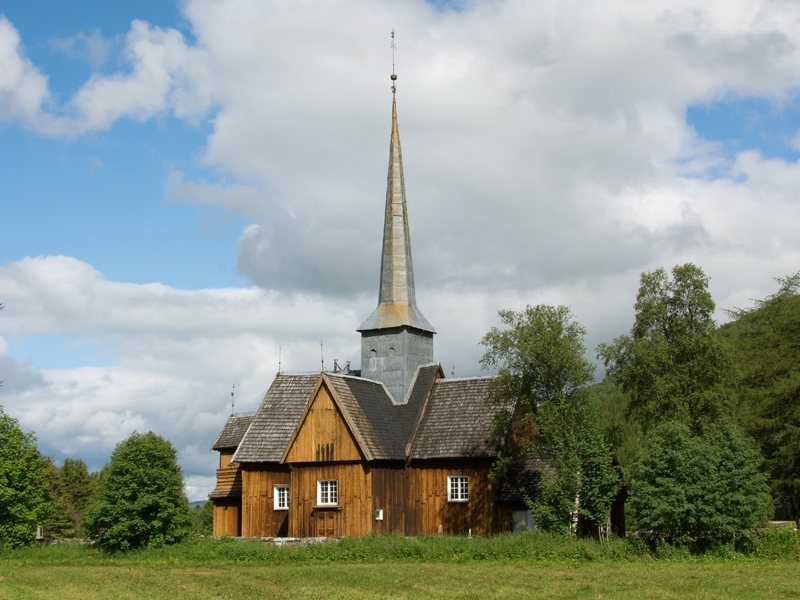
Kvikne Church is a timber church in Yset, Tynset Municipality, Norway, built from 1652 to 1654 on the site of an earlier church. Its history reaches back to a medieval wooden church, and the present building later served as a polling place in Norway’s first national elections.
The medieval predecessor
A church stood at Kvikne by 1570, the date of its earliest surviving historical records. It was a wooden stave church, a medieval timber building framed by upright posts, and may have been built in the 13th century. A Romanesque crucifix associated with the church is dated to around 1200, suggesting that the church may have originated earlier. A letter to Christian IV, then king of Denmark and Norway, also mentioned the church in 1635.
Construction of the present church
A copper mine opened at Kvikne in 1632, bringing population growth that left the old church too small. It was demolished on 12 July 1652, and a replacement was built on the same site using some materials from the earlier church.
Knut Mortensen drew up the plans and led the construction. The mine’s supervisor also worked as a builder. The new church was consecrated on 1 July 1654.
Later history and continuing use
The church underwent renovation during the 18th century. In 1814, it served as a polling place in Norway’s first national elections. Parish voters chose electors, who then selected representatives for the Constituent Assembly that drafted the Norwegian constitution.
Norwegian writer, poet, and playwright Bjørnstjerne Bjørnson was baptized at the church. He was born at Bjørgan parsonage while his father served as Kvikne’s priest. The former priests’ home is now a museum.
Kvikne Church remains an active congregation of the Evangelical Lutheran Church of Norway. It belongs to Kvikne parish, within Nord-Østerdal deanery, a grouping of parishes, and the Diocese of Hamar, a larger church district. The church also has automatic protection as a Norwegian cultural heritage site.
Remains
Exterior and layout
The brown, log-built timber church has a cruciform plan with short cross-arms. Tarred vertical boarding covers the exterior, and wooden shingles cover the roof. A roof turret rises above the junction of the main body and cross-arms, while a west porch has a small bell structure. The sacristy, a room where clergy prepare for services and keep religious objects, stands behind the choir, the area around the altar, at the eastern cross-arm. A churchyard lies beside the building. The church is well preserved, with its interior largely intact and relatively few alterations. The sacristy was added in the 18th century, and larger windows were installed in 1733. In 1768, the west porch and its small bell structure were built, and the bells were moved there from the tower. The roof turret was repaired in 1841 and covered with zinc in 1929.
Interior and furnishings
Painted decoration and galleries
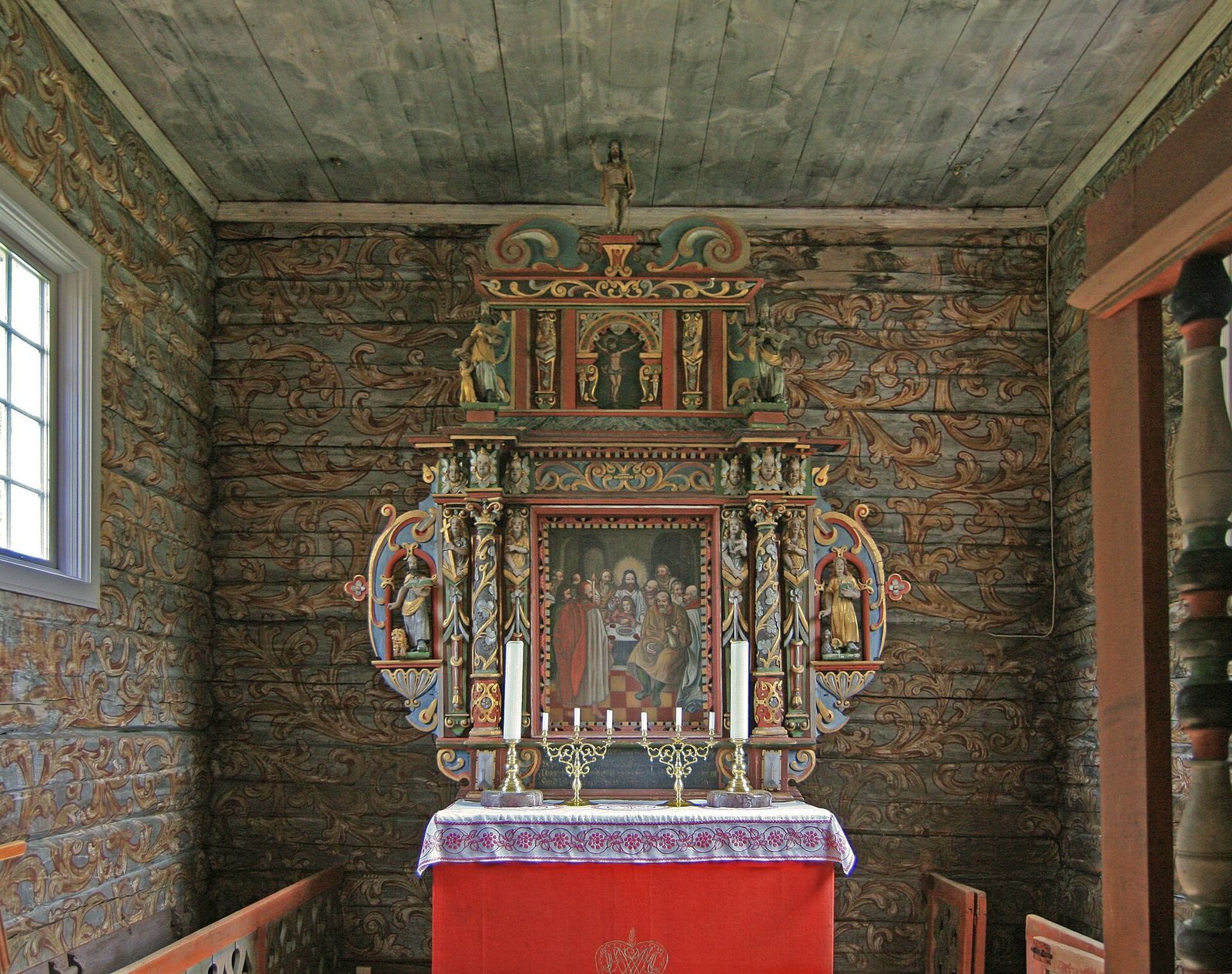
Floral tendrils were painted on the walls in the 1730s. The gallery fronts in the cross-arms carry images of Jesus and his disciples. A monogram of Christian VI, king of Denmark and Norway, is also part of the church’s decoration.
Altarpiece
The three-tier altarpiece is in the Renaissance style. Its lowest level depicts the Last Supper, the middle one shows the Crucifixion, and the upper level features Jesus. The woodcarving is attributed to Johan Bildsnider, while the paintings are attributed to Johan Kontrafeier.
Pulpit and baptismal bowl
The craftsman Jørgen Snickare made the pulpit. A brass baptismal bowl is decorated with Adam and Eve beside the tree of knowledge.
Crucifix and organ
A Romanesque triumphal crucifix, a cross associated with the division between the main worship space and the altar area, is also linked to the church. The 1976 organ was made by Norsk Orgel- og Harmoniumfabrikk. The church has seating for about 200 people.