Aulne Abbey: A Medieval Monastery in Belgium
Site at a Glance
- Popularity
- High
- Country
- Belgium
- Primary era
- Medieval
- Eras represented
- Medieval, Early Modern, Modern
- Civilizations
- Belgian, Holy Roman Empire, Prince-Bishopric of Liège
- Site type
- Religious
- Remains
- Fortified Monastery
On this page16 sections
History
Aulne Abbey is a former monastery beside the Sambre at Gozée, in the municipality of Thuin, Belgium. Founded as a Benedictine community in 656 or 657, it later became a Cistercian abbey and, by the end of the thirteenth century, one of the most powerful religious houses in the Principality of Liège, a territory ruled by prince-bishops who combined religious and secular authority.
Foundation and early oversight
Landelin, a monk associated with the founding of religious houses in the region, left Lobbes to live as a hermit on land given to him. He is said to have planted a cross at Aulne in 656. Followers gathered around him, and he established a community under the Rule of St Benedict, a foundational guide for monastic life, in place of the stricter rule associated with Columbanus. A local legend places the foundation earlier, in 637. Aulne initially depended on the Benedictine abbey at Lobbes as a priory. Landelin later left to found a monastery at Wallers.
After Aulne and Lobbes declined, Hydulphe of Lobbes and Pepin of Herstal called on Ursmer, a disciple of Landelin, to lead the community. Norse raiders ravaged Aulne around 880–882, and the priory remained abandoned for about fifty years. Richer, bishop of Liège and abbot of Lobbes, restored it around 920–945 and established it as a secular abbey, a community of clergy living together outside a monastic order. By the tenth century, such clerics had replaced the Benedictine monks. In 888, Aulne had been assigned property and income intended to support the bishop of Liège; by 961, it was under the bishop’s direct oversight rather than Lobbes’s jurisdiction. During a Hungarian incursion in 955, the monks and nearby residents sought protection under the abbot of Lobbes.
Cistercian reform and medieval prosperity
An effort by Abbot Raoul to introduce the Rule of St Augustine in 1144 was overturned by the bishop of Liège. On 3 December 1147, Cistercian monks from Clairvaux, a leading Cistercian abbey in France, arrived under Francon de Morville. Canons and local people initially resisted their establishment. The transfer was confirmed in 1158 by Henry II of Leyen, prince-bishop of Liège, and a dispute with neighbours continued until Hugh of Pierrepont settled it in 1205. Under Hugh, Aulne gained privileges and was released from the bishop’s assigned property and income. Its holdings expanded, and its prosperity grew. From 1237, the abbey also governed Soleilmont Abbey, which remained under its authority until the eighteenth century.
Aulne’s community included Simon, a lay brother, meaning a non-ordained member of a monastery. He joined the Cistercians at sixteen and became known for his mystical reputation. In 1215 Pope Innocent III summoned him to Rome to advise during the Fourth Lateran Council, a major church council. Simon declined an offer of ordination and returned to Aulne. He died in 1228, aged eighty-four, and was venerated despite never being formally canonized.
Disruption and rebuilding
Discipline weakened during the abbacy of Jacques de Gozée (1298–1331). Reform efforts included an instruction to the abbot of Clairvaux in 1304, a recommendation from Pope John XXII in 1322, and a reform order issued by Pope Benedict XII in 1336. During the fourteenth century, poorer climate, epidemics and warfare, alongside workers moving to towns, reduced the number of lay brothers and agricultural labourers.
In the fifteenth century, fighting between forces from Liège and the dukes of Burgundy repeatedly forced the monks to leave and caused serious damage. The abbey underwent extensive rebuilding, but by 1492 it was so impoverished that Pope Innocent VIII directed the abbots of Lobbes and Cambron and the dean of Binche to support the community and pay its debts. Elected in 1497, Abbot Gérard Bosman repaid obligations, acquired land, restored discipline and began major building work with help from Érard de La Marck, prince-bishop of Liège. The choir and transept were rebuilt, and the church was consecrated in 1525. His successor, Jean de Lannoy, continued the improvements and built the abbot’s quarters.
French troops raided Aulne in 1538. In 1578, forces involved in the Dutch Revolt, a sixteenth-century uprising against Spanish Habsburg rule in the Low Countries, ravaged the abbey. The monks took refuge in a house at Thuin. Henri de Velpen, elected abbot in 1586, worked to restore the damaged community and its religious life.
Renewed prosperity and revolutionary destruction
During the seventeenth century, warfare between Spanish and French forces repeatedly devastated the Principality of Liège. Abbot Jérôme Reyers negotiated to prevent Aulne’s complete destruction, but the abbey faced heavy levies, while its farms suffered damage and military requisitions. Around 1663, the community comprised about seventy religious: fifty-eight priest-monks, three novices and nine lay brothers.
The abbey prospered again in the eighteenth century. Abbot Maur Carion paid its debts before his death in 1728. His successor, Barthélémy Louant, began an extensive rebuilding and renovation programme, continued by later abbots, including Joseph Scrippe.
The Liège revolutionary government imposed levies in 1790 and 1791, and French revolutionary forces entered the region in 1792. Abbot Norbert Herset fled twice before returning in 1794. On 10 May, as French troops approached, more than fifty monks evacuated with valuable possessions. French forces pillaged the abbey and set it on fire on 14 May. General Charbonnier acted under an order from Saint-Just, who feared, probably mistakenly, that Aulne and Lobbes could become enemy strongholds. Resentment of the abbots’ authority, including their grain-pricing policies, also contributed to the destruction. The fire consumed a library of about 40,000 books and several thousand manuscripts.
Monks returned from exile and began protective repairs in 1795. The authorities restored their property that September, but the abolition of religious orders in 1796 ended the attempt to resume monastic life. Aulne and its Lower Court farm were sold in 1798; the buildings were later dismantled, and their stone was reused in nineteenth-century canal and railway works. After the last monk with rights to use the property, Norbert Decouve, died in 1854, an old people’s hospice established under Herset’s arrangements opened at Aulne in 1856. The ruins came under state maintenance in 1896. The Walloon Region acquired the site in 2010. Aulne’s ruins were classified as heritage in 1991 and recognized as exceptional Walloon heritage in 2013.
Remains
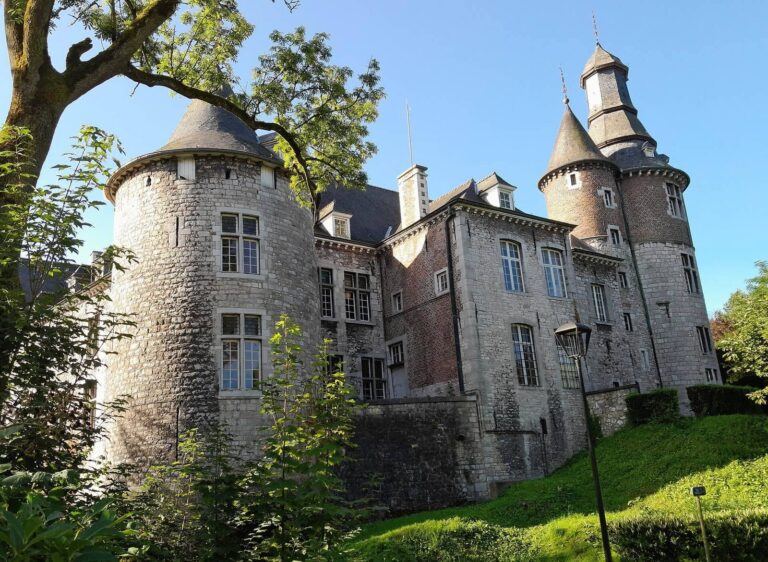
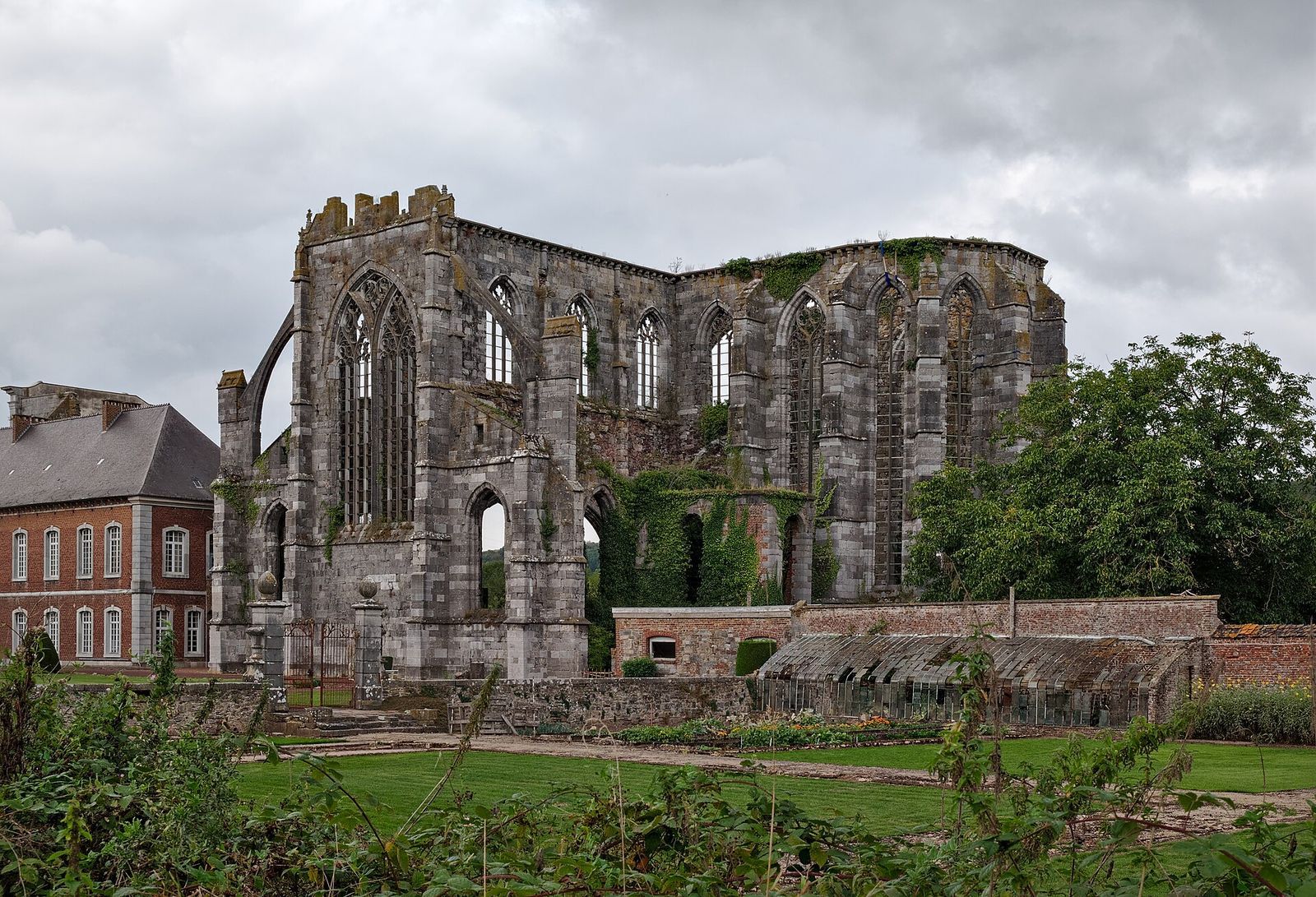
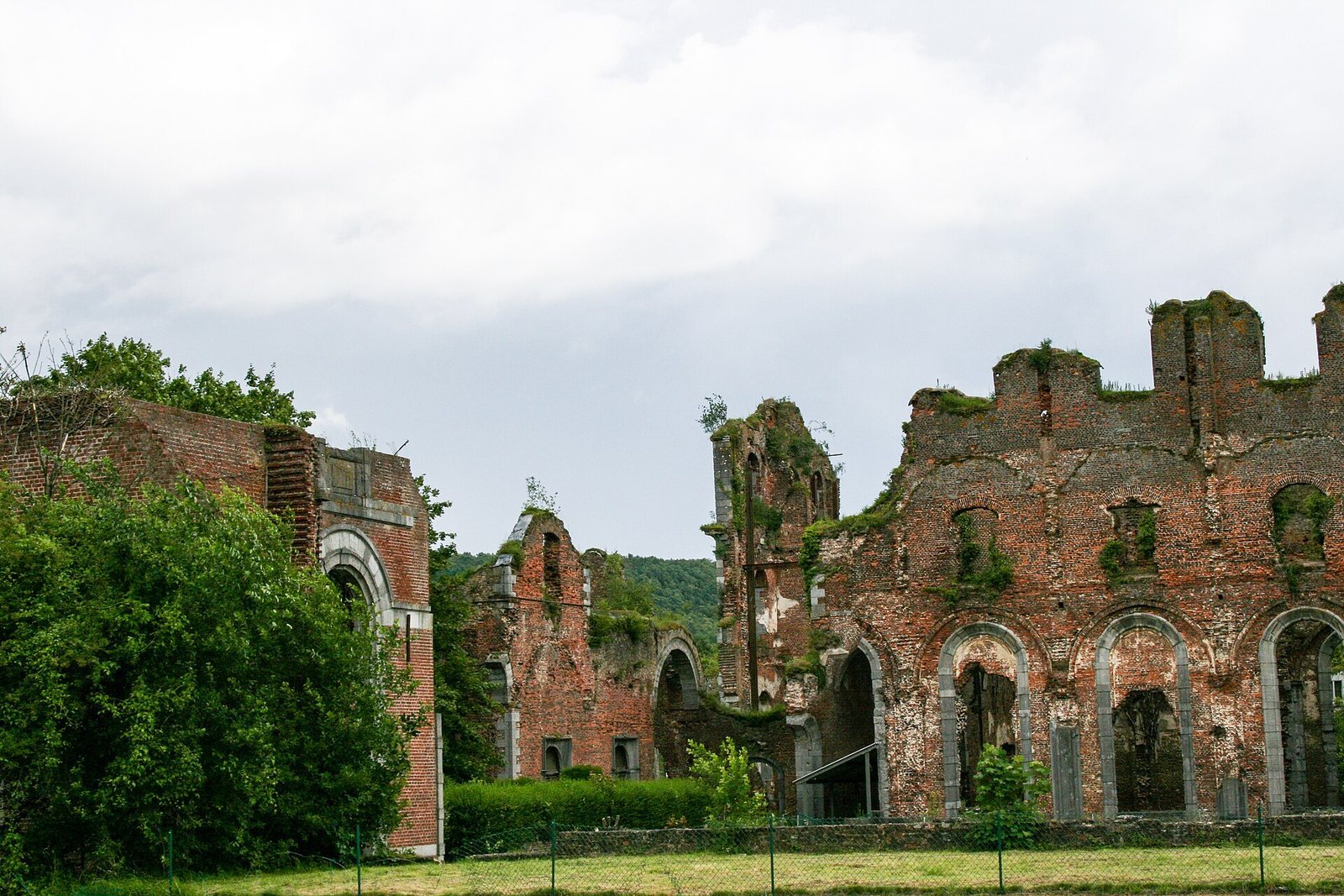
The surviving complex combines fragments of a Gothic church with remains of eighteenth-century monastic buildings, within an enclosure beside the Sambre. A wall once surrounded the abbey. Its surviving medieval gate tower, church remains and later buildings reflect the site’s changing uses and rebuilding.
Abbey church
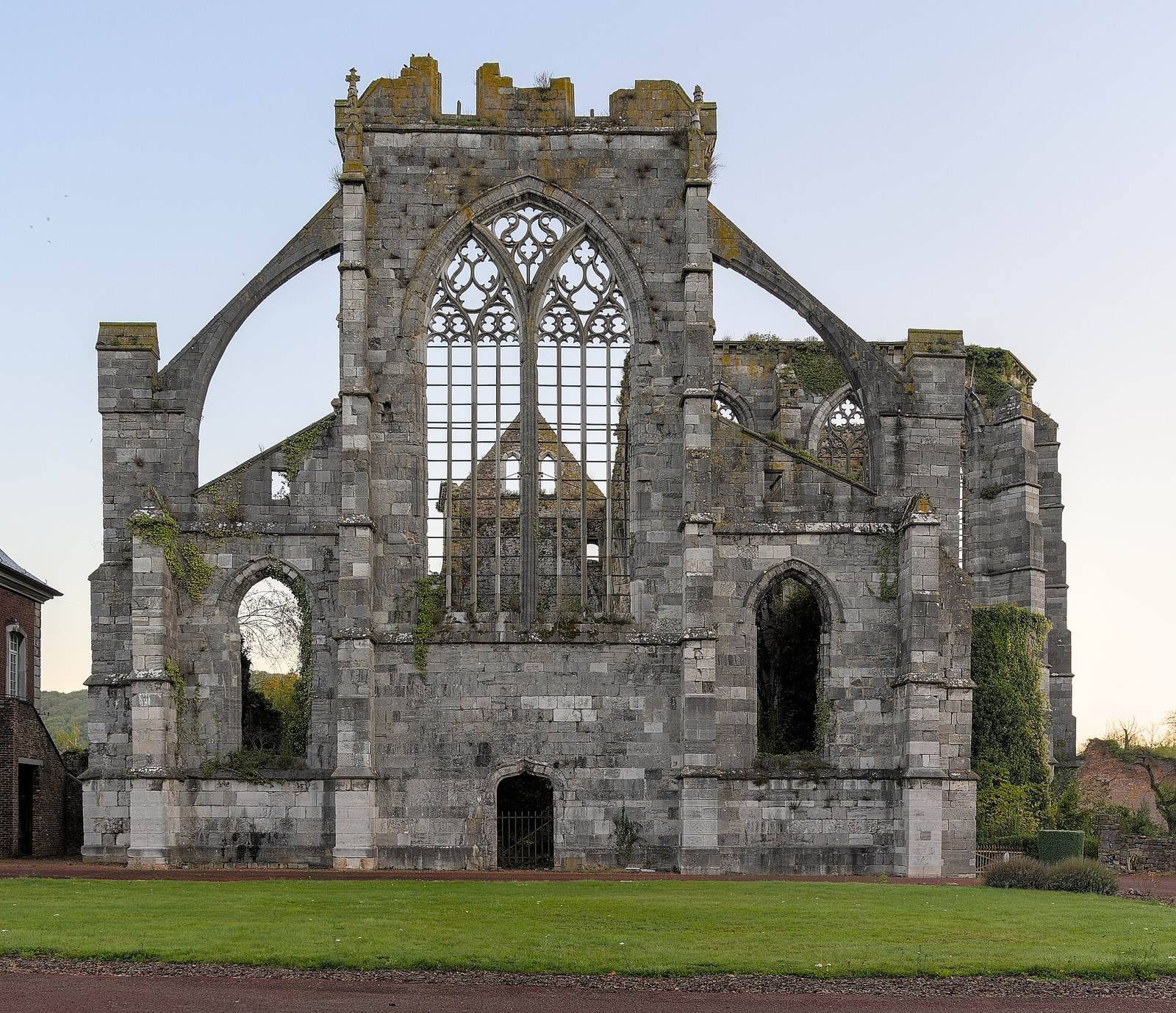
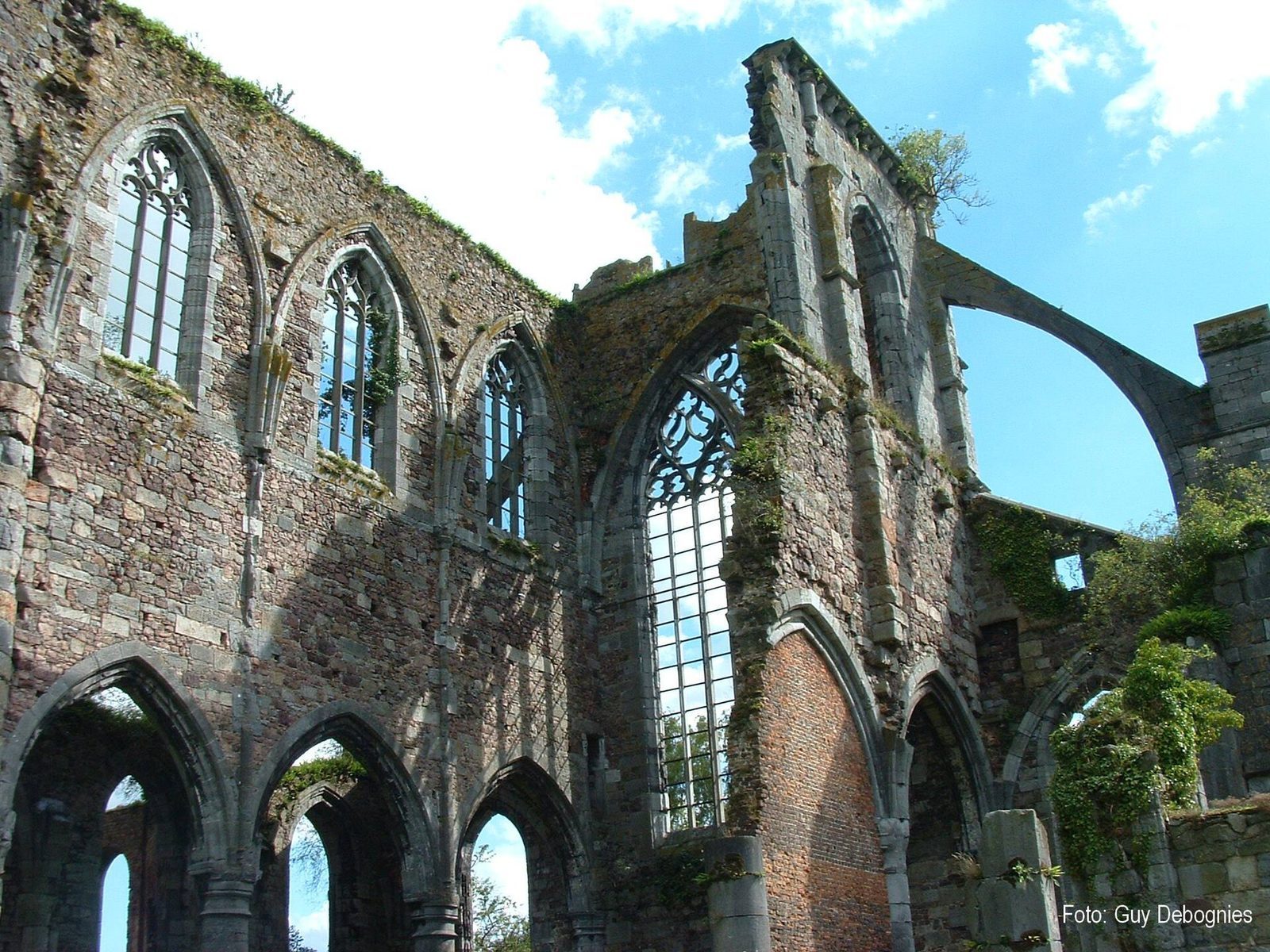
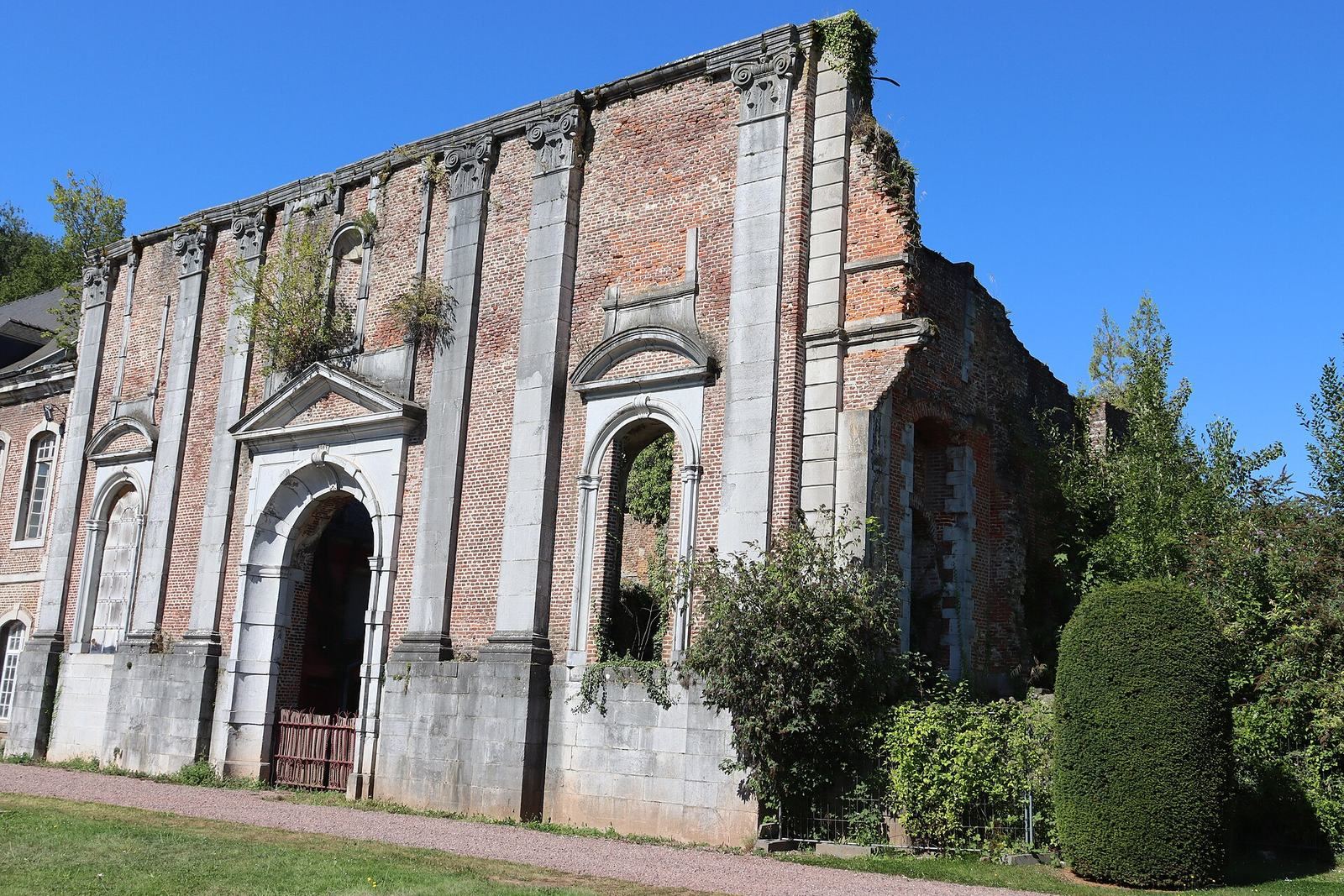
Dedicated to the Virgin Mary, the abbey church was built between 1214 and 1247 under Abbot Gilles de Beaumont. Its Gothic remains include the façade, choir and transept, with surviving fabric dating from the thirteenth to fifteenth centuries. The nave between the transept and choir has disappeared, while only a few pointed arches remain from the sacristy and chapter house. Abbot Barthélémy Louant later gave the church a new façade.
Enclosure and waterworks
Landelies Gate
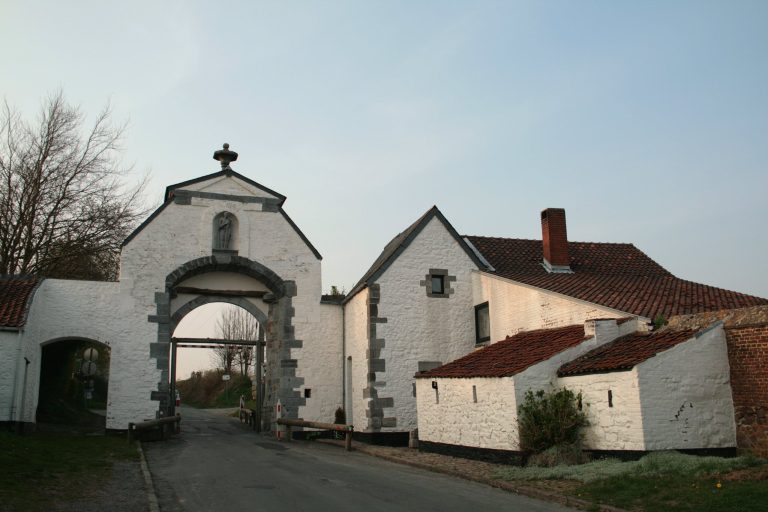
The Landelies Gate is a surviving medieval gate tower in the enclosure wall. It served as the abbey’s sole entrance until the eighteenth century. Food was distributed there to people in need, and a monk charged with receiving visitors lived on its upper floor. A carved stone relief from the late sixteenth century, showing St Bernard among alder trees at the Virgin Mary’s feet and bearing the abbey’s arms, was originally placed above the gate. Around 1888, it was set into the east wall of the hospice’s women’s wing.
Ponds and mill
An irrigation system and six ponds supplied fish to the abbey. The mill stood outside the enclosure and dates to the thirteenth century. Its stonework bears the abbey’s arms, the date 1611 and the arms of Abbot Henri de Velpen.
Monastic buildings and farm
Monastic buildings
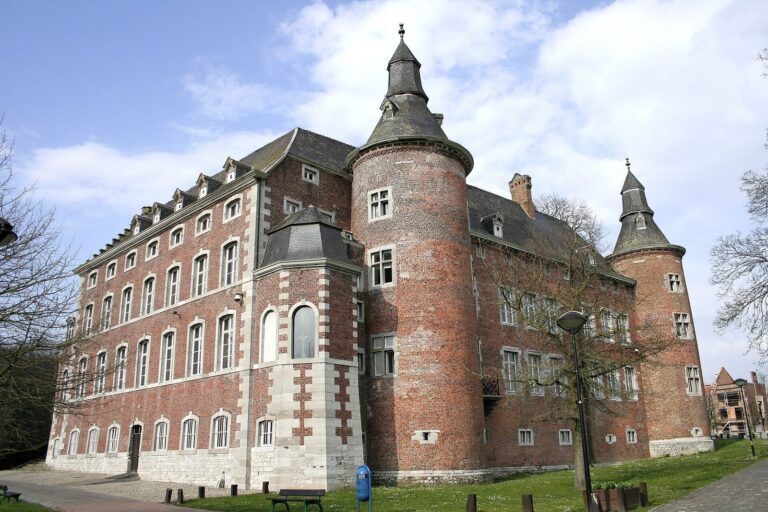
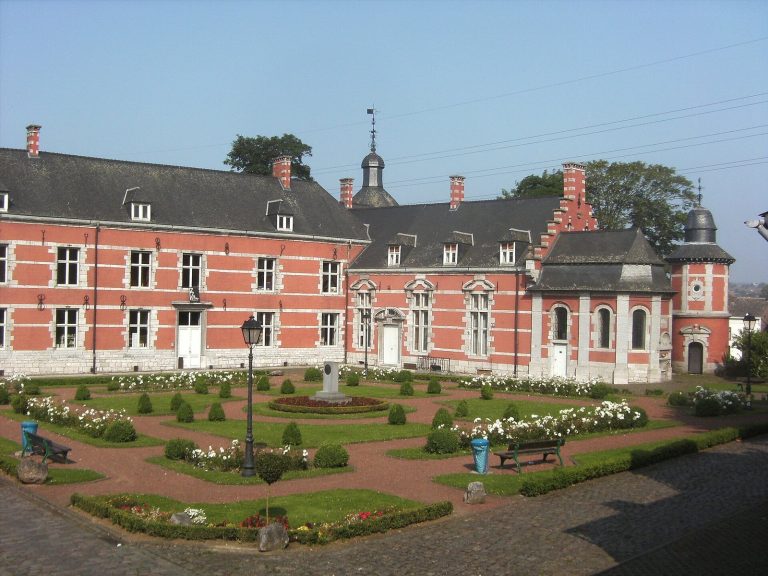
The surviving eighteenth-century remains include parts of the cloister, the abbot’s quarters, stables and other monastic buildings. Rebuilding between 1728 and 1753 involved the cloister, refectories, dormitories, guest quarters, infirmary and quarters for older monks and the prior. Abbot Scrippe added an honour pavilion facing the church, a coach house in 1768 and a new abbot’s residence in 1772. Some buildings were later restored and used by the hospice. The abbey also had a tannery and brewery; a new brewery was built among the ruins in 1998, on the site of the stables.
Lower Court farm
Outside the enclosure, the eighteenth-century Lower Court farm includes an arcaded gallery. Although damaged in 1794, it remained habitable and sheltered monks who returned after the Revolution.
Hospice and later church
Hospice
The hospice opened in 1856 in buildings handed over by the monks. Its complex includes modern buildings and a chapel, and some restored abbey buildings were adapted for its use. The carved relief once displayed above the Landelies Gate was placed in the hospice’s east wall around 1888.
Church at the former entrance
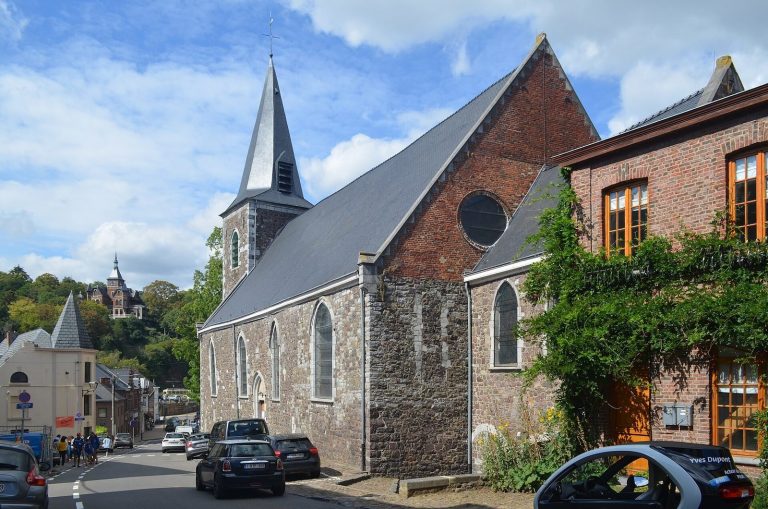
A new church was built at the former main entrance to the abbey. Its first stone was laid in 1869, it was blessed in 1873 and it was completed in 1875. It later served as the parish church and was recorded as deconsecrated in 2019. Its furnishings included a marble high altar from Rance, a pulpit carved in 1688 and acquired from Templeuve in 1874, and a restored organ bought in Evere.