Auld Aisle Cemetery: Historic Burial Ground in Kirkintilloch, Scotland
Site at a Glance
- Popularity
- Low
- Country
- United Kingdom
- Primary era
- Early Modern
- Eras represented
- Early Modern, Modern
- Civilizations
- British
- Site type
- Burial
- Remains
- Necropolis
On this page10 sections
History
Church and Parish Origins
Auld Aisle Cemetery is a historic burial ground in southern Kirkintilloch, Scotland, United Kingdom, and is probably among Scotland’s oldest surviving cemeteries. It occupies the former grounds of St Ninian’s, a pre-Reformation parish church, meaning a church serving a local ecclesiastical district before the Scottish Reformation. St Ninian was a Christian saint traditionally associated with early missionary work in Scotland. The church replaced a chapel dedicated to the Virgin Mary, dating to the 12th century and situated north of Kirkintilloch.
St Ninian’s probably declined in importance in the mid-17th century, after a new St Mary’s Church was completed. The old church was abandoned after 1659, following the division of the former parish of Lenzie into Cumbernauld and Kirkintilloch.
Expansion and Recognition
A watchtower in the cemetery dates to the early 18th century. The burial ground was extended westward in 1863, when its gate lodge was built. On 14 May 1971, the cemetery was designated a Category A listed building, Scotland’s highest grade of listed-building protection. The gate lodge is also included in Scotland’s Buildings at Risk Register.
Those buried at Auld Aisle include Alexander Bain (1811-1877), the first to invent and patent the electric clock; social reformer and philanthropist Beatrice Clugston (1827-1888); chemist Archibald Couper (1831-1892); politician John Ferguson (1836-1906); and poet David Gray (1838-1861). Nicola Ann Raphael (1985-2001), whose death by suicide was linked to bullying, is also buried here.
Remains
Eastern Cemetery
Enclosure and Entrance
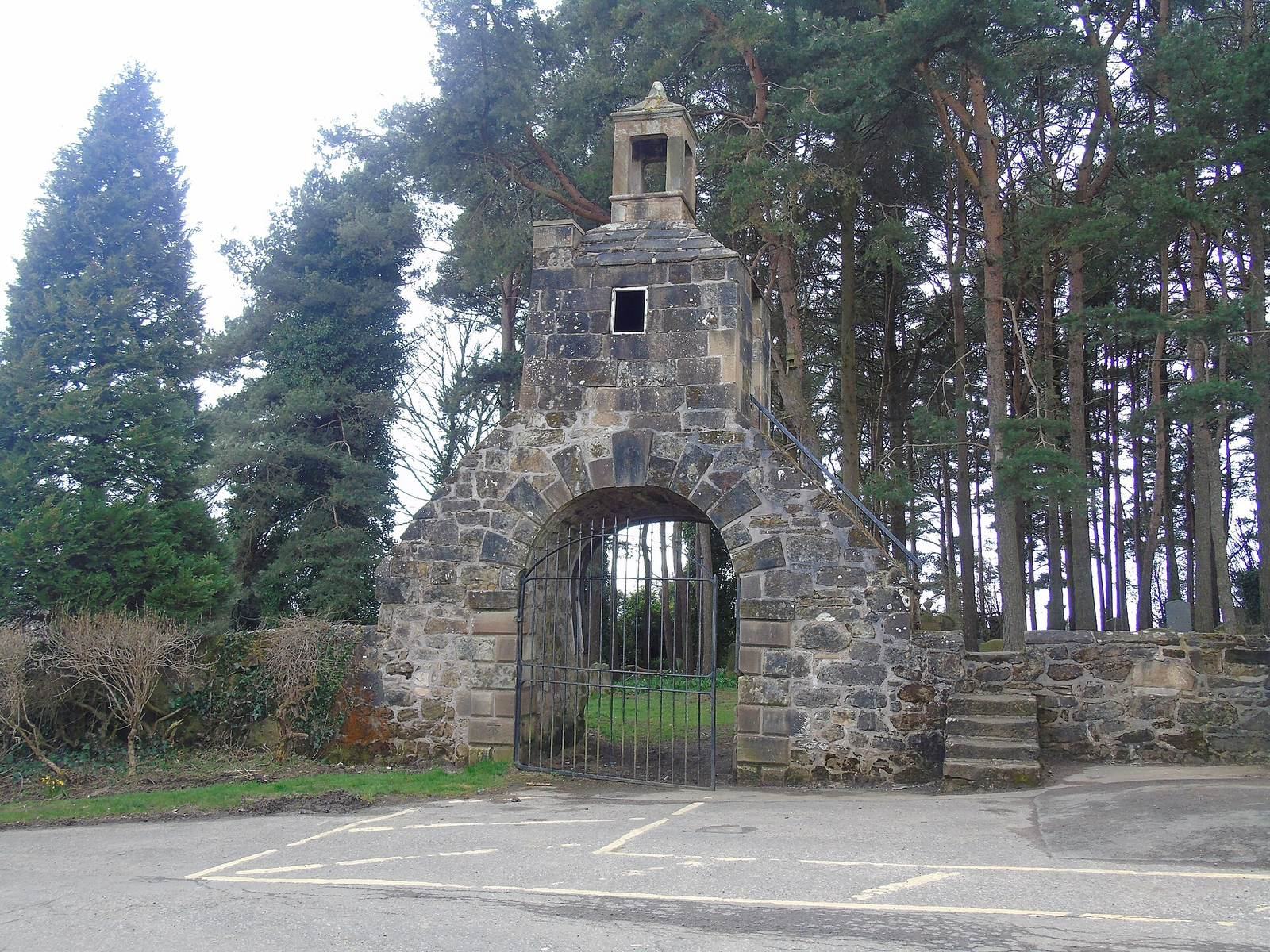
The older cemetery occupies the eastern part of the site and is enclosed by a wall of rubble stone, masonry made from irregularly shaped stones. Graves here date from the 18th century. An old entrance is spanned by an arch built of ashlar, carefully cut stone blocks set in regular courses. Above it stands a small, open sandstone bell tower with a pyramid-shaped roof. Beneath the arch, a guardroom has blind windows, recessed features made to resemble windows, and is reached by a stairway on the north side.
Watch-House
The cemetery’s watch-house, a small building for a watchman, is single-storey and T-shaped in plan. Built of rubble stone, it has two continuous decorative bands and a covered entrance set within an angle of the building.
Western Extension and Burial Areas
Gate Lodge
The gate lodge dates to the cemetery’s 1863 western extension. It is in poor condition, although its assessed risk of further deterioration is low.
Monuments and Service Graves
Several ornate monuments stand in the newer section. The cemetery also contains 38 graves of Commonwealth service personnel, including 17 from the First World War and 21 from the Second World War.