Cumbernauld Castle: A Fleming Stronghold in Scotland


Site at a Glance
- Rating
- 4.4
- Popularity
- Low
- Country
- United Kingdom
- Primary era
- Medieval
- External website
- Open
- Eras represented
- Medieval, Early Modern
- Civilizations
- Kingdom of Scotland
- Site type
- Military
- Remains
- Castle
On this page10 sections
History
Cumbernauld Castle was a medieval Scottish stronghold in Cumbernauld, United Kingdom, and the predecessor of Cumbernauld House. The earliest castle belonged to the Comyn family before passing to the Flemings after Robert the Bruce killed John “the Red” Comyn in 1306 during the struggle for the Scottish crown. By the end of the fourteenth century, the Flemings had built a larger stone castle that became the centre of their growing power and influence.
From Comyn fortress to Fleming castle
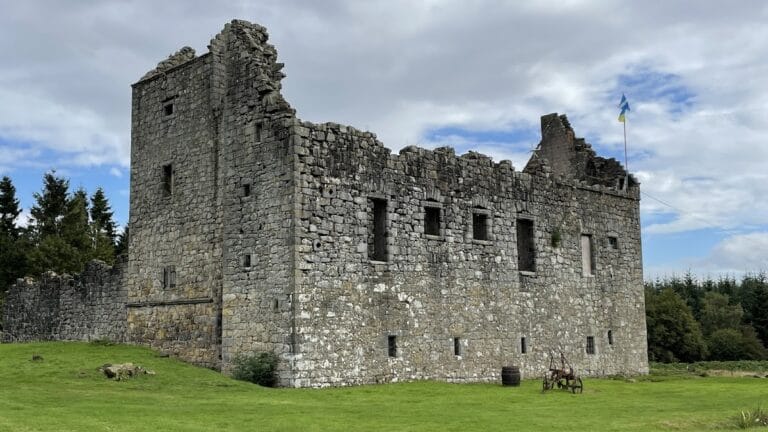
The first fortification was a motte-and-bailey castle, combining a raised earthwork mound with an enclosed defensive court. The Flemings’ later castle occupied the site now associated with Cumbernauld House. Its earliest substantial form was probably a strong rectangular stone tower, perhaps arranged in an L-plan with a projecting wing. Additional buildings, including a great hall, were probably added as the complex developed.
Cumbernauld Castle also served as a setting for formal acts of Fleming authority. On 3 November 1421, a charter issued there granted James Fleming his father’s lands after allegations of murder. The castle’s role extended beyond family affairs, since Scottish royalty visited it during the fifteenth and sixteenth centuries. James IV came while courting Margaret Drummond, with Margaret Tudor accompanying him on one visit, and Mary, Queen of Scots, also stayed at the castle.
Royal visits and the Marian Civil War
Mary’s stay was marked by a fatal structural disaster. On 26 January 1562, the great hall collapsed while she was at Cumbernauld Castle, killing seven or eight men. Mary survived and visited the relatives of those injured or killed in the nearby village.
The castle later became involved in the Marian Civil War, the conflict between Mary, Queen of Scots’ supporters and those who opposed her authority after her abdication. John Fleming, 5th Lord Fleming, supported Mary and held Dumbarton Castle in her name. In September 1570, Regent Lennox, who opposed the queen’s supporters, sacked Cumbernauld and expelled John Fleming’s wife, Elizabeth Ross, together with their three infant children.
Political meetings, siege, and destruction
In 1640, eighteen Scottish noblemen met at Cumbernauld to sign the Cumbernauld Bond. They opposed the policies of the Earl of Argyll and the political faction under his control. Cumbernauld may have become a burgh of barony in 1649, although that status remains disputed.
The castle’s military history continued during the conflicts of the seventeenth century. The Earl of Wigton was ordered to garrison it in 1650. In 1651, General Monck, acting for Oliver Cromwell, besieged Cumbernauld Castle and largely destroyed it. Irvine later stated that Highlanders burned the old castle during the rebellion of 1715.
Replacement by Cumbernauld House
Cumbernauld House was built in 1731, after which the ruined castle was converted into stables. Dragoons stationed there burned the stables in 1746. The changing appearance of the site can also be followed through maps. The castle appears on early mapping associated with Timothy Pont and more clearly on Blaeu’s coloured map. Herman Moll’s map of 1745 still named Cumbernard Castle, while Charles Ross’s map of 1777 showed the house in its place.
Archaeological investigation began in 1963–64, when Cumbernauld Historical Society and the Glasgow Archaeological Society excavated part of the castle’s domestic periphery. Cumbernauld and Kilsyth district museums investigated an adjacent area in 1981–82. Those excavated areas were later refilled, leaving the castle’s surviving masonry and earthworks as the principal visible evidence of its development.
Remains
Earthwork and castle setting
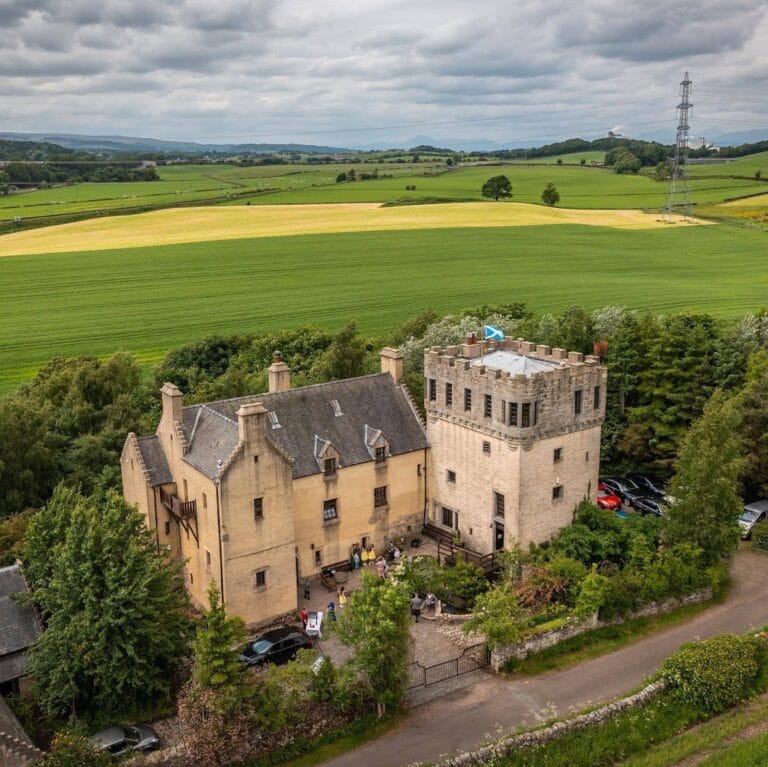
The earliest motte survives in Cumbernauld House Park, approximately 360 metres northeast of Cumbernauld House. This raised mound represents the earthwork element of the first motte-and-bailey fortification. The later castle occupied the site of the present house, where masonry blocks from its vanished original tower can still be identified among stones incorporated into the building.
Courtyard and surviving masonry
Parts of the castle courtyard buildings remain near the later house and its associated grounds. A particularly clear survival is the wall separating the lower service area from the car park. Along its lower side is a long row of projecting corbels, masonry blocks designed to support beams, with a distinctive sixteenth-century pattern. They carried the timbers of a lean-to building.
One original castle wall remains visible in the allotment area. The site as a whole is ruined, but surviving masonry is incorporated into or remains close to Cumbernauld House. These fragments preserve elements of the castle’s later courtyard arrangement and its relationship with the replacement residence.
Excavated domestic features
The 1963–64 excavation uncovered part of the domestic periphery. Its discoveries included a fifteenth-century rubbish chute, an adjoining prison and cellar, and a well house reached by a flight of steps. Together, these features reveal practical and service areas connected with the occupied castle.
The later excavation in 1981–82 exposed a cobbled courtyard, the base of a circular building, and substantial walling. The remains supplement the evidence from the surviving walls and help define the range of structures that once stood around the main castle.
Park and surviving animal tradition
During the period of Mary, Queen of Scots’ visits, the surrounding park contained deer and wild white cattle. In the sixteenth century, these cattle were described as a long-maintained herd found at Cumbernauld and reportedly not preserved elsewhere in Britain.